Basilique Saint-Sernin: Toulouse Romanesque Church
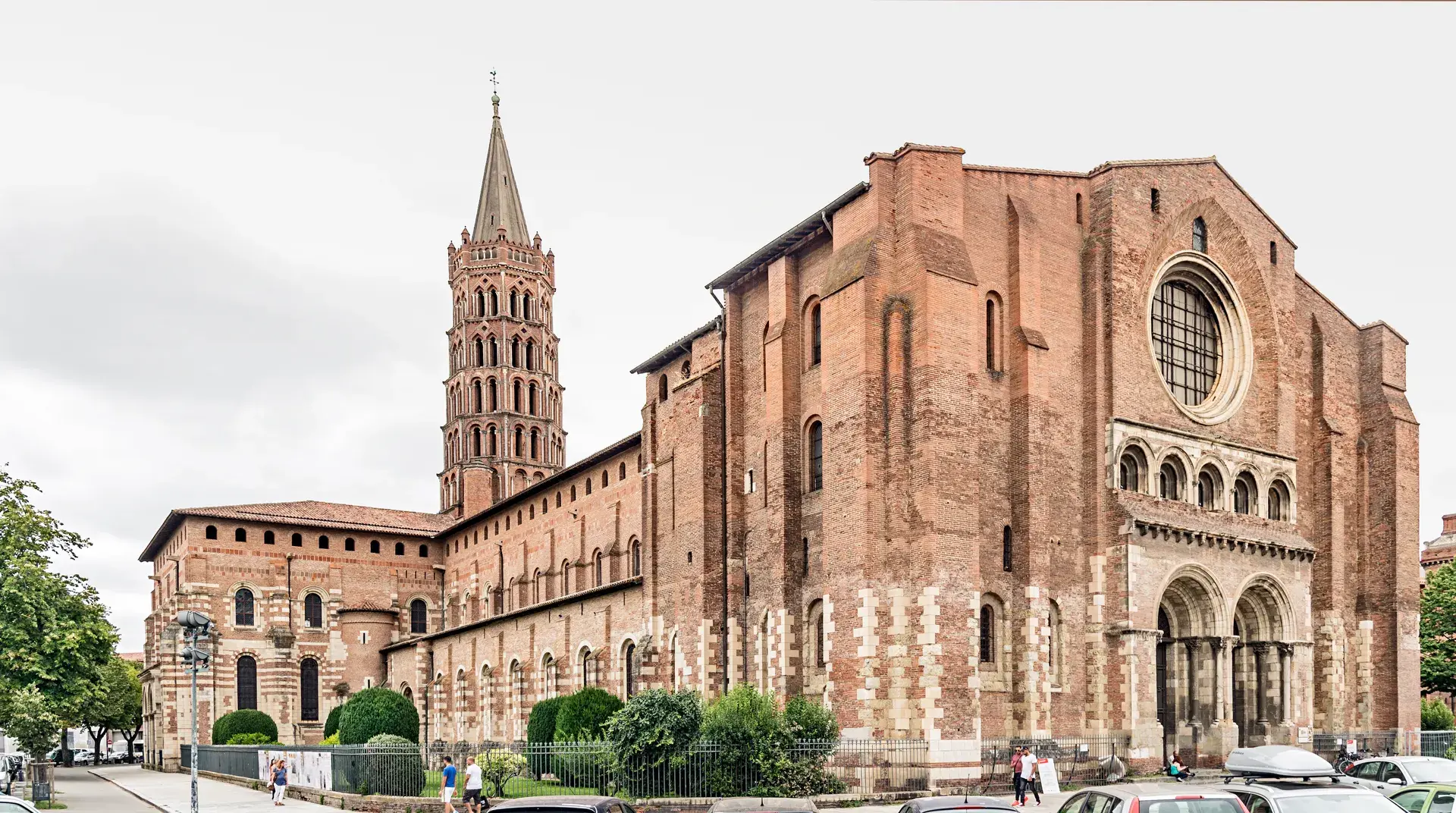
Marvel at the towering brick exterior and iconic bell tower of Basilique Saint-Sernin, a masterpiece of medieval Romanesque architecture.
A Masterpiece of Romanesque Architecture
The Basilica of Saint-Sernin stands as one of the largest preserved Romanesque churches in Europe. Construction of the monumental structure began around 1080 over earlier fourth-century foundations, with its high marble altar consecrated in 1096 by Pope Urban II. The building is characterized by the region's distinctive red clay bricks, known as brique foraine, accented by light limestone masonry along its portals, capitals, and decorative registers.
The basilica is crowned by a 65-meter octagonal bell tower that showcases centuries of architectural evolution. The bottom three tiers feature rounded Romanesque arches, while the top two tiers, completed in the 13th century, display pointed Gothic mitre arches. In 1998, the basilica was officially inscribed as a UNESCO World Heritage Site as part of the Routes of Santiago de Compostela in France.
The Legend of Saint Saturnin and Medieval Pilgrimage
The site is deeply connected to the foundational lore of Toulouse. It was built to house the tomb of Saint Saturnin, the city's first recorded bishop, who died around 250 AD. According to Christian tradition, Saturnin was martyred by being tied to a bull at the Roman Capitole and dragged along what is now the Rue du Taur.
Positioned on the Via Tolosana route to Santiago de Compostela, the abbey church became a major medieval pilgrimage shrine. Its architecture was purposefully designed to manage the constant flow of crowds. The interior incorporates a barrel-vaulted central nave flanked by double side aisles, an expansive transept, and an ambulatory. This layout allowed medieval pilgrims to circulate around the crypt and reliquaries without interrupting ongoing liturgical services.
Relics, Art, and Architectural Restoration
The basilica holds one of the largest collections of Catholic relics in France. Over 120 reliquaries are historically preserved in the crypt and ambulatory, including fragments attributed to multiple apostles and the Crown of Thorns. Artistically, the south-facing Porte Miègeville, completed around 1115, serves as an early masterpiece of Romanesque narrative stone sculpture, featuring marble reliefs depicting the Ascension of Christ.
During the 19th century, prominent architect Eugène Viollet-le-Duc undertook heavy restorations on the building. However, in the late 20th century, a controversial "dé-restauration" process deliberately dismantled many of his modifications to return the rooflines and masonry closer to their original Romanesque form.
Modern Worship and Symphonic Sounds
Today, Basilique Saint-Sernin functions as an active Catholic minor basilica and parish church, holding daily services and major liturgical ceremonies. While the central nave is open to the public daily, the ambulatory chapels, treasury, and crypt require dedicated tickets for entry.
The interior's high stone barrel vaulting and vast brick side aisles create an expansive reverberation ideally suited for sacred choral chanting. The basilica frequently hosts classical concerts utilizing its 1888 grand pipe organ. Built by master builder Aristide Cavaillé-Coll, it is considered one of the finest surviving symphonic organs in France, having completely escaped the 20th-century neoclassic alterations suffered by many similar instruments.
FAQ
When was Basilique Saint-Sernin built?
Construction of the current basilica began around 1080 over earlier fourth-century foundations. The high marble altar was consecrated in 1096, and work on the nave continued into the 13th and 14th centuries.
Why is Basilique Saint-Sernin famous?
It is one of Europe's largest preserved Romanesque churches and a UNESCO World Heritage Site. Historically, it was a major medieval pilgrimage stop, housing the tomb of Saint Saturnin and a collection of over 120 Catholic relics.
Can the public visit Basilique Saint-Sernin?
Yes, the basilica is an active parish church open to the public daily. Visitors can access the central nave for free, though dedicated tickets are required to tour the ambulatory chapels, treasury, and crypt.