Place du Capitole: The Historic Heart of Toulouse
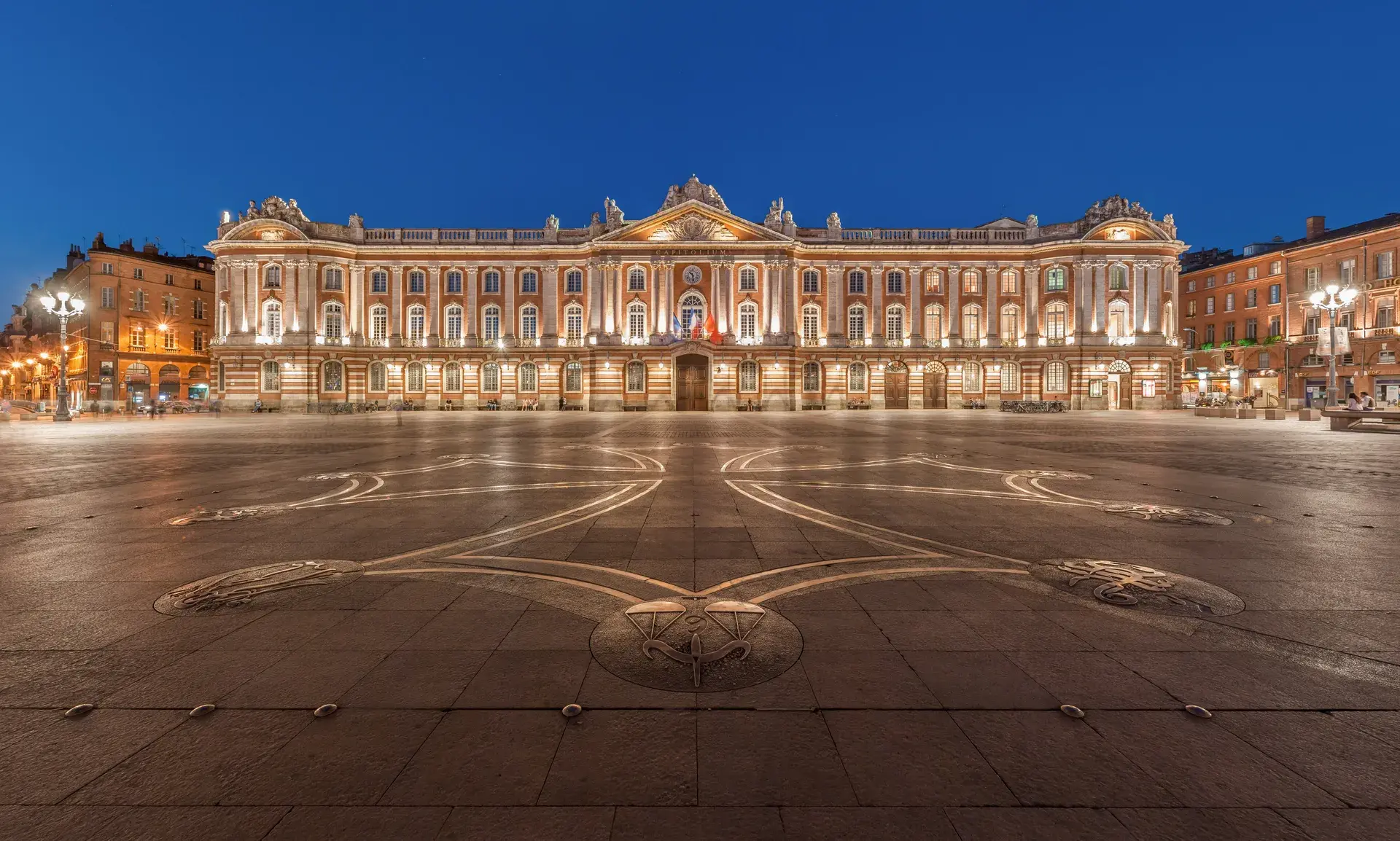
Stand in the vast expanse of Place du Capitole to admire the grand neoclassical facade of the municipal palace stretching across the square. Located at the geographic and civic heart of Toulouse, this 12,000-square-metre pedestrian plaza epitomizes the city's regional Occitan heritage and its characteristic pink brickwork.
A Legacy of Municipal Power
The site's civic history began in 1190 when the Capitouls, the city's elected municipal magistrates, acquired the land for their administrative hall. By the 18th century, plans were initiated to clear the dense medieval quarter to create a monumental royal square. Architect Guillaume Cammas designed the 135-metre neoclassical facade of the Capitole building between 1750 and 1760, utilizing alternating local pink brick and limestone.
During the French Revolution, the space was temporarily renamed Place de la Liberté and served as the site of the city's guillotine. Later, between 1809 and 1852, municipal architect Jacques-Pascal Virebent designed the uniform neoclassical facades lining the north, west, and south edges to frame the square symmetrically.
Artistic and Architectural Highlights
The Capitole's central portico is supported by exactly eight pink marble columns. These deliberately represent the eight historic administrative districts, known as capitoulats, and their governing magistrates.
Embedded in the center of the esplanade is an 18-metre-wide, 20-ton bronze Occitan Cross created by artist Raymond Moretti in 1995. The twelve round points at the tips of the cross are intricately cast with the twelve signs of the zodiac. Moretti also designed 29 large serigraph panels for the ceilings of the western arcades, illustrating key figures and events in Toulouse's history. Under these arcades, the expansive outdoor soundscape of the open stone pavement shifts abruptly into concentrated echoes of conversation and clinking tableware from brasserie terraces.
Hidden Curiosities and Modern Function
The Capitole building remains the working municipal headquarters of Toulouse and houses the Théâtre du Capitole. Its historic state rooms, including the Salle des Illustres, are open to the public for free when not in use for official receptions or civil weddings.
Behind the main building sits the Donjon du Capitole. Originally a 16th-century gunpowder tower, it was remodeled in the 19th century by Eugène Viollet-le-Duc and now houses the city's tourist office. Within the Capitole's Cour Henri IV, a floor plaque marks the exact spot where the Duke of Montmorency was beheaded in 1632 following an armed rebellion against Cardinal Richelieu.
Used as an open-air surface parking lot in the 1960s, the entire square was pedestrianized in 1993. Today, it serves as the city's primary gathering space for public markets, civic rallies, and sports celebrations.
FAQ
Can visitors go inside the Capitole building?
Yes, the historic state rooms, including the Salle des Illustres, are open to the public for free when they are not in use for civil weddings or official municipal receptions.
What is the large bronze cross on the ground in the square?
The square features an 18-metre-wide bronze Occitan Cross created in 1995 by artist Raymond Moretti. Its twelve round points are cast with the twelve signs of the zodiac.
Why are there eight columns on the front of the Capitole building?
The eight pink marble columns supporting the central portico deliberately represent the eight historic administrative districts of Toulouse, known as capitoulats, and their governing magistrates.
What is the history of the Donjon du Capitole?
Located behind the main building, the Donjon is a 16th-century gunpowder tower that was remodeled in the 19th century by architect Eugène Viollet-le-Duc. Today, it houses the official city tourist office.