Hôtel d'Assézat: Toulouse's Renaissance Palace
Discover how a lucrative blue dye funded the grandest Renaissance palace in Toulouse. The Hôtel d'Assézat represents the height of 16th-century mansion building, standing as a monument to the city's economic golden age.
The Fortune of the Blue Dye
During the mid-16th century, Toulouse was the European center of the woad trade, a plant used to produce a highly sought-after blue textile dye known as pastel. Pierre d'Assézat, an influential woad merchant and city magistrate, utilized his immense fortune to commission a private townhouse that rivaled royal residences in scale and decorative sophistication.
Construction began in 1555 under the direction of prominent architect and sculptor Nicolas Bachelier and stonemason Jean Castagné. Following the elder Bachelier's death, his son Dominique continued the work, completing the structure in 1562. Today, the mansion remains the premier Renaissance landmark just west of Place Esquirol between the merchant center and the Garonne River.
Architectural Splendor and the 26-Meter Tower
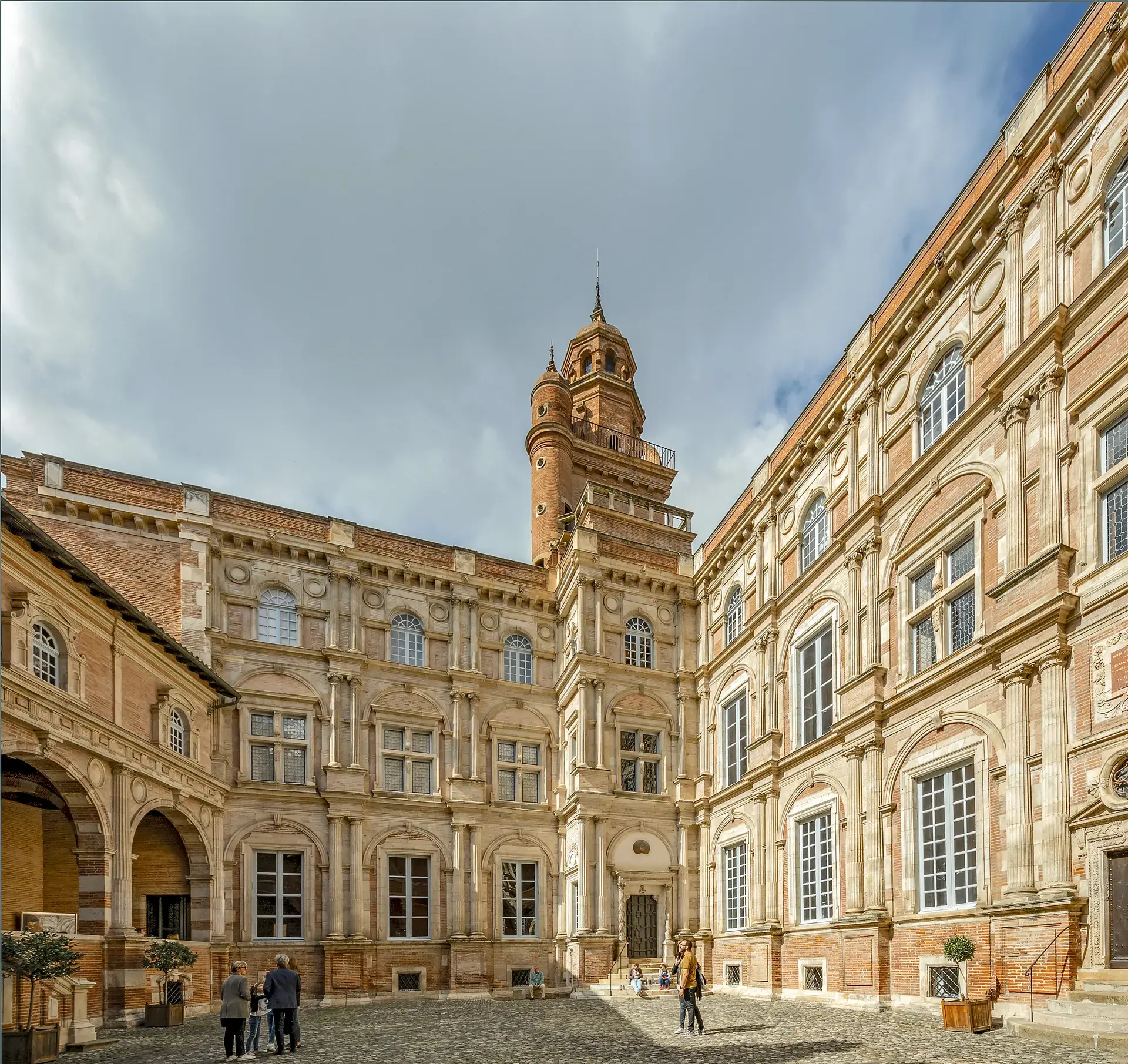
The Hôtel d'Assézat displays a harmonious fusion of early French classicism and Italian Mannerist elements, heavily influenced by Sebastiano Serlio’s architectural treatises. The facades feature a striking contrast between the local warm pink brick of Toulouse and pale carved limestone, which frames the arches, windows, and entablatures. The inner courtyard, known as the cour d'honneur, exhibits a strict three-tier classical elevation with paired columns ascending through the Doric, Ionic, and Corinthian orders.
To broadcast his status above the city skyline, d'Assézat commissioned a massive corner stair tower that rises 26 meters (85 feet) above the courtyard. It remains the tallest private mansion tower in Renaissance Toulouse. The architecture is further enriched by Mannerist stone carvings, including grotesque masks, scroll consoles, cabochons, and diamond points. The interior stair pavilion even features a carved classical term, a whimsical architectural element consisting of a half-man, half-pilaster.
Exile and Historical Legacy
Despite his vast wealth, Pierre d'Assézat faced severe political and personal turmoil. As a Calvinist convert during the French Wars of Religion, he participated in a failed 1562 Huguenot attempt to seize control of Toulouse. This rebellion led to his exile and the temporary loss of his grand mansion. He eventually returned to the city a decade later after recanting his faith.
The property passed through several private owners over the following centuries. In the late 19th century, the palace was bequeathed to the City of Toulouse to provide a home for historical learned societies. It was classified as an official French historic monument in 1914.
A Home for Art and Poetry
Since 1994, the palace has housed the Fondation Bemberg. This cultural institution displays the extensive private art collection of Georges Bemberg, featuring Renaissance paintings, Venetian masters, and modern works by French Impressionists and Pierre Bonnard.
Alongside the art foundation, the building continues to serve as the seat for local learned societies. This includes the historic Académie des Jeux floraux, an organization dedicated to poetry. The mansion honors this literary tradition with a ceremonial room named after Clémence Isaure, the semi-legendary medieval patroness associated with the revival of the city's Floral Games.
FAQ
Who built the Hôtel d'Assézat?
The mansion was commissioned by Pierre d'Assézat, a wealthy woad merchant and city magistrate. It was designed and built by architects Nicolas Bachelier, Jean Castagné, and Dominique Bachelier between 1555 and 1562.
Why is the tower at Hôtel d'Assézat so tall?
The 26-meter (85-foot) corner stair tower was built specifically to display the owner's vast wealth and social status above the city skyline, making it the tallest private mansion tower in Renaissance Toulouse.
What is inside the Hôtel d'Assézat today?
Today, the building houses the Fondation Bemberg, which displays an extensive collection of Renaissance and modern art. It also serves as the headquarters for local learned societies, including the Académie des Jeux floraux.