Place Saint-Georges: History & Cafés in Toulouse
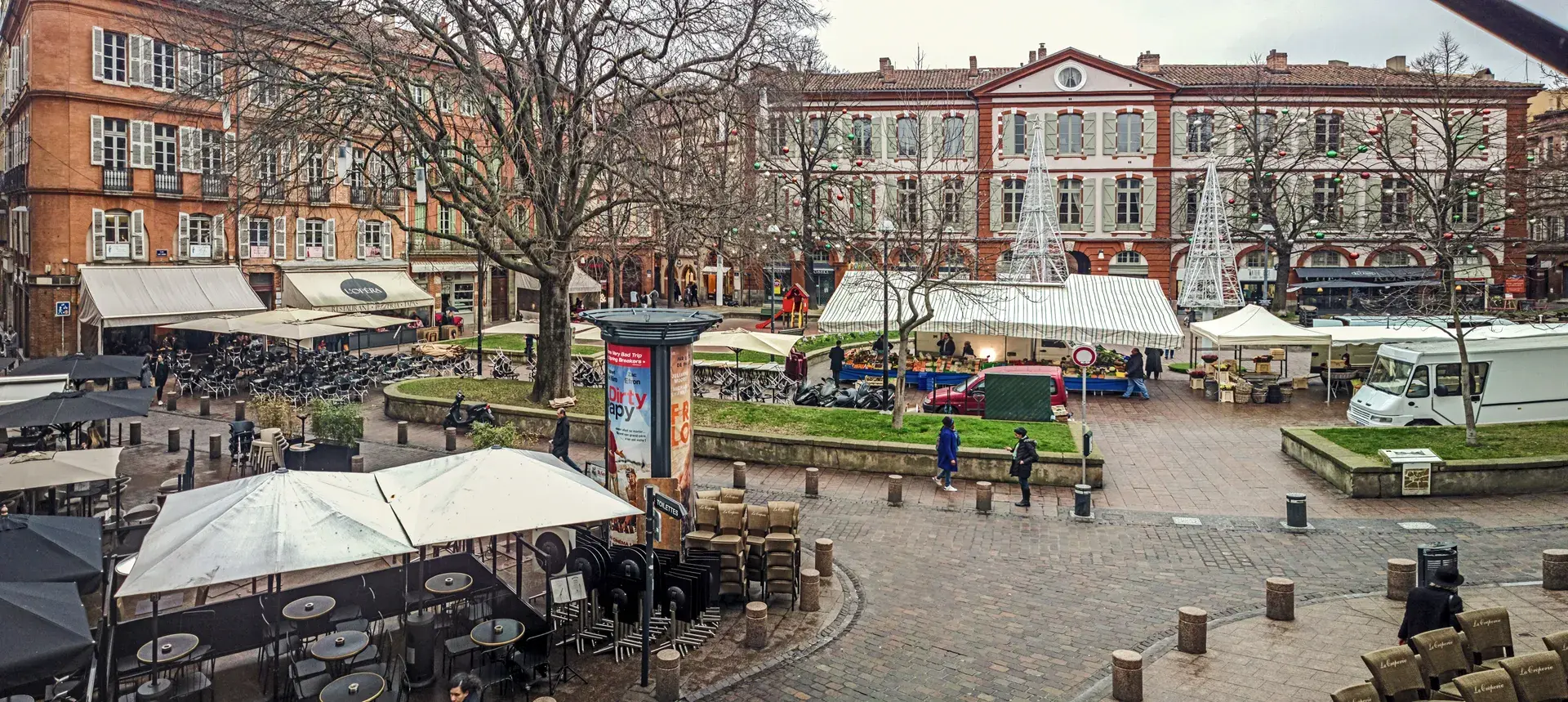
Visitors can immerse themselves in the vibrant café culture and lively atmosphere surrounding the picturesque Place Saint-Georges. Positioned midway between Toulouse's major shopping avenues and Place Wilson, this irregular pentagon-shaped square serves as a lively, informal neighborhood counterweight to the grand civic space of Place du Capitole. Covering approximately 4,190 square meters in the historic center, the area is defined by the warm, distinct pink-terracotta tones of the city's local brick masonry.
A Thriving Café Scene
Today, Place Saint-Georges is celebrated as one of Toulouse's premier gathering spots, renowned for its dense concentration of restaurant and bistro terraces. The almost entirely pedestrianized square provides a tree-shaded environment where the sound of clinking glasses and outdoor conversation fills the air. This relaxed, sunlit destination contrasts sharply with the square's much darker historical function.
From Medieval Market to Execution Ground
Documented before the 12th century, the square originally functioned as a bustling commercial center, hosting a lucrative covered wine market surrounded by bakeries and taverns. It was named after a 13th-century chapel dedicated to Saint George that stood at the center before being relocated and eventually demolished in 1808. Over the centuries, the location transitioned into a grim public scaffold, serving as Toulouse's primary execution ground.
The Legacy of Jean Calas
The square is most infamous for the events of March 10, 1762, when Protestant merchant Jean Calas was publicly broken on the wheel, strangled, and burned. His wrongful conviction, driven by religious intolerance, prompted philosopher Voltaire to launch an international campaign. This effort led to Calas's posthumous exoneration in 1765 and inspired Voltaire's landmark Treatise on Tolerance. Today, the northeast corner of the area is officially designated as Square Jean-Calas, featuring a memorial plaque and a children's playground that was renovated in 2021.
Architecture and Historical Curiosities
The square is encircled by multi-period brick townhouses and mansions. The most notable architectural feature is the classical 18th-century Hôtel Lafage. Commissioned in 1747 by Henri-Joseph Lafage, the building boasts twelve bays of brick and white stone facade ornamentation.
Throughout its history, the square has seen various temporary uses, such as hosting displaced merchants from Place Royale in 1752 while the Capitole's facade was rebuilt. In 1797, it served as the marché des Proxénètes, a market for used-clothes vendors and rag merchants. Reflecting its evolving identity, the site was previously known as Place de Montaygon, Place Calas, and Place Paul-Vidal before returning to the name Place Saint-Georges.
FAQ
Why is Place Saint-Georges historically significant?
Historically, the square served as Toulouse's primary public execution ground. It is most famous for the 1762 execution of wrongfully convicted Protestant merchant Jean Calas, which sparked an international campaign by philosopher Voltaire and inspired his Treatise on Tolerance.
What architectural styles can be seen at Place Saint-Georges?
The square is surrounded by multi-period brick townhouses and mansions featuring the traditional pink-terracotta tones of local masonry. A standout structure is the 18th-century Hôtel Lafage, known for its twelve bays of brick and white stone ornamentation.
Is Place Saint-Georges accessible to vehicles?
The square is almost entirely pedestrianized, functioning as a shaded, traffic-calmed gathering space. It contains only a calm single-lane access zone.