Guide to Pont Neuf, Toulouse's Oldest Bridge
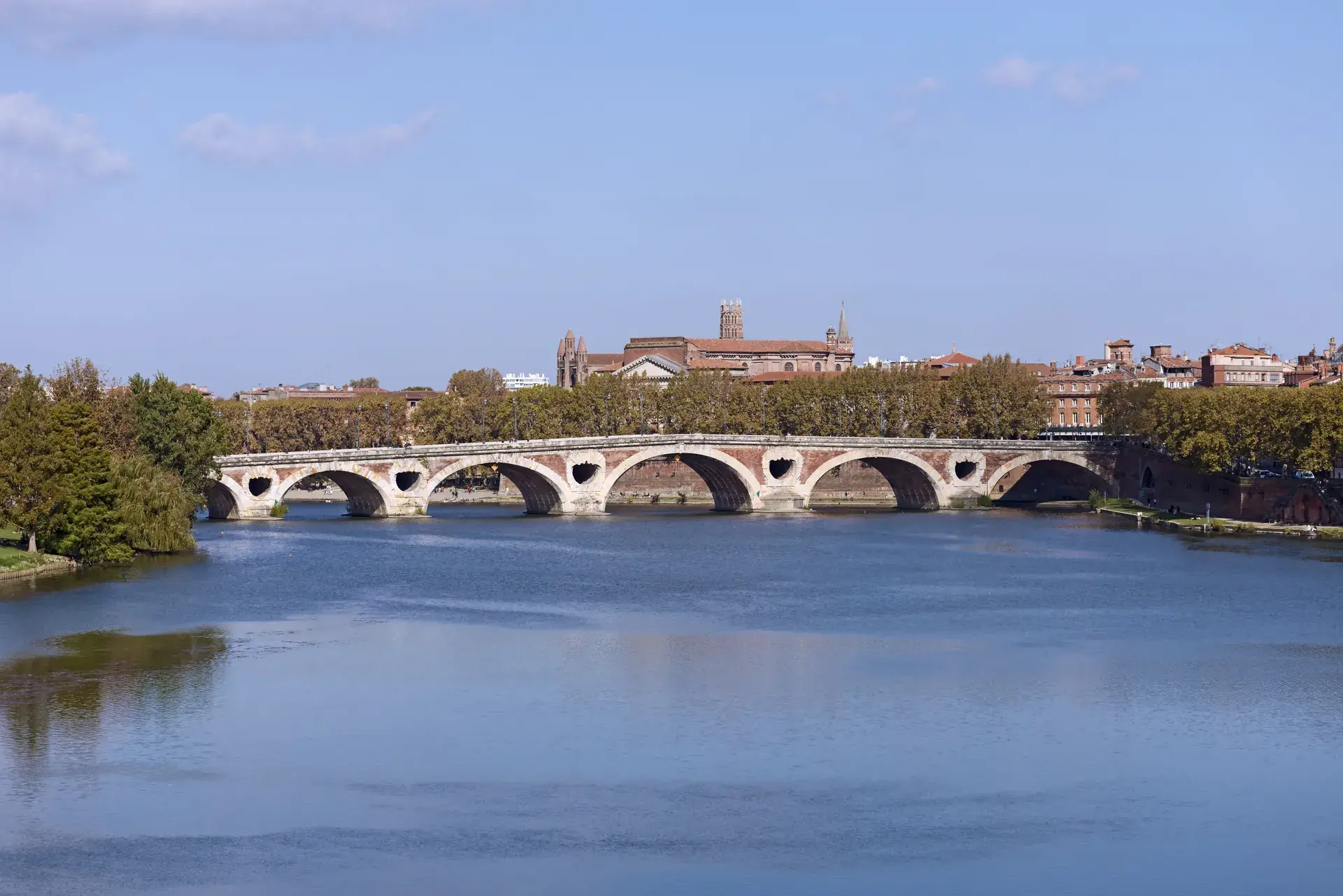
Despite its name translating to "New Bridge," Pont Neuf is the oldest surviving bridge in Toulouse. Also historically known as the Pont de Pierre or Grand Pont, this resilient 16th-century crossing spans approximately 220 meters across the Garonne River. It anchors the historic transition between the river's quays and the heart of the old city, standing as a physical testament to the enduring relationship between Toulouse and the unpredictable Garonne.
A Century of Construction
The bridge was originally commissioned by the city's governing consuls, known as capitouls, with royal backing from King Francis I. The primary objective was to establish a robust, permanent crossing capable of moving troops rapidly toward Spain. It replaced older, unstable wooden-and-stone crossings that were repeatedly swept away by the river's violent currents.
Construction began in 1544 and took nearly a century to reach completion in 1632. The protracted timeline was the result of regional Wars of Religion, financial shortages, unstable riverbed subsoils, and frequent seasonal flooding. King Louis XIV formally inaugurated the bridge on October 19, 1659. The massive undertaking spanned generations, involving notable designers such as Renaissance sculptor and architect Nicolas Bachelier, Pierre Souffron, and Parisian royal architect Jacques Lemercier.
Architectural Innovations and Materials
Pont Neuf was part of a new generation of Renaissance bridges designed intentionally without houses or shops on the deck. This approach prioritized clear traffic flow and structural longevity. The structure combines local pink-fired Toulouse brick with durable white limestone reinforcements along the piers, arches, and cutwaters.
The bridge features seven asymmetrical basket-handle arches and six massive piers. The arches intentionally vary in span and shape because the Garonne’s left bank sits several meters lower than the right bank. To further manage the river's force, the piers utilize triangular and curved stone cutwaters designed to split the current.
Engineers also incorporated large circular hydraulic relief openings, called dégueuloirs, into the spandrels above each pier. These apertures were originally styled in architectural plans to resemble the open mouths and manes of roaring lions. They are complemented by carved stone mascarons and corbels that serve as functional rainwater deflectors and decorative masks.
The Sole Survivor of the 1875 Great Flood
The ingenious design of Pont Neuf proved its worth during the cataclysmic Great Flood on June 23 and 24, 1875. The Garonne crested at over 8.3 meters above normal, carrying a torrent exceeding 8,000 cubic meters per second.
This historic deluge devastated the low-lying Saint-Cyprien quarter, washing away approximately 1,400 homes and causing every other bridge crossing the Garonne in Toulouse to collapse. Pont Neuf was the sole bridge that remained standing, saved entirely by its deeply rooted pier foundations, asymmetrical arches, and the hydraulic relief vents that allowed high floodwaters to flow directly through the structure.
Pont Neuf Today
Today, the bridge serves as a vital urban thoroughfare connecting the historic right-bank core around Rue de Metz to the Saint-Cyprien neighborhood on the left bank. It remains open 24/7 for pedestrians, cyclists, and light road transit.
The crossing is one of the city's primary vantage points for evening strolls and sunset photography. It offers clear views of riverside landmarks, including the Dôme de la Grave and the Hôtel-Dieu Saint-Jacques, maintaining its status as a central pillar of Toulouse's urban identity.
FAQ
Why is the oldest bridge in Toulouse called Pont Neuf?
Despite translating to "New Bridge," Pont Neuf was given its name during its 16th-century construction to distinguish it from older, unstable wooden-and-stone crossings that it eventually replaced.
How long did it take to build Pont Neuf?
Construction of the bridge took nearly a century, beginning in 1544 and concluding in 1632. Delays were caused by the Wars of Religion, financial shortages, and seasonal floods.
Why are the arches of Pont Neuf different sizes?
The bridge features seven asymmetrical basket-handle arches that intentionally vary in span and shape because the left bank of the Garonne River sits several meters lower than the right bank.
How did Pont Neuf survive the 1875 Great Flood?
The bridge survived the catastrophic 1875 flood thanks to its deeply rooted pier foundations and large circular hydraulic relief openings, called dégueuloirs, which allowed high floodwaters to flow directly through the structure and relieve hydrostatic pressure.