Saint-Etienne Cathedral: A Unique Architectural Hybrid
Two Incomplete Visions
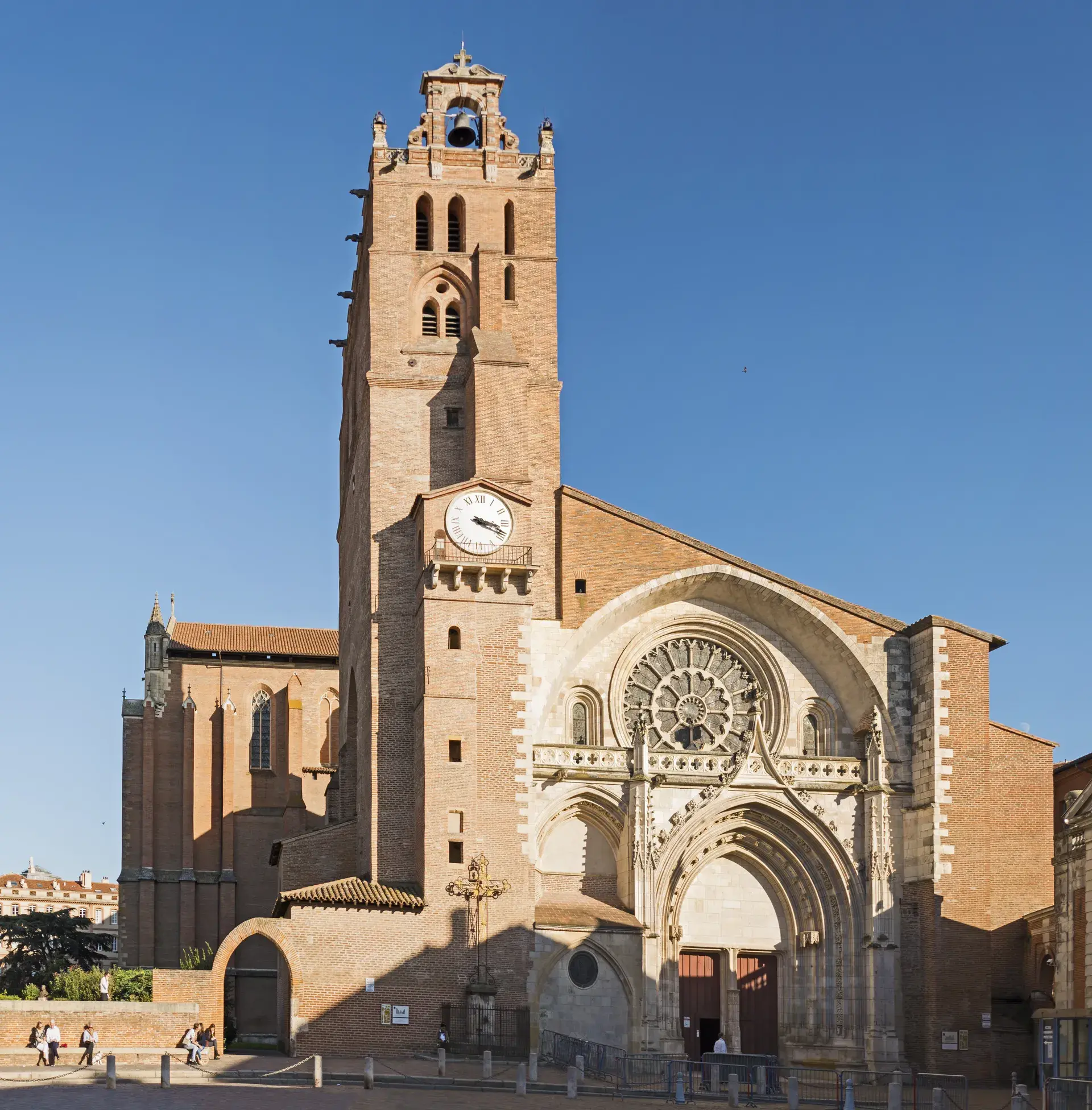
Saint-Étienne Cathedral, the active seat of the Archbishop of Toulouse, is a striking physical record of shifting ambitions. Built primarily from pink and red brick between the early 13th and 17th centuries, the building is famously composed of two incomplete structures awkwardly welded together on different axes.
The original structure, the Raymondine nave, was initiated around 1210 to 1220. Engineered as a wide, aisle-free preaching hall during the Albigensian conflicts, it reflects the heavy, dark red brickwork of the Southern French Gothic style. In 1272, Bishop Bertrand de l'Isle launched a project to replace this nave entirely. He envisioned a soaring, multi-aisled Gothic choir in the Northern French style, similar to the great cathedrals of Île-de-France. Due to funding shortages, the original nave remained standing, and the enormous new choir—twice as wide and aligned on a slightly different axis—was simply attached to it.
The Massive Transition Pillar
The abrupt intersection of these two mismatched spaces defines the interior. The squat, dark red nave connects to the towering, light-flooded choir via a massive round transition pillar. Constructed in the early 16th century by Bishop Jean d'Orléans, this pillar was an attempt to link the incompatible structures, connecting the central axis of the older nave with the southern row of pillars in the new choir.
Remarkable Interior Details
Beyond its structural irregularities, Saint-Étienne Cathedral houses several significant artifacts. The primary organ case, carved from walnut around 1612, hangs dramatically 17 to 18 meters high on a vertical stone wall like a "swallow's nest," rather than resting on a traditional floor gallery. The building also contains the tomb and crypt of Pierre-Paul Riquet, the 17th-century engineer who masterminded the Canal du Midi.
In the Saint Vincent de Paul chapel, the cathedral preserves the oldest intact stained glass in Toulouse, dating back to the late 13th century. The building's history extends beyond its Catholic origins; during the French Revolution, the cathedral was stripped of its religious status, rededicated as a "Temple of Reason," and temporarily used as a scrap-iron depot before reverting to religious use in 1802.
The Surrounding Saint-Étienne District
The cathedral anchors the aristocratic Saint-Étienne quarter, a historic district defined by cobbled streets and 16th- to 18th-century private mansions. Directly outside the building sits the Fontaine du Griffoul. Originally erected between 1549 and 1584, it is recognized as the oldest surviving public fountain in Toulouse.
FAQ
Why does Saint-Etienne Cathedral have mismatched architectural styles?
The unusual appearance is the result of an incomplete centuries-long project to replace the original 13th-century Southern Gothic nave with a massive Northern French-style Gothic cathedral. Due to funding shortages, the old nave was never demolished, and the new, wider choir was attached on a different axis.
Who is buried in Saint-Etienne Cathedral?
The cathedral contains the tomb and crypt of Pierre-Paul Riquet, the 17th-century engineer responsible for creating the Canal du Midi.
What happened to the cathedral during the French Revolution?
During the French Revolution, the building lost its religious status, was rededicated as a 'Temple of Reason,' and briefly served as a scrap-iron depot before being returned to religious use in 1802.