Augsburg Cathedral: Architecture and Prophet Windows
Architectural Form and Early History
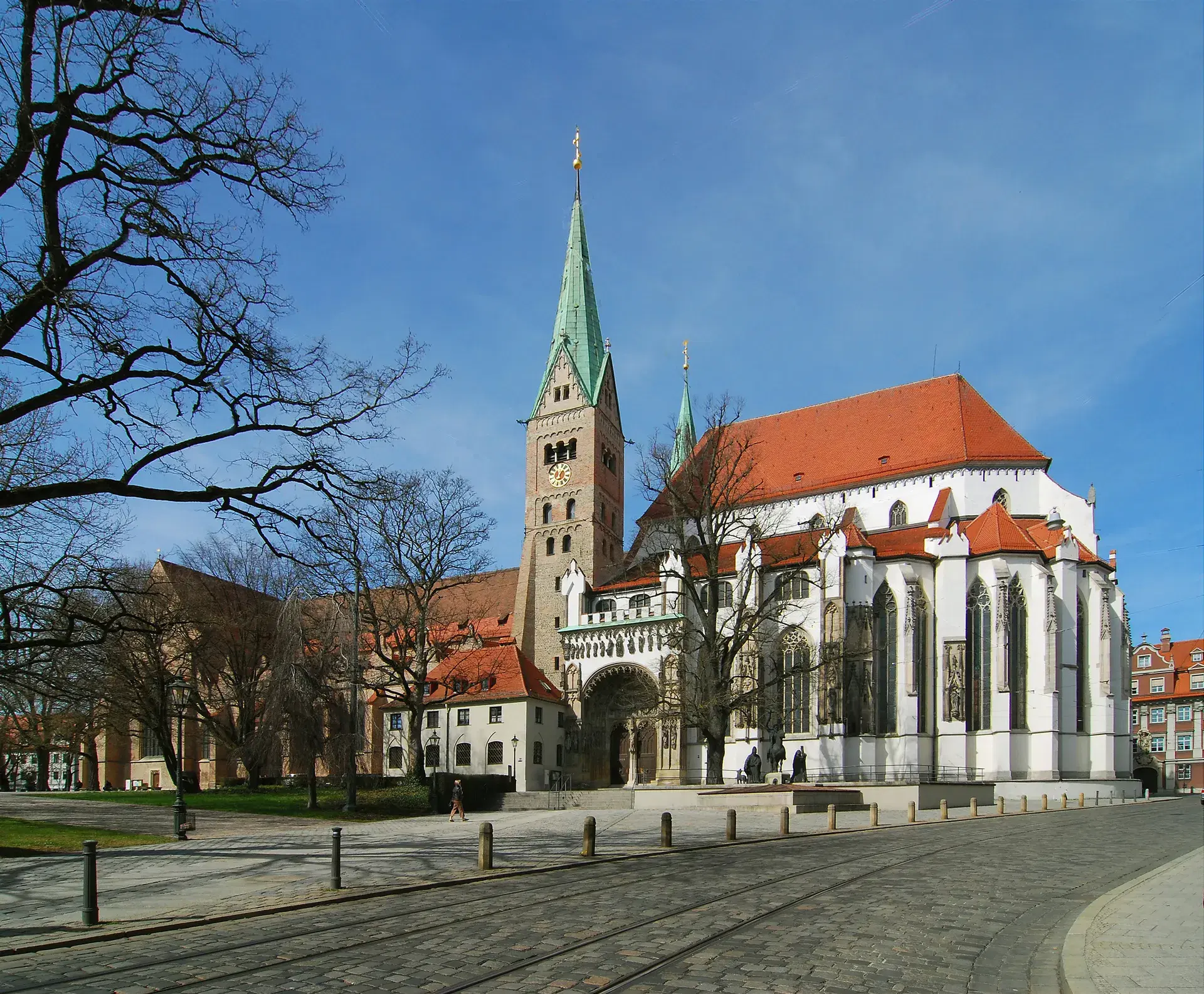
Augsburg Cathedral, officially known as the Hohe Domkirche Mariä Heimsuchung, stands on Roman foundations from the ancient provincial capital of Augusta Vindelicorum. Archaeological evidence indicates the presence of a Carolingian church on the site by approximately 822. After sustaining damage during tenth-century Magyar raids, the building underwent repairs supervised by Bishop Ulrich. A structural failure caused the western section of the nave to collapse in 994, after which Bishop Liutold initiated reconstruction supported by funding from Holy Roman Empress Adelaide.
Bishop Henry III oversaw the construction of the Romanesque basilica starting in 1043, leading to its dedication in 1065. Over the centuries, the complex expanded into a five-aisled double-choir basilica measuring approximately 113 meters in length and 40 meters in width, flanked by twin Romanesque bell towers rising to a height of 62 meters. Between 1356 and 1431, a high Gothic eastern choir with radiating ambulatory chapels was added to the older Romanesque structure, giving the building its dual-choir layout.

Augsburg walking tour with audio and quizzes: city of the Fuggers
2 hours8 stopsAudio guideStart any day, at your own paceTicket on your phone · 30-day refundThe Romanesque Prophet Windows
Located in the high clerestory of the southern nave wall, the Prophet Windows (Prophetenfenster) constitute the cathedral's most celebrated artistic treasure. Dating to the late eleventh or early twelfth century, these five panels depict the Old Testament figures of David, Jonah, Daniel, Moses, and Hosea. They are widely recognized as the oldest figurative stained glass cycle preserved in its original architectural setting (in situ) anywhere in the world.
The narrow Romanesque openings allow vertical shafts of ochre, red, and green light to filter across the whitewashed stonework of the nave. The glass cycle survived World War II air raids because the individual panels were removed from their stone frames and secured in underground storage before aerial bombings damaged the surrounding city.
Historical Artifacts and Interior Works
Beneath the western choir lies a vaulted Romanesque crypt that dates to the tenth century. Above in the cathedral interior, an early twelfth-century stone episcopal throne rests on armrests and a base carved into the shape of crouching lions. Four paintings mounted on the nave pillars depict scenes from the life of the Virgin Mary; these panels were produced in 1493 by Augsburg artist Hans Holbein the Elder, the father of the Tudor court painter Hans Holbein the Younger.
The cathedral's original Romanesque portal doors, cast around 1065, feature 35 bronze relief panels displaying biblical scenes alongside medieval animal and mythological motifs. To ensure their long-term conservation, the historic bronze doors were transferred to the adjacent Diözesanmuseum St. Afra, and modern doors designed by sculptor Max Faller were installed at the cathedral entrance in 2000.
Historical Events and Modern Status
Throughout its history, the building has served as a center of religious and imperial affairs. On January 26, 1690, Archduke Joseph was crowned Roman-German King in the cathedral by the Archbishop of Mainz. The cathedral lost various interior artworks to iconoclasm during the Protestant Reformation, received Baroque furnishings during the seventeenth and eighteenth centuries, and was later stripped back to reveal its underlying medieval masonry during nineteenth-century restoration campaigns.
Augsburg Cathedral marks the northern anchor of the city's primary historic axis, which connects along Hoher Weg, Karolinenstraße, and Maximilianstraße to the Basilica of St. Ulrich and Afra at the southern end. Today, the cathedral functions as the episcopal seat of the Diocese of Augsburg and the active church of the Dompfarrei, holding daily liturgies and sacred music concerts, with public access available outside liturgical services.
FAQ
What makes the Prophet Windows in Augsburg Cathedral unique?
Dating to the late 11th or early 12th century, the five clerestory panels depicting David, Jonah, Daniel, Moses, and Hosea form the oldest figurative stained glass cycle preserved in situ in the world.
Where are the cathedral's original 11th-century bronze doors located?
The original bronze doors cast around 1065 are preserved for conservation in the adjacent Diözesanmuseum St. Afra, while replacement doors installed in 2000 stand at the cathedral entrance.
What architectural styles define Augsburg Cathedral?
The cathedral is a five-aisled double-choir basilica that combines an Ottonian and Romanesque core built between 995 and 1065 with a Gothic eastern choir erected between 1356 and 1431.