
Vogeltor: Augsburg’s 15th-Century City Gate
History and Origins of the Vogeltor
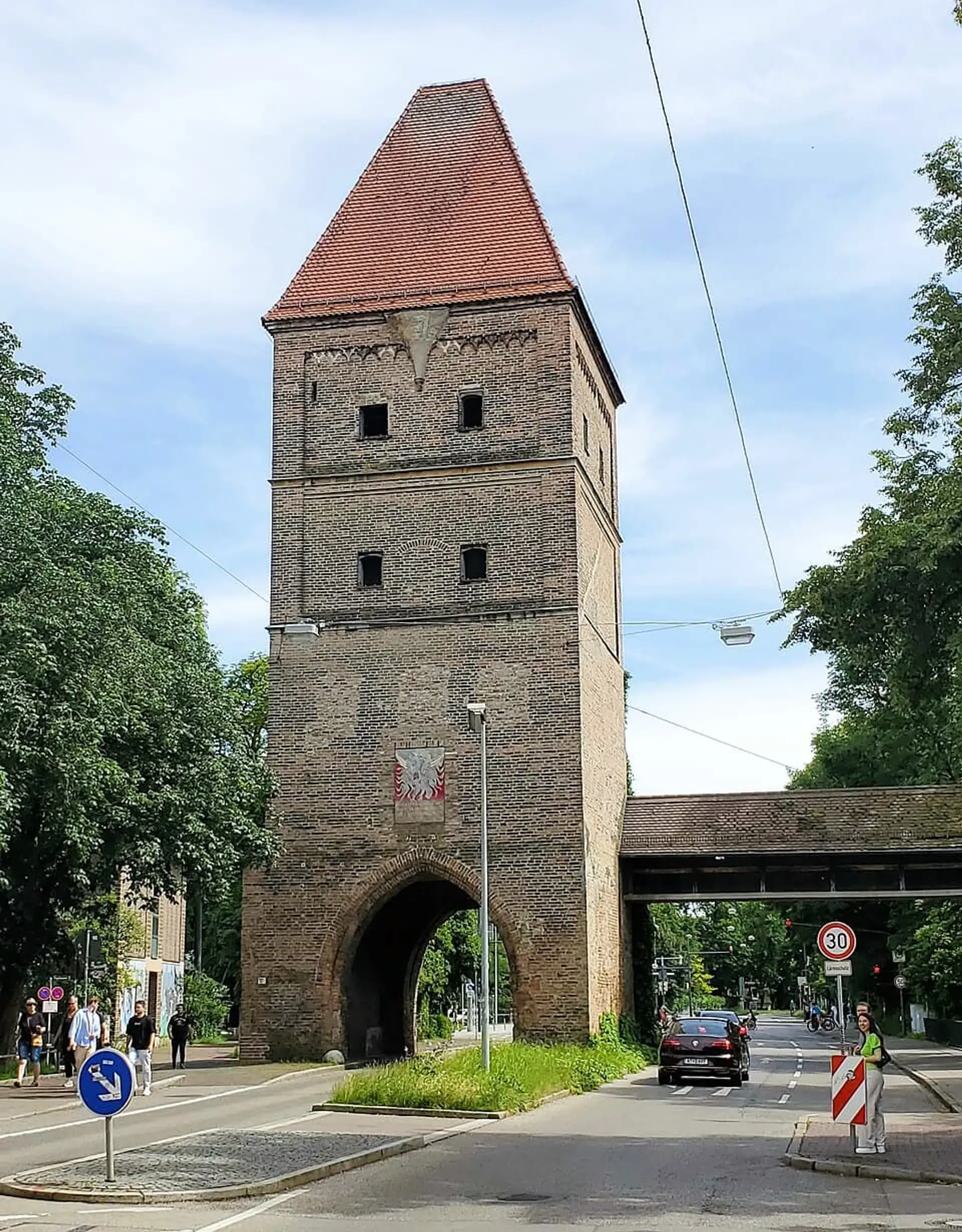
The Vogeltor is a late-Gothic defensive gate tower located along Oberer Graben in Augsburg. Erected around 1445 during the term of Mayor Konrad Vögelin, it was constructed to replace an older gate and drawbridge dating to 1374–1375 that spanned the city ditch. Historical records suggest the tower was named either in honor of Mayor Vögelin or after a documented fowler (Vogelfänger) who inhabited the earlier gate tower between 1403 and 1409.
Today, the structure is recognized as one of five surviving historic gate towers that demarcated the medieval and early modern fortifications of Free Imperial Augsburg, standing alongside the Rotes Tor, Wertachbrucker Tor, Jakobertor, and Fischertor.
Augsburg walking tour with audio and quizzes: city of the Fuggers
2 hours8 stopsAudio guideStart any day, at your own paceTicket on your phone · 30-day refundArchitectural Features and Defense
Built primarily of brick, the Vogeltor is a square, four-storey tower characterized by corner pilasters (Lisenen) and decorative pointed-arch friezes. The gate passageway itself forms a pointed arch. Inside this transit archway, a three-bay stellar rib vault (dreijochiges Sternrippengewölbe) spans overhead, anchored by a suspended central stone boss carved into a rosette.
On its western flank, the gate connects directly to a preserved section of the 15th-century city wall via an elevated, covered wall-walk (Wehrgang) bridging the adjacent route. Above the southern gateway arch, an exterior painted fresco depicting the Crucifixion sits within a framed architectural niche.
Wartime Destruction, Reconstruction, and the Buttocks Relief
During an Allied bombing raid on the night of February 25–26, 1944, the Vogeltor caught fire and was gutted. Only the ground-level stone arch and intricate vaulting survived structurally intact. In 1954, the city rebuilt the upper tower with a steep hipped roof. While exterior window openings mark four separate storeys, the reconstructed interior remains entirely hollow and without floor slabs.
High on the southern exterior wall below the roof eaves, a stone relief depicts a man exposing his bare buttocks. According to local folklore, the city council questioned whether the newly constructed tower stood plumb and withheld the master builder's pay. To demonstrate that the walls were completely vertical without modern tools, the builder reportedly dropped waste from an upper window; when the drop fell cleanly to the street without touching the facade, he successfully proved the wall's vertical alignment and secured his payment.
Waterworks and Modern Urban Context
Beyond military defense, the site was integrated into Augsburg's water infrastructure. In 1538, a municipal pumping station (Wasserwerk am Vogeltor) was constructed adjacent to the tower, routing canal water into the city through an arched wall (Bogenmauer) to supply local districts until upgraded infrastructure replaced it in 1879. The rush of flowing canal water remains audible at this surviving arched wall.
Urban modernization around 1880 led to the leveling of the outer ravelin, the backfilling of the defensive moat, and the removal of the wooden drawbridge. In the modern era, the Vogeltor stands next to the Dominican Convent of St. Ursula as a listed architectural monument (Baudenkmal). It serves as an active thoroughfare on Oberer Graben, accommodating roadway traffic alongside pedestrian and bicycle paths.
FAQ
Why is the interior of the Vogeltor hollow?
Although exterior window openings indicate four storeys, the interior has remained hollow and devoid of floor slabs since its 1954 post-war reconstruction following severe fire damage sustained in 1944.
What is the legend behind the bare-buttocks stone carving?
Local tradition holds that the master builder carved the figure after the city council withheld payment, claiming the tower leaned. To prove the walls were plumb, the builder dropped waste from an upper window; when it fell straight without touching the brickwork, he demonstrated the tower was vertical and received his wages.
How did the Vogeltor get its name?
Historians trace the name either to Augsburg Mayor Konrad Vögelin, who was in office when the tower was built around 1445, or to a fowler (Vogelfänger) recorded living in the site's predecessor tower between 1403 and 1409.