Rathausplatz Augsburg: Elias Holl's Town Hall
The Civic Heart of Augsburg
Rathausplatz is an expansive public square measuring approximately 80 by 80 meters with an irregular quarter-circle plan in the center of Augsburg. Positioned along the historic north-south route tracing the Roman Via Claudia Augusta, the square historically served as the civic, commercial, and political counterbalance to the ecclesiastical bishop's quarter to the north. Today, the pedestrian plaza connects major avenues, including Maximilianstraße to the east and Philippine-Welser-Straße to the west, as well as historic lanes such as Eisenberg, Fischmarkt, Steingasse, and Unter dem Bogen.

Augsburg walking tour with audio and quizzes: city of the Fuggers
2 hours8 stopsAudio guideStart any day, at your own paceTicket on your phone · 30-day refundElias Holl’s Architectural Masterpieces
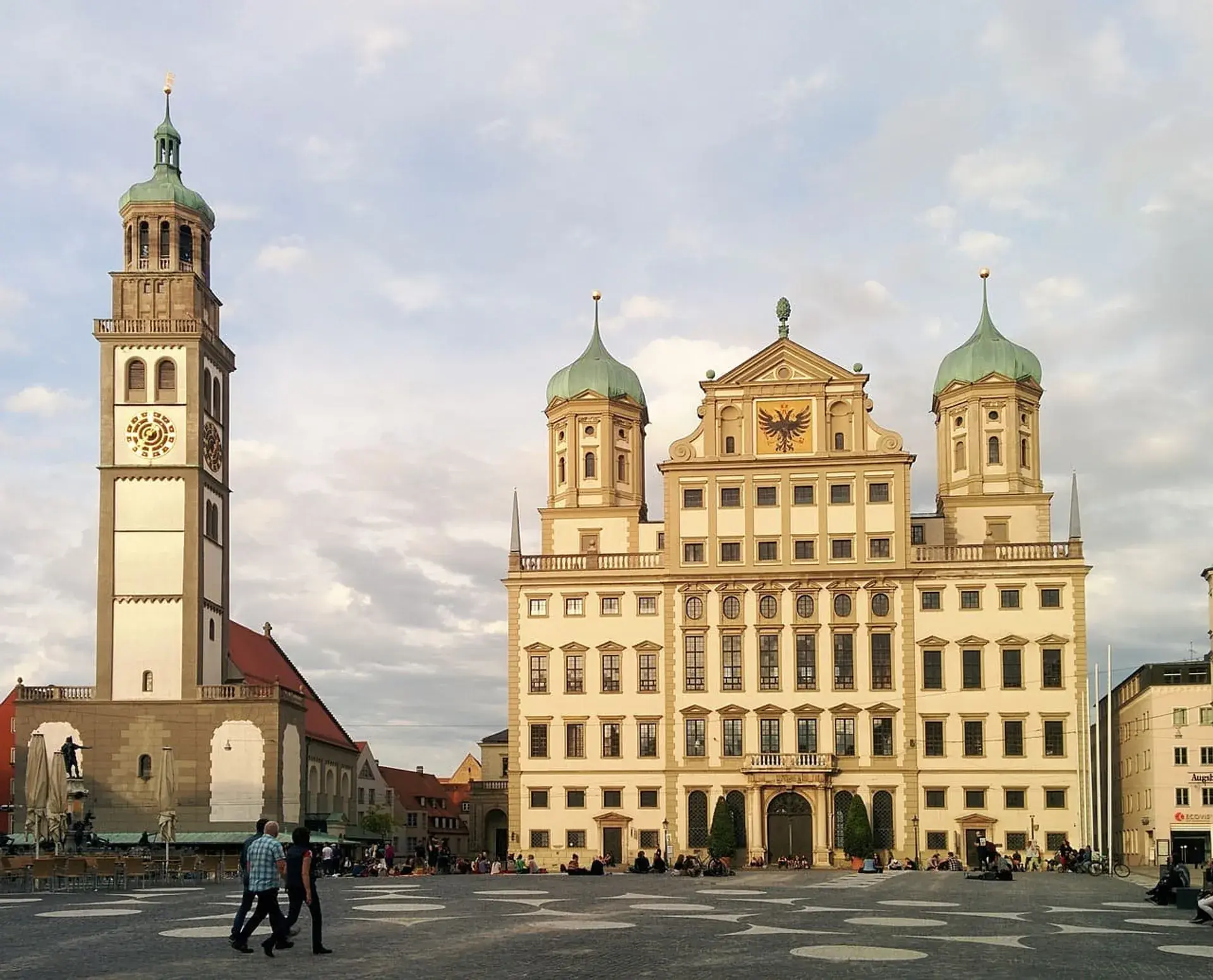
The eastern side of the square is anchored by Augsburg Town Hall and the adjoining Perlachturm. Designed and built or altered between 1614 and 1620 by city master builder Elias Holl, these structures form the definitive civic silhouette of the former Free Imperial City.
The Town Hall features a 57-meter vertical facade flanked by twin onion-domed towers. Adjacent stands the Perlachturm, a historic tower housing the Turamichele, a mechanical figure dating to the 16th century that appears to battle the devil. The southern boundary of the square is defined by the former police headquarters, which now functions as municipal administrative offices.
An Accidental Civic Panorama
The broad frontal view of the Town Hall is an unintended result of post-war civic action. During the Middle Ages, the northern section was a much smaller area known as the Eiermarkt, used for selling butter, poultry, and eggs. Opposite the Town Hall stood merchant and patrician stube buildings, which were replaced in 1828 by Johann Nepomuk Pertsch's neoclassical Stock Exchange. This compact urban fabric meant Elias Holl designed the Town Hall facade to be viewed primarily at an oblique angle from narrow street approaches.
In February 1944, British air raids devastated the city center, damaging the Town Hall and gutting the Stock Exchange. Post-war municipal planners initially intended to rebuild a modern administrative block on the footprint of the ruined exchange. However, an unprecedented vista of Holl's facade had opened up. A referendum of 55,000 citizens halted the construction plans, clearing the site to create the open Rathausplatz by 1963. The square was surfaced with black-and-white ornamental paving blocks flanked by granite slabs.
The Augustusbrunnen
At the northeastern edge of Rathausplatz stands the monumental Augustusbrunnen, a late-Mannerist bronze fountain created between 1588 and 1594 by sculptor Hubert Gerhard and bronze founder Peter Wagner. Enclosed by an ornamental Renaissance wrought-iron protective grille, the fountain depicts Roman Emperor Augustus alongside personifications of four local waterways: the Lech, Wertach, Singold, and the Brunnenbach canal. The bronze figures on the square are replicas, placed there to preserve the originals, which are exhibited in the Maximilianmuseum.
Traditions and Modern Public Life
Rathausplatz functions as a pedestrian hub, demonstration site, and venue for outdoor dining. It also serves as the main stage for prominent local traditions. In late September, the square hosts the Turamichele Festival, centered on the historic mechanical combat between Archangel Michael and the devil.
During Advent, the square accommodates the Augsburger Christkindlesmarkt, a market with roots dating back to a 1498 gingerbread market that relocated to Rathausplatz in 1963. On weekend evenings during the market, the facade of the Town Hall is incorporated into the Engelesspiel. Established in 1977 and inspired by a painting by Hans Holbein, this tradition features 23 costumed local performers who appear in the windows and balcony as musical angels.
FAQ
Why was the broad view of the Augsburg Town Hall considered an accident?
Architect Elias Holl designed the Town Hall facade for a narrow streetscape intended to be seen from an angle. The open panorama only exists because British air raids in 1944 gutted the neoclassical Stock Exchange that stood in front of it, and a post-war referendum of 55,000 citizens prevented a new building from being constructed on the site.
What figures are featured on the Augustusbrunnen at Rathausplatz?
Created between 1588 and 1594 by Hubert Gerhard and Peter Wagner, the fountain depicts Roman Emperor Augustus and four personified regional waterways: the Lech, Wertach, Singold, and Brunnenbach canal. The figures on display are replicas, with the original bronzes protected inside the Maximilianmuseum.
What is the Engelesspiel at Rathausplatz?
The Engelesspiel is an Advent tradition started in 1977 and inspired by a Hans Holbein painting. During weekend evenings of the Augsburger Christkindlesmarkt, 23 costumed performers appear in the windows and balcony of Elias Holl's Town Hall to perform music.