Maximilianstraße: Augsburg's Imperial Grand Boulevard
From Roman Highway to Imperial Boulevard
Maximilianstraße, locally known as Maxstraße, spans approximately 500 meters through the historic heart of Augsburg. Stretching from Rathausplatz in the north to Ulrichsplatz and the Basilica of St. Ulrich and Afra in the south, the street follows the ancient route of the Via Claudia Augusta. Established around 15 BC, this military and commercial highway linked northern Italy with the Roman provincial capital of Augusta Vindelicum.
During the Middle Ages and early modern period, the corridor did not exist as a single open boulevard. Instead, it comprised an interconnected series of market spaces. The most prominent of these was the Weinmarkt (Wine Market), which served as a focal point for the wine trade, assemblies for imperial diets (Reichstage), civic pageantry, and tournaments.
Until the early 19th century, freestanding buildings stood in the center of the thoroughfare, dividing the traffic. These included the medieval Tanzhaus, dismantled in the early 17th century, and the Elias Holl-designed Siegelhaus, which handled wine taxation and quality inspection alongside adjacent salt and wine storehouses. In 1809, Bavarian administrators demolished the central Siegelhaus and storehouses, opening the street into an expansive boulevard with an uninterrupted perspective southward toward the Basilica of St. Ulrich and Afra.
Augsburg walking tour with audio and quizzes: city of the Fuggers
2 hours8 stopsAudio guideStart any day, at your own paceTicket on your phone · 30-day refundPalaces of Augsburg's Merchant Dynasties
Maximilianstraße preserves an architectural sequence representing Gothic, Renaissance, Rococo, Neoclassical, and post-war reconstruction styles. During the city's golden age as a European financial hub, wealthy patricians built grand residences along this corridor.
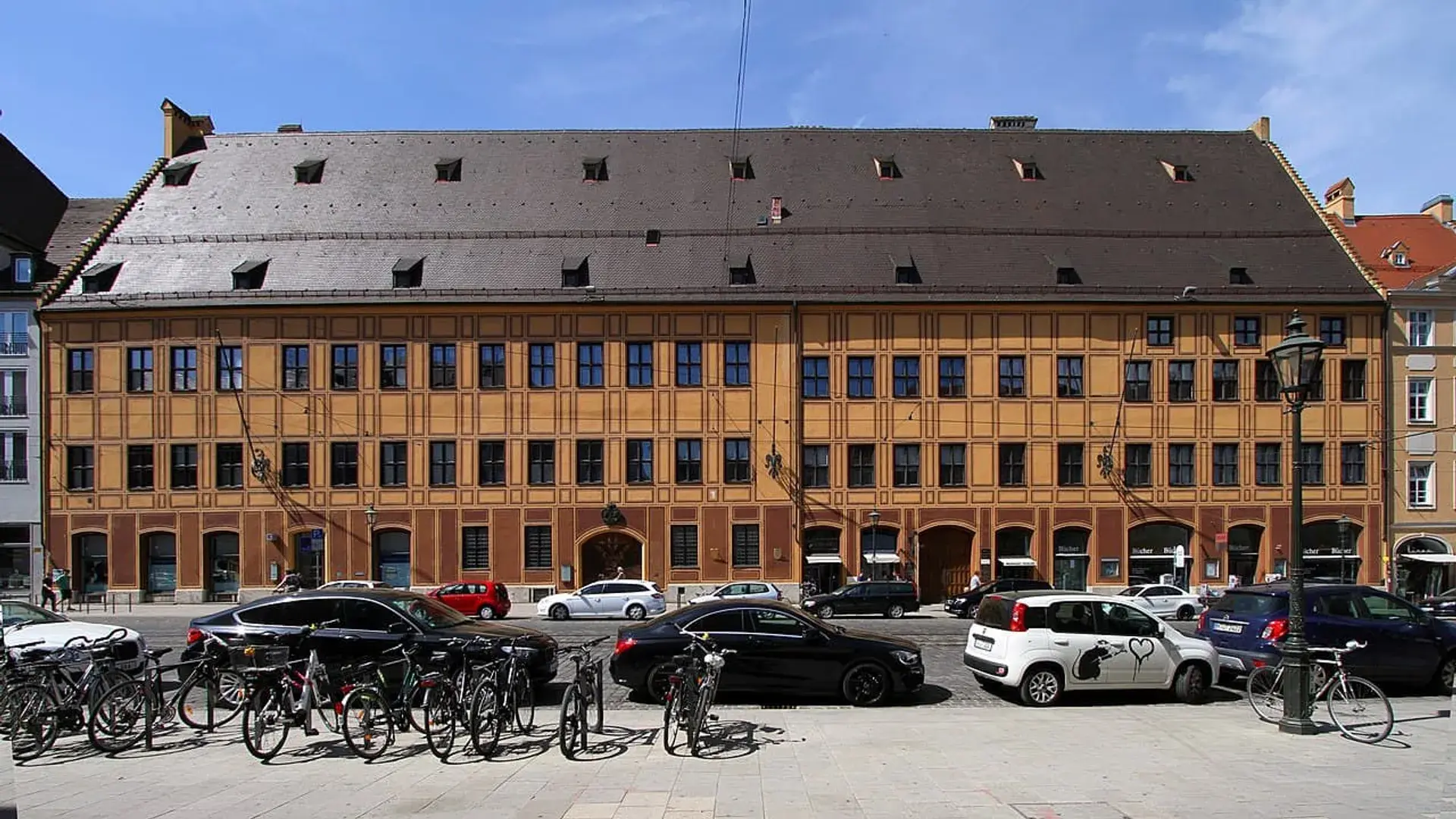
Among the most notable properties is the Fuggerhäuser at Maximilianstraße 36, the palace of the prominent Fugger banking family. Behind its facade lies the Italianate Renaissance Damenhof courtyard, an arcaded space contrasting with the stone pavement outside. Farther along the avenue stands the Rococo Schaezlerpalais, another landmark of Augsburg's patrician past, while traditional establishments such as Café Dichtl at number 18 continue the street's hospitality heritage.
UNESCO World Heritage Renaissance Fountains
A hallmark of Maximilianstraße is its monumental late-Renaissance bronze fountains. The Mercury Fountain (Merkurbrunnen), designed in 1599, and the Hercules Fountain (Herkulesbrunnen), completed in 1602, stand in basins that provide a continuous acoustic backdrop of splashing water.
Together with the nearby Augustus Fountain at Rathausplatz, these works form Augsburg's triad of monumental public fountains. In 2019, they were inscribed onto the UNESCO World Heritage list as central components of the Water Management System of Augsburg. The bronze figures standing outdoors on the street today are precise replicas crafted to safeguard against environmental weathering. The late-Renaissance originals by sculptors Hubert Gerhard and Adriaen de Vries are preserved indoors within the covered courtyard of the nearby Maximilianmuseum.
The Diplomatic Naming of the Avenue
Following Augsburg's loss of status as an imperial free city and its annexation by Bavaria in 1806, the newly cleared boulevard was named in honor of King Maximilian I Joseph of Bavaria. The moniker remained contentious among locals proud of their imperial past.
In 1957, the Augsburg city council diplomatically resolved the civic grievance by officially rededicating the street to Holy Roman Emperor Maximilian I. Because Emperor Maximilian I had been a patron of Augsburg with close ties to its merchant families, this political reinterpretation allowed the city to honor its preferred historical figure without needing to replace existing street signage.
Contemporary Promenade and Culture
Maximilianstraße functions as Augsburg’s central historic promenade. The street is lined with retail shops, bars, restaurants, and outdoor café terraces that animate the old town. It also acts as the venue for public cultural events, including the annual Weinstraße wine festivals, maintaining the celebratory and commercial tradition that began on the medieval Weinmarkt centuries ago.
FAQ
Why are the fountain statues on Maximilianstraße replicas?
The bronze figures on the Mercury and Hercules fountains are modern replicas installed to protect the sculptures from pollution and weathering. The late-Renaissance originals by Hubert Gerhard and Adriaen de Vries are housed in the covered courtyard of the nearby Maximilianmuseum.
How did Maximilianstraße become such a wide street?
Until the early 19th century, central buildings such as the medieval Tanzhaus and the Elias Holl-designed Siegelhaus stood in the middle of the street. In 1809, Bavarian authorities cleared these structures, transforming the divided market squares into a broad boulevard with an open view toward the Basilica of St. Ulrich and Afra.
Which ruler is Maximilianstraße named after?
Originally named after King Maximilian I Joseph of Bavaria following Augsburg's 1806 annexation, the boulevard was officially rededicated in 1957 by the city council to Holy Roman Emperor Maximilian I, a historic patron of the city.