St. Anna Church: Luther's 1518 Augsburg Refuge
History of St. Anna Church
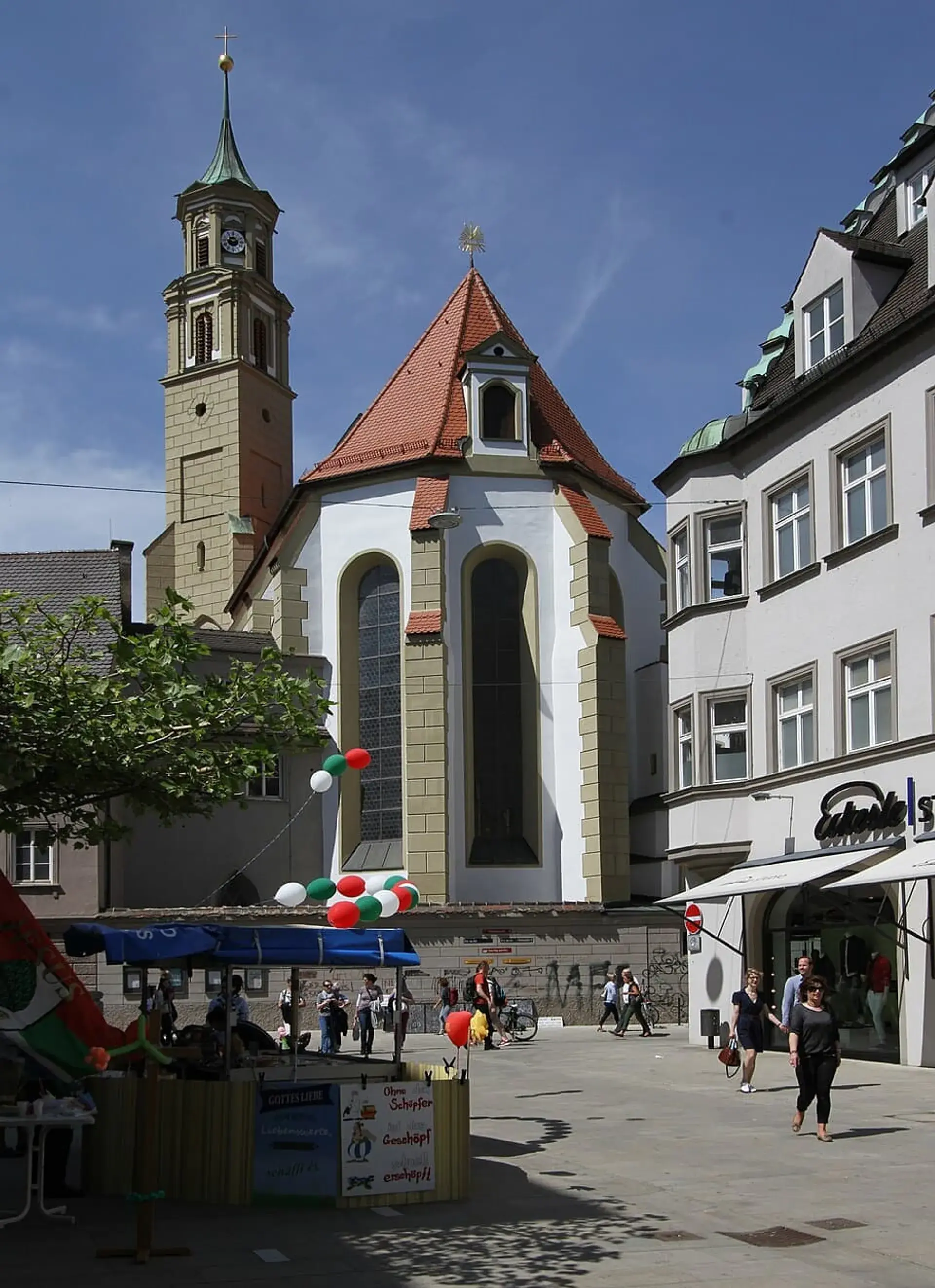
St. Anna Church stands along Annastraße facing Martin-Luther-Platz in Augsburg. Established in 1321 as a monastery church for Carmelite friars, the building later became a central stage for pivotal events in European religious history. In October 1518, Martin Luther stayed with the Carmelites here during the Diet of Augsburg. While residing at the monastery, Luther underwent interrogation by papal legate Cardinal Thomas Cajetan, who ordered him to recant his 95 theses. Luther refused to recant and, fearing arrest, fled the city under the cover of night with the help of Carmelite friar Christoph Langenmantel.
Following Luther's stay, the monastery embraced religious reform under Prior Johannes Frosch. The monastic community dissolved in 1534, and St. Anna transitioned into one of Augsburg's earliest centres of the Lutheran Reformation, formally instituting Evangelical worship during the 1540s. Control of the church alternated between Catholic and Protestant authorities during the Counter-Reformation and the Thirty Years' War, including a period under Jesuit administration. The 1648 Peace of Westphalia permanently confirmed St. Anna as an Evangelical-Lutheran parish church. Later, on October 31, 1999, the church served as the site where representatives of the Roman Catholic Church and the Lutheran World Federation signed the historic Joint Declaration on the Doctrine of Justification.

Augsburg walking tour with audio and quizzes: city of the Fuggers
2 hours8 stopsAudio guideStart any day, at your own paceTicket on your phone · 30-day refundArchitectural Evolution
The structure reflects several centuries of distinct architectural styles. Its medieval foundations include 14th-century Gothic cloisters and the Goldsmiths' Chapel (Goldschmiedekapelle), which was donated in 1420 by Afra Hirn and later maintained by the Goldsmiths' Guild.
Between 1747 and 1748, the church nave underwent a late Baroque and Rococo transformation. This remodeling introduced ornate stuccowork created by Franz Xaver and Johann Michael Feichtmayr, paired with ceiling frescoes painted by Johann Georg Bergmüller. Externally, the church features a distinct tower set at an unusual 45-degree angle to the building's main axis. This orientation was originally calculated to prevent the tower's mass from crushing the vaults beneath, before master builder Elias Holl altered and heightened the tower in 1602.
The Fugger Chapel and Sacred Art
At the western end of the interior lies the Fugger Chapel (Fuggerkapelle), constructed between 1509 and 1512 and consecrated in 1518. Built as the burial place for Jakob Fugger the Rich and his brothers Ulrich and Georg, it is recognized as one of the earliest Renaissance sacred structures built north of the Alps. Remarkably, although St. Anna has served as a Protestant church since the 16th century, the Fugger Chapel remains a legally consecrated Roman Catholic space. Instead of being partitioned off behind an iron grille, it opens directly into the Protestant nave, creating a continuous shared interior across denominations.
The church preserves significant Renaissance and Reformation art. The 1512 organ shutters in the Fugger Chapel, painted by Jörg Breu the Elder, depict scenes of the Ascension that incorporate likenesses of donor Jakob Fugger, artist Jörg Breu, and Holy Roman Emperor Maximilian I. In the East Choir, panel portraits produced by the workshop of Lucas Cranach the Elder present depictions of Martin Luther and Elector Johann Friedrich I of Saxony.
Museum Lutherstiege and Present Day Use
St. Anna functions as the primary Evangelical-Lutheran parish church in Augsburg, holding weekly Sunday services, prayer gatherings, and sacred music concerts. Stepping from the busy pedestrian shopping district of Annastraße through the portal leads directly into the quiet, cloistered inner courtyard known as the Lutherhöfle.
The historic monastic convent rooms and stairs house the Museum Lutherstiege. This permanent interactive exhibition details Martin Luther’s 1518 confrontation with Cardinal Cajetan, his subsequent night-time escape, and the wider history of the Reformation in Augsburg.
FAQ
Why did Martin Luther stay at St. Anna Church in 1518?
Martin Luther stayed with the Carmelite friars at St. Anna in October 1518 during the Diet of Augsburg. During this visit, he was interrogated by papal legate Cardinal Thomas Cajetan and refused to recant his 95 theses before fleeing the city at night.
What makes the Fugger Chapel inside St. Anna unique?
Built between 1509 and 1512 as the burial site for Jakob Fugger the Rich and his brothers, it is one of the earliest Renaissance sacred buildings north of the Alps. Additionally, it remains a legally consecrated Roman Catholic chapel that is entirely open to the surrounding Protestant nave.
Why is the church tower oriented at a 45-degree angle?
The tower was set at a 45-degree angle relative to the main building axis as an engineering solution to keep its weight from crushing the church vaults, prior to being redesigned and heightened by builder Elias Holl in 1602.
What is the Museum Lutherstiege?
Located within the historic convent rooms and staircases of St. Anna, the Museum Lutherstiege is a permanent interactive exhibition focusing on Luther's 1518 interrogation, his escape, and the history of the Reformation in Augsburg.