Caracalla Therme: Baden-Baden's Modern Thermal Spa
Ancient Springs and Imperial Namesake
Caracalla Therme stands at Römerplatz 1 in the historic bath district (Bäderviertel) of Baden-Baden. The thermal springs in this area were first developed by the Romans in the first century AD, when the settlement was known as Aquae. Around 213 AD, Roman Emperor Caracalla carried out extensive renovations and expansions of the military and public bathing facilities, providing the historical foundation and name for the modern spa complex. Local lore often associates Caracalla’s patronage with seeking relief for physical ailments such as arthritis.
During the nineteenth century, the site adjacent to the current facility was home to the Kaiserin-Augusta-Bad, an upscale women’s bathhouse built between 1890 and 1893. After falling into neglect in the 1930s, that structure was demolished in the early 1960s, and an interim successor, the Neues Augustabad, proved unpopular. Between 1983 and 1985, the location underwent a complete restructuring to construct the present-day bathing complex. Today, Caracalla Therme forms an active element of Baden-Baden’s UNESCO World Heritage status under "The Great Spa Towns of Europe," inscribed in 2021 to recognize millennia of unbroken spa culture.
Thermal Waters of the Florentinerberg
The complex is supplied by 12 distinct artesian thermal springs that rise from depths of up to 2,000 meters beneath the Florentinerberg. Discharging approximately 800,000 liters of mineral-rich water every day, these natural springs reach surface temperatures of roughly 68 °C.
The thermal water is naturally enriched with minerals, including sodium chloride, fluorides, and metasilicic acid. This mineral concentration gives the pools a buoyant, silky feel. The spa utilizes these ancient subterranean sources to power an extensive array of indoor and outdoor hydrotherapy amenities.
Postmodern Architecture and Roman Balnea Design
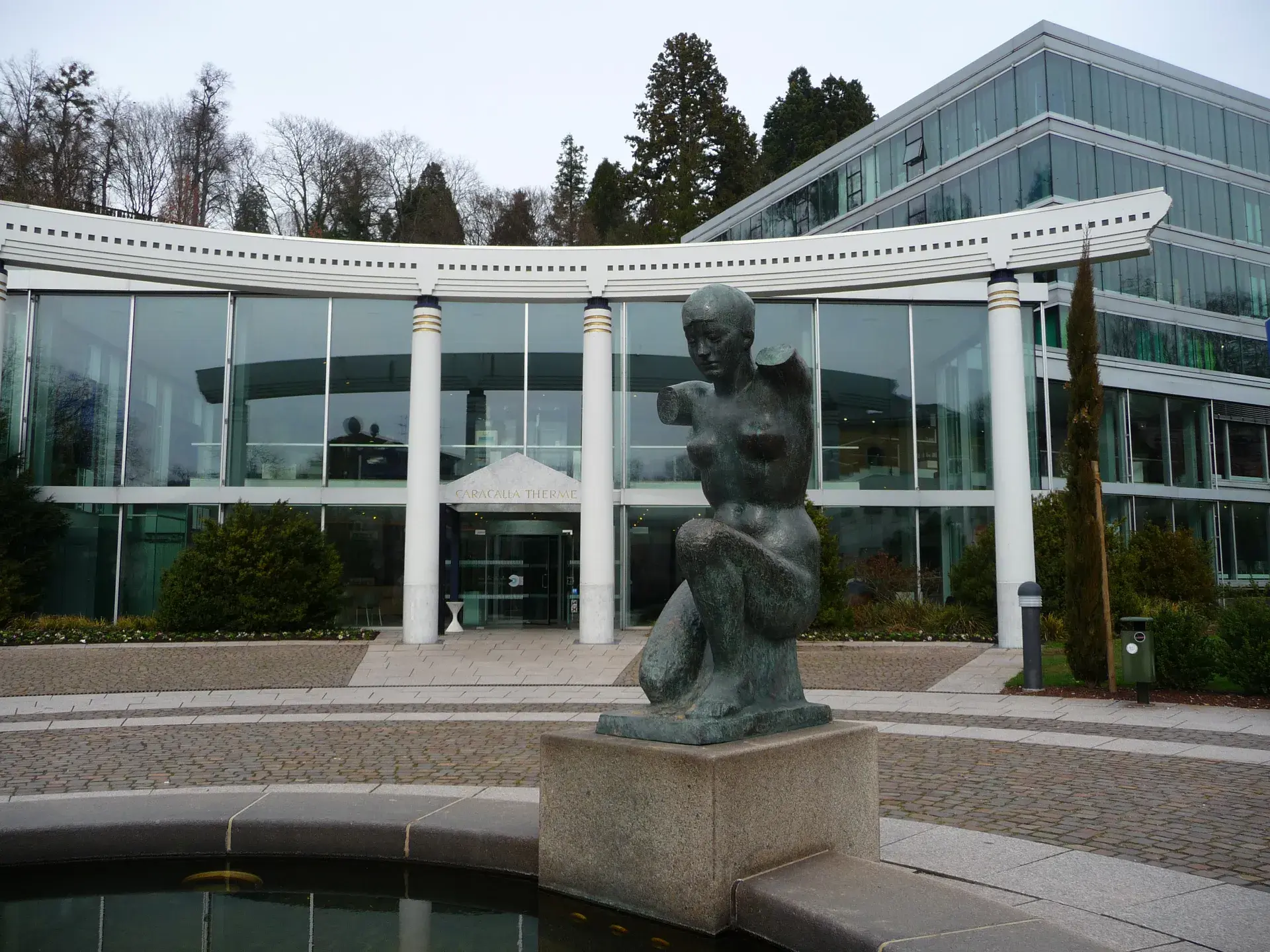
Designed by Freiburg architect Hans-Dieter Hecker, Caracalla Therme encompasses 5,000 square meters of wellness space. Built between 1983 and 1985, the facility officially opened its doors in 1985. It is owned by the state-run Bäder- und Kurverwaltung Baden-Württemberg (BKV) and has been managed by CARASANA Bäderbetriebe GmbH since 1994.
Architecturally, the building blends functionalist 1980s glass-and-concrete engineering with ancient classical themes. A central glass rotunda is supported by monumental white concrete columns, an aesthetic choice intended to evoke the grandeur of classical Roman balnea. These colonnades frame both the interior bathing hall and the exterior pool perimeter, linking twentieth-century leisure engineering to antique Roman design.
Indoor and Outdoor Wellness Facilities
Caracalla Therme offers diverse wellness zones spread across multiple levels. Inside, the spacious circular bathing hall connects to rock grottoes featuring hot plunge pools at 38 °C and cold plunge pools at 18 °C. The interior also incorporates an aromatic herbal steam bath and a brine inhalation room designed for halotherapy.
Outdoors, two large marble pools remain open across all seasons, with water temperatures kept between 32 °C and 38 °C. These pools feature built-in current channels, counter-current jets, and whirlpools. In cold weather, dense steam clouds rise from the heated outdoor pools into the cool Black Forest air against the backdrop of cascading waterfalls. On the upper floor, an extensive Roman-style sauna world offers multiple heat experiences ranging from 57 °C to 95 °C, including wood-fired saunas that extend into the adjacent palace garden, alongside nine treatment rooms in the WellnessLounge.
Bathing Etiquette and the Friedrichsbad Contrast
Caracalla Therme maintains clear dress codes across its distinct sections. Standard swimwear is mandatory in all indoor and outdoor swimming pools and grottoes. In contrast, the upper-level sauna world operates strictly as a textile-free zone, adhering to traditional German sauna culture.
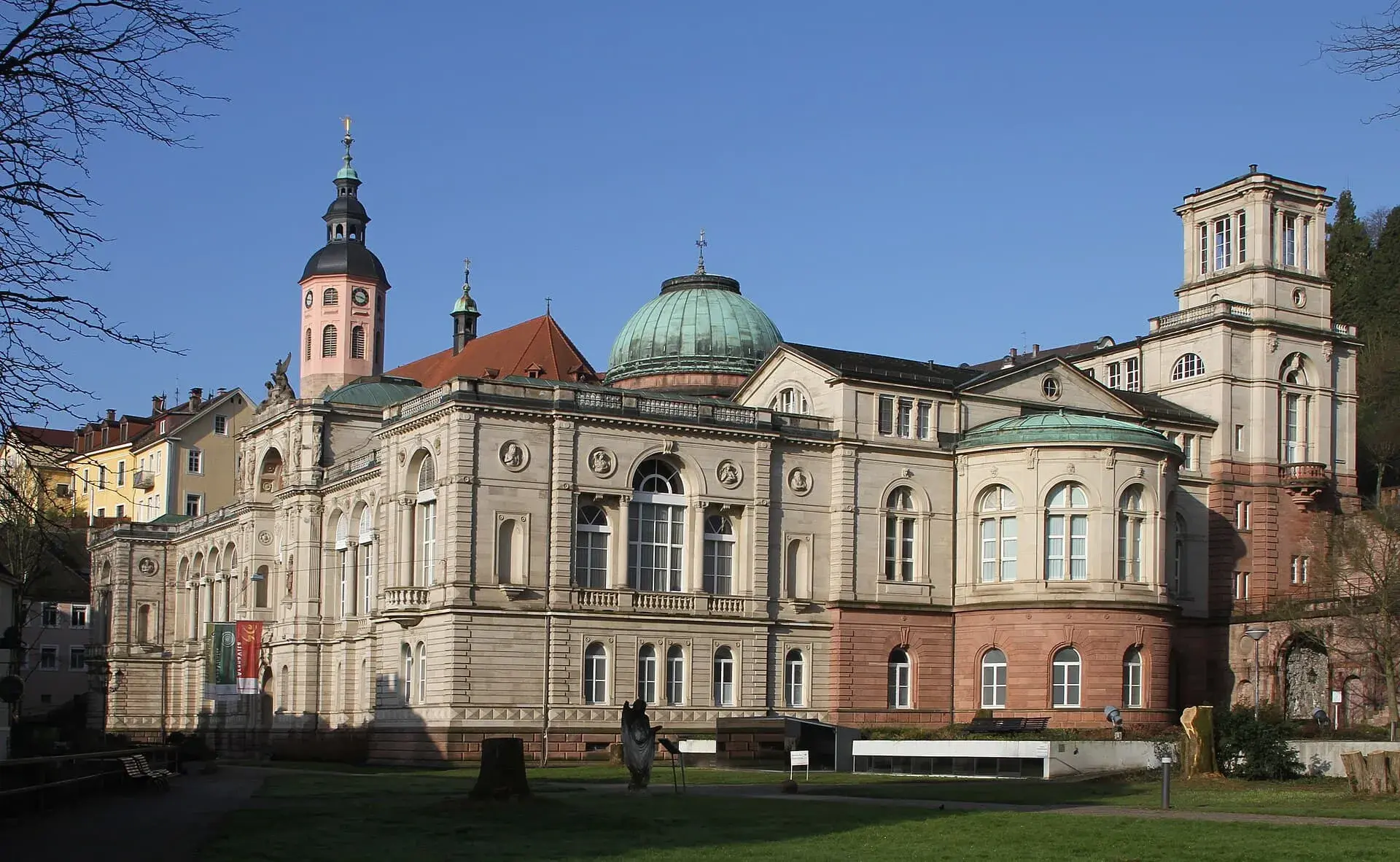
This operational model stands in direct contrast to its immediate neighbor, the nineteenth-century Friedrichsbad. While both bathhouses tap the identical spring system beneath the Florentinerberg, they offer divergent approaches to thermal bathing. Caracalla Therme caters to modern, free-form leisure bathing in swimwear, whereas Friedrichsbad mandates a structured, untimed 17-station Roman-Irish bathing ritual conducted entirely without textiles.
FAQ
What is the dress code at Caracalla Therme?
Standard swimwear is mandatory in the main indoor and outdoor pool areas, whereas the upper-level sauna landscape operates strictly as a textile-free zone.
Where does the thermal water at Caracalla Therme originate?
The water is supplied by 12 artesian springs ascending from depths up to 2,000 meters beneath the Florentinerberg, emerging naturally at temperatures up to 68 °C.
How does Caracalla Therme differ from the adjacent Friedrichsbad?
Although both spas tap the same natural springs, Caracalla Therme offers unstructured leisure bathing in swimwear, while Friedrichsbad requires an untimed, sequential 17-station ritual conducted entirely without clothing.