Ivan Turgenev Monument: Baden-Baden Literary Memorial
A Literary Anchor on Lichtentaler Allee
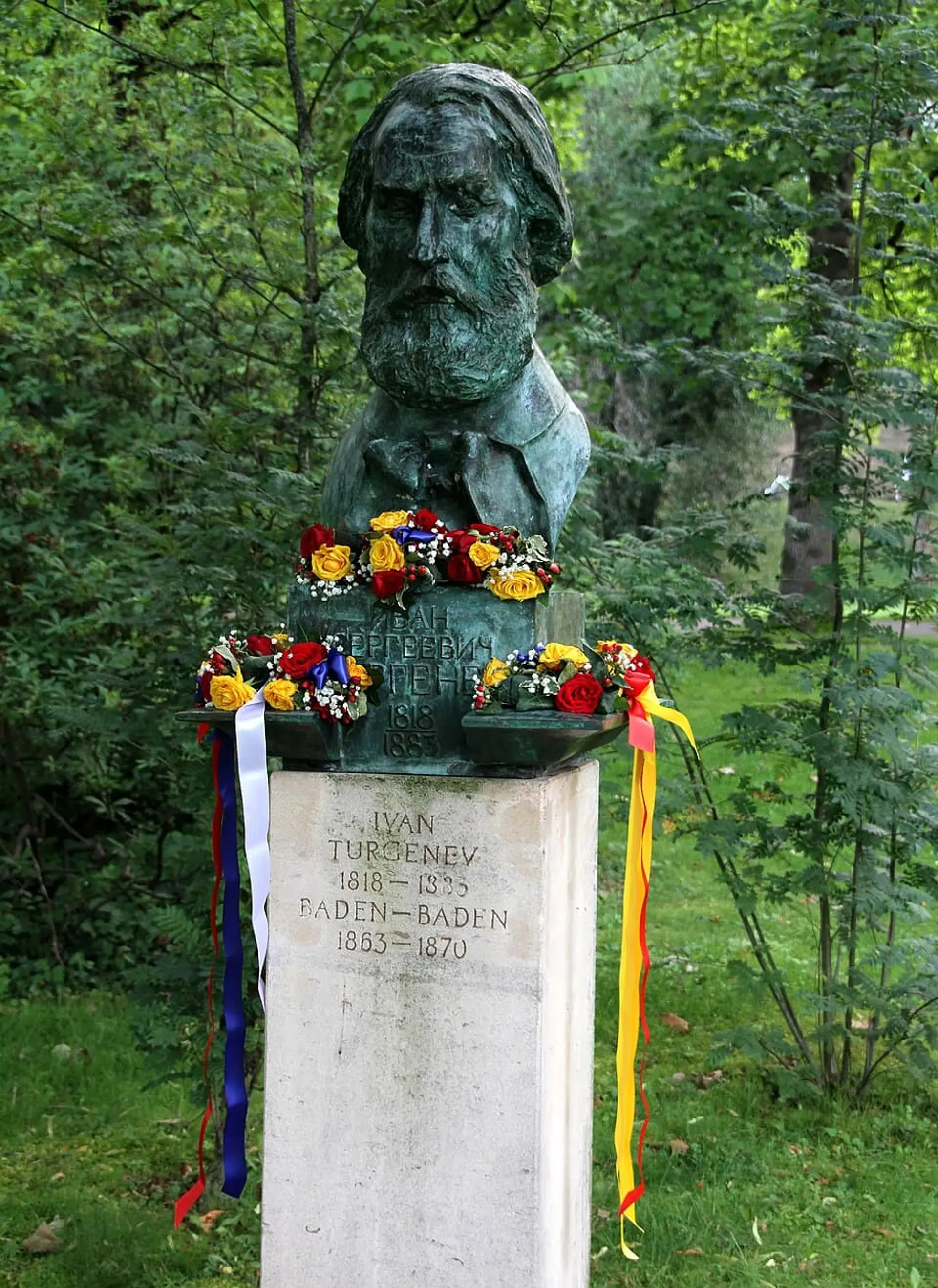
The Ivan Turgenev Monument stands within the historic riverside park of Lichtentaler Allee in Baden-Baden. Positioned approximately opposite the Brenners Park-Hotel & Spa, the memorial borders the gently running waters of the Oos River. The artwork consists of a dark patinated bronze bust resting atop a light-colored sandstone pedestal. Sculpted by Russian artist Yuriy Grigoryevich Orekhov, who signed the piece in 1999, the bust was formally unveiled in October 2000.
The installation was a collaborative gift presented by the Ministry of Culture of the Russian Federation, the Russian Embassy in Germany, the Oryol Region—where Turgenev was born—and the City of Baden-Baden. The bronze base of the bust features an inscription in Russian script marking the author's name and lifespan (1818–1883). Below it, the stone plinth provides a German inscription that records both his life dates and the timeframe of his local residence from 1863 to 1870.
Seven Years in Baden-Baden: Salons and Devotion
Ivan Turgenev arrived in Baden-Baden in 1863, drawn there by his devotion to the celebrated French mezzo-soprano Pauline Viardot and her husband Louis Viardot. When the Viardots acquired an estate on Fremersbergstrasse after Pauline retired from the stage, Turgenev purchased the adjacent land and constructed Villa Turgenjew to remain near their household circle.
Between 1863 and 1870, the Viardot and Turgenev properties developed into an influential European cultural salon. Their gatherings brought together artistic luminaries such as composer Johannes Brahms, pianist Clara Schumann, and visiting dignitaries including Prussian King Wilhelm and Queen Augusta. This chapter of cosmopolitan life ended in 1870 with the outbreak of the Franco-Prussian War, which forced the French Viardot family to depart Germany. Turgenev followed them to London and later to Bougival, concluding his seven-year Baden-Baden residency.
Literary Friction and the Novel 'Smoke'
Turgenev's residence directly shaped his literary output, most notably his 1867 novel Smoke (Dym). Set amid the town's promenade culture and Kurhaus terraces, the work offered a sharp satire aimed at both the reactionary Russian aristocracy and radical Slavophile thinkers who gathered at the resort.
That same year, Baden-Baden became the backdrop for an explosive literary dispute. Fyodor Dostoevsky visited the spa town, incurring severe financial losses at the gaming tables. An encounter between the two writers swiftly disintegrated into a clash between Turgenev's Western European liberalism and Dostoevsky's conservative, anti-Western Slavophilism. The confrontation lingered in Dostoevsky's memory, prompting him to caricature Turgenev as the vain, affected author Karmazinov in his subsequent novel Demons.
Botanical Tributes and the "Russian Tree"
The setting surrounding the monument incorporates deliberate historical and botanical touches. Directly sheltering the pedestal is a mature linden tree. By local tradition, this canopy has long been identified as the "Russian Tree," reflecting the 19th-century habit of Russian travelers and emigrants congregating beneath its branches to debate politics.
Surrounding the sandstone base, the municipal parks department deliberately planted rowan trees (mountain ash). This landscaping choice honors a specific affinity Turgenev noted in his writings, where he recorded a fondness for the species. Today, the monument remains accessible year-round along the Lichtentaler Allee pedestrian and cycling route, serving as an important stop on literary itineraries exploring Baden-Baden's 19th-century status as the "Summer Capital of Europe."
FAQ
Where is the Ivan Turgenev Monument located?
The monument is located along the pedestrian and cycling path of Lichtentaler Allee along the Oos River, roughly opposite the Brenners Park-Hotel & Spa in Baden-Baden.
Why did Ivan Turgenev live in Baden-Baden?
Turgenev relocated to Baden-Baden in 1863 to be near the French mezzo-soprano Pauline Viardot and her husband Louis Viardot, establishing Villa Turgenjew adjacent to their estate.
Why were rowan trees planted around the bust?
The Baden-Baden municipal parks department landscaped rowan trees around the pedestal as a tribute to Turgenev, who had recorded a personal affection for the species.
What is the story behind the "Russian Tree" near the monument?
According to local tradition, the large linden tree sheltering the bust is associated with the 19th-century gathering spot where Russian visitors to the spa town met to discuss news and politics.
Gallery