Kurhaus & Casino Baden-Baden: History and Grandeur
Origins of the Conversationshaus
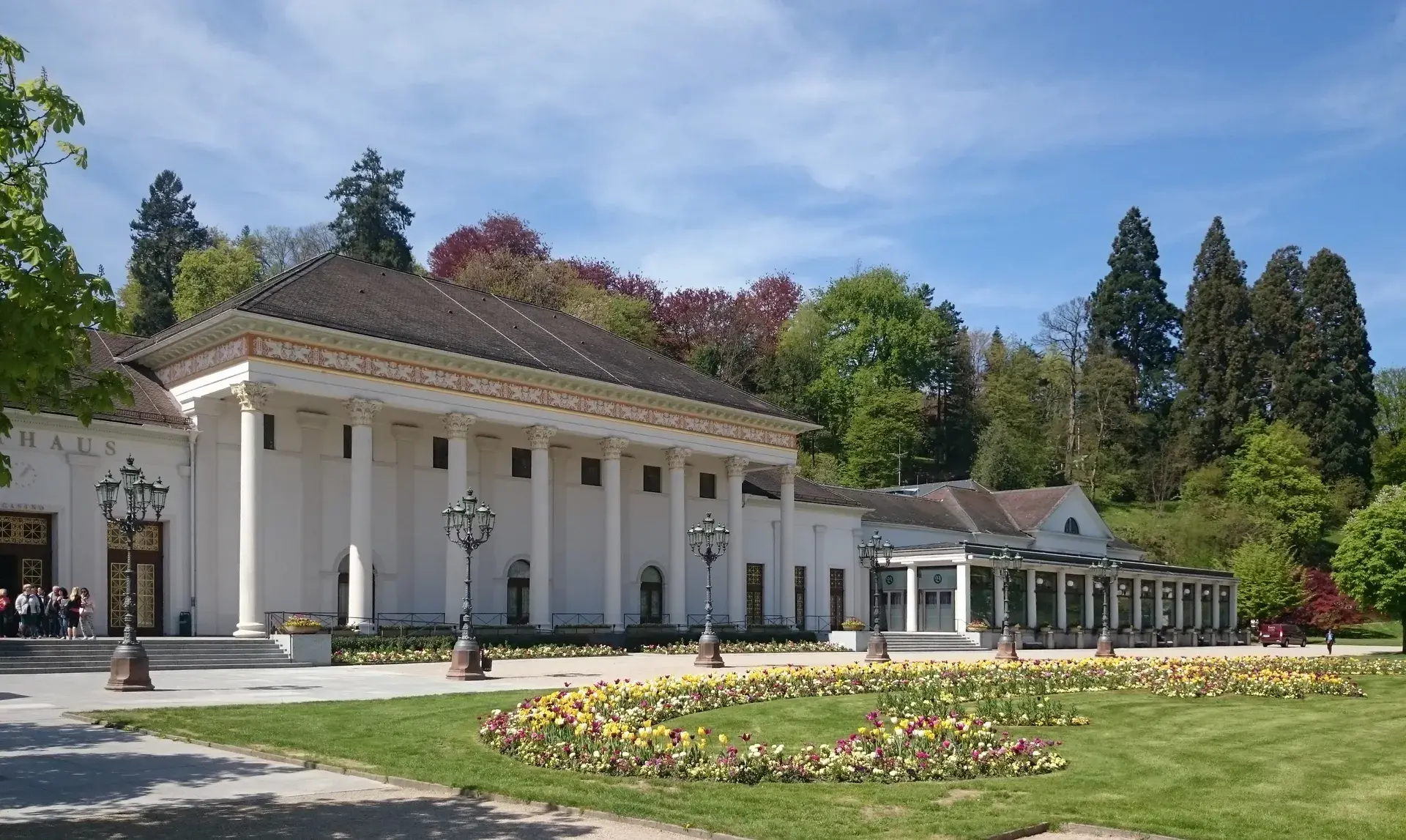
Commissioned in 1821 by Grand Duke Ludwig, the Kurhaus was conceived as a central social venue for thermal visitors. Built between 1821 and 1824 on the site of the former 1766 Promenadenhaus, the complex was originally designated as a Conversationshaus. It provided an indoor refuge where spa guests could promenade during inclement weather, read, listen to musical performances, and participate in low-stakes wagering.
Positioned between Baden-Baden's historic old town and the park landscape of the Lichtentaler Allee, the structure anchors the city's renowned spa district. Today, the Kurhaus stands as a key architectural landmark within the "Great Spa Towns of Europe" UNESCO World Heritage designation, embodying the 19th-century European tradition of integrating therapeutic routines with high-society culture.
Neoclassical Architecture and French Salons
The complex showcases the vision of Karlsruhe court architect Friedrich Weinbrenner, who designed the core structure in the Neoclassical style. The central building, constructed between 1821 and 1823, features an exterior portico supported by eight Corinthian columns quarried from local Murgtal sandstone. Above these pillars runs an antique frieze displaying paired griffins. Behind the central facade lies the Weinbrennersaal, the building's original conversation hall.
Over the following decades, the building expanded to accommodate growing social and gaming functions. In 1853 and 1854, the right wing was outfitted with gaming rooms inspired by French royal interiors, including decors reminiscent of Versailles, Louis XVI styling, and the Pompadour Salon. Between 1912 and 1917, architect August Stürzenacker added the left wing, introducing a monumental staircase and the Bénazetsaal, which underwent comprehensive modernization in 2011.
The exterior presents a disciplined, uniform white Neoclassical facade, while the interior gaming salons display elaborate French decorative arts. The rooms are finished with crimson damask wall coverings, deep vermilion carpets, gilded cherubs, monumental crystal chandeliers, and traditional green baize gaming tables.
The Bénazet Era and the Summer Capital of Europe
The trajectory of the Kurhaus shifted significantly in 1838 when France implemented a national ban on gambling houses. Parisian gaming concessionaire Jacques Bénazet relocated his business from Paris to Baden-Baden. Jacques, and later his son Édouard Bénazet, hired Parisian theatrical designers and artisans to transform the interior salons into palatial gaming spaces.
Under the direction of the Bénazet family, the casino attracted international royalty, nobility, diplomats, and artists, turning Baden-Baden into the celebrated "Summer Capital of Europe." Decades later, actress Marlene Dietrich famously proclaimed it "the most beautiful casino in the world." Beyond entertainment, the revenue generated at the gaming tables directly financed the city's public works, with the Bénazet family funding the municipal theater, local park systems, and the Iffezheim horse racing track.
Literary Lore and Evening Traditions
The high-stakes environment inside the salons has generated notable historical encounters. In the 1860s, Russian author Fyodor Dostoyevsky visited the Kurhaus casino and accrued devastating gambling debts. Pressed by his financial losses and a demanding publishing contract, he channeled his experiences into his 1866 novel The Gambler, written under a strict deadline.
Outside the building, the Kurgarten retains historic gas-fueled candelabras. In keeping with long-standing practice, these multi-armed street lamps are still lit by hand at dusk, casting a warm illumination across the grounds and colonnades as evening visitors gather.
Modern Gaming, Culture, and Public Access
Casino Baden-Baden continues to operate active gaming tables, offering roulette, blackjack, and poker alongside slot machines within its historical salons. In addition to gaming, the Kurhaus serves as a civic and conference center, hosting galas, corporate meetings, and musical performances by the Baden-Baden Philharmonic inside the Weinbrennersaal and Bénazetsaal.
Visitors can observe the historic interiors without gambling through guided architectural tours offered during morning and midday hours before gaming commences. The adjoining Kurhaus colonnades accommodate boutique shops, cultural ticket counters, and the restaurant Hectors on the ground level.
FAQ
Can the historic casino rooms be visited without gambling?
Yes, guided architectural and historical tours operate during morning and midday hours, allowing visitors to view the salons before regular gaming tables open.
Who designed the Kurhaus and Casino Baden-Baden?
The original Neoclassical central building was designed by Karlsruhe court architect Friedrich Weinbrenner between 1821 and 1824. Later additions were made in the 1850s for gaming salons and between 1912 and 1917 by architect August Stürzenacker.
Which novel was inspired by gambling at the Kurhaus?
Russian novelist Fyodor Dostoyevsky wrote his 1866 novel 'The Gambler' under a tight publisher deadline to clear massive debts accrued at Casino Baden-Baden in the 1860s.
How did casino revenues impact the city of Baden-Baden?
Casino operators Jacques and Édouard Bénazet reinvested gambling proceeds into Baden-Baden's civic infrastructure, funding the municipal theater, extensive park systems, and the Iffezheim horse racing track.