Zum Breiten Herd: A Renaissance Gem in Erfurt
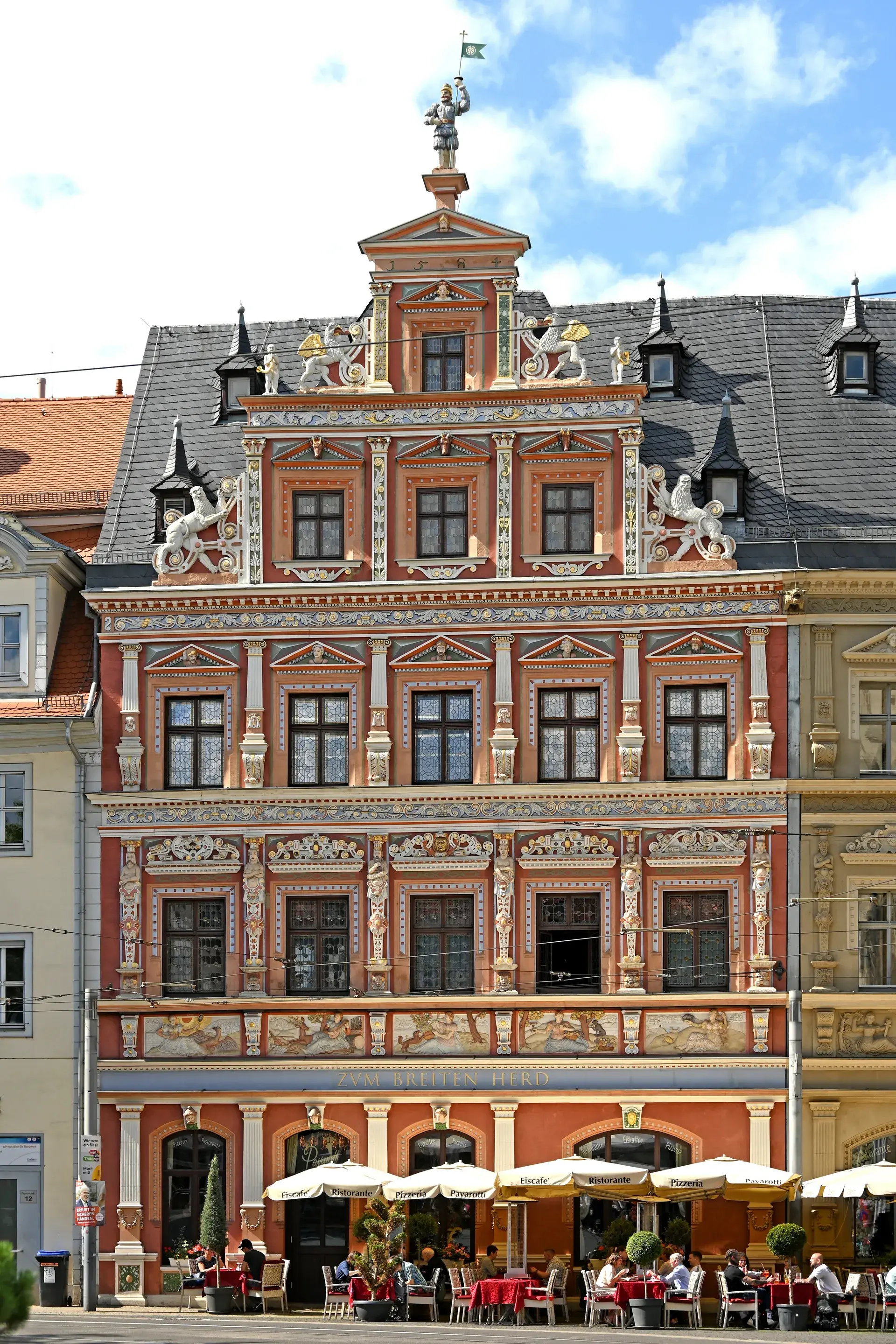
On the north side of Erfurt's historic Fischmarkt stands the Haus zum Breiten Herd, a magnificent Renaissance town house. Built in 1584, it is a vivid symbol of the prosperity and influence of the city's merchants during an era of great economic growth, fueled in part by the trade of woad, a valuable blue dye.
A Masterpiece of Renaissance Architecture
Commissioned by the city bailiff and council master Heinrich von Denstedt, Zum Breiten Herd is considered one of the most splendid Renaissance buildings in Erfurt. Its facade, created by the workshop of Hans Friedemann the Elder, is a showcase of German Renaissance architecture, featuring elaborate stucco decorations and colorful reliefs.
On the first floor, personifications of the five senses—sight, hearing, smell, taste, and feel—are depicted, based on designs by the Antwerp artist Frans Floris. The facade is further adorned with grimacing heads known as Gaffköpfe in the gables of the upper windows, and a statue of a mercenary soldier, or Landsknecht, crowns the top of the house. The vibrant colors seen today are the result of a polychrome reconstruction in 1968, with further restoration of the artworks in 2005.
A Witness to History
The name "Zum Breiten Herd," translating to "The Wide Hearth," symbolizes warmth and hospitality, suggesting its role as a center for gatherings and business. The house played a part in a significant European event during the 1808 Congress of Erfurt. King Friedrich August I of Saxony resided in the building and received a formal visit from Napoleon Bonaparte and his marshals.
In a fascinating blend of history and modernity, the building also marks a technological milestone for the city. The Walther hardware store, once located in the Haus zum Breiten Herd, was the site where Erfurt's first electric light was switched on, laying the foundation for the city's power supply.
Architectural Layers and Current Use
The building's history includes several transformations. In 1727, a Baroque summer house with a hall was added to the courtyard by the Brunswick envoy, Privy Councillor Christoph Schulze. In 1734, the house was combined with the neighboring inn, "Zum Stötzel."
Since 1925, the Zum Breiten Herd and the adjacent Gildehaus have served as the headquarters for the Erfurt Chamber of Crafts. Located on the bustling, pedestrianized Fischmarkt, the building remains a prominent landmark. While the main house is used by the Chamber, an Italian restaurant occupies the ground floor of the connected Gildehaus. Behind the main facade, the hidden Baroque summer house is occasionally made accessible for guided tours.
FAQ
What is the Zum Breiten Herd?
The Haus zum Breiten Herd is a highly decorated Renaissance town house built in 1584 on the Fischmarkt in Erfurt, Germany. It is renowned for its architectural beauty and historical importance.
What do the figures on the facade of Zum Breiten Herd represent?
The facade features personified reliefs of the five human senses (sight, hearing, smell, taste, touch), grimacing heads called 'Gaffköpfe', and a figure of a mercenary soldier (Landsknecht) at its peak.
Who famously visited the Zum Breiten Herd?
During the Congress of Erfurt in 1808, King Friedrich August I of Saxony stayed in the house and received a formal visit from Napoleon Bonaparte.
What is the building used for today?
Since 1925, the Zum Breiten Herd and the adjoining Gildehaus have been the seat of the Erfurt Chamber of Crafts. It remains a major point of interest on the city's Fischmarkt.