Altstadtbrücke: Görlitz's Bridge to Poland
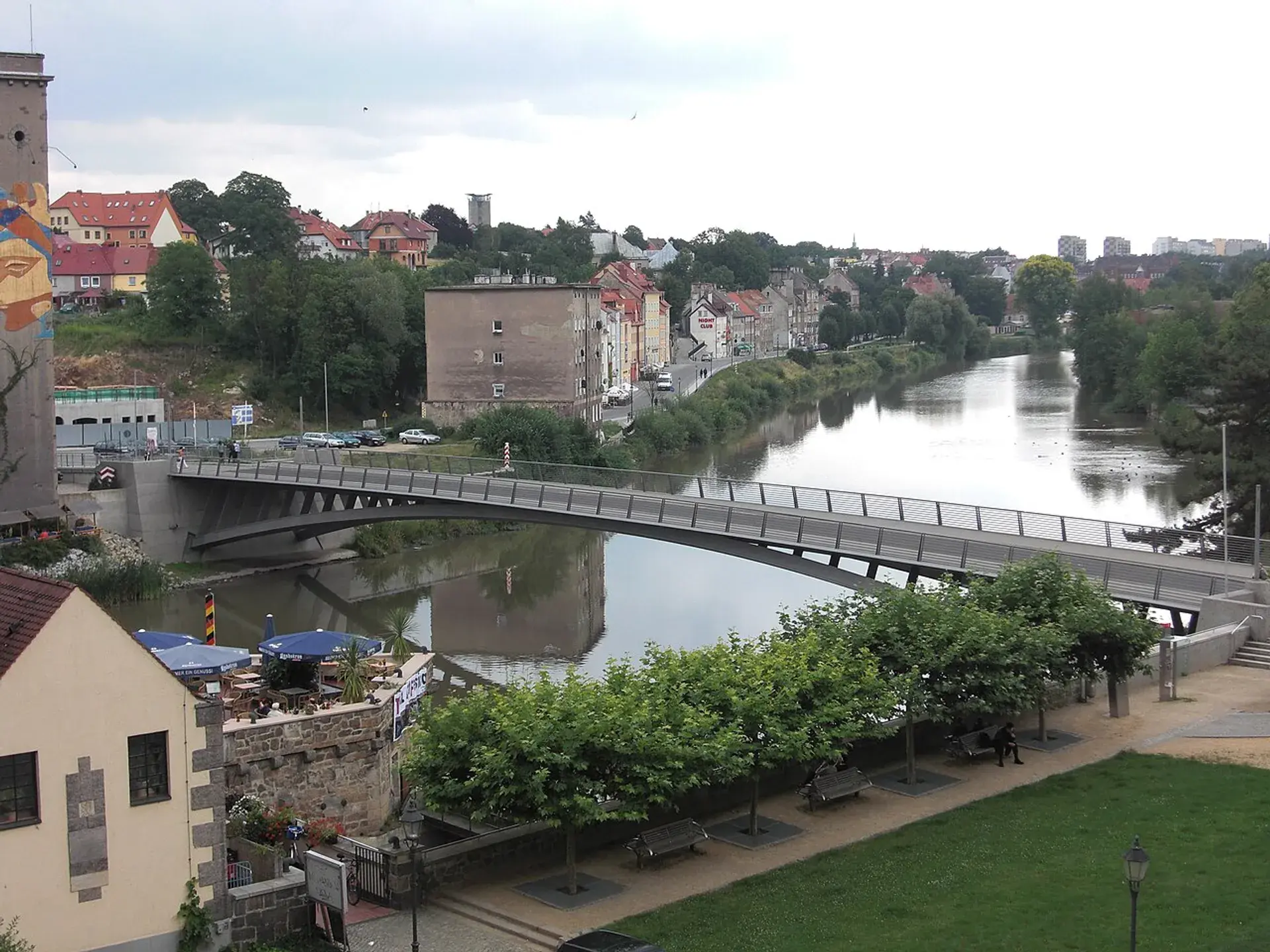
For 59 years, a centuries-old trade route ended in thin air above the Lusatian Neisse river, severing the historic center of Görlitz from its eastern suburb. Today, the Altstadtbrücke (Old Town Bridge) spans this gap. Known in Polish as Most Staromiejski, the modern steel-arch footbridge links Görlitz, Germany, directly with Zgorzelec, Poland.
A History of Division and Reunification
A river crossing on this site dates back to a documented wooden bridge in 1298, which carried the prominent Via Regia trade route. Over the centuries, successive timber and stone bridges were repeatedly destroyed by seasonal floods, war, and major urban fires, including a devastating blaze in 1525.
In 1906 and 1907, a stone and steel truss arch bridge was constructed, but it met a violent end during World War II. Retreating German Wehrmacht forces blew up the structure on May 7, 1945. The resulting Oder-Neisse border divided the municipality in two, leaving the crossing unbridged for 59 years. It was not until German reunification and Poland's 2004 accession to the European Union that the current structure was built to reconnect the divided cities, officially opening on October 20, 2004.
The Modern Border Crossing
Spanning 79.98 meters and measuring 8.5 meters wide at its center, the Altstadtbrücke operates exclusively as a pedestrian and cyclist border crossing within the Schengen area. Pedestrians cross daily without standard passport controls, though the German side maintains surveillance installations for occasional border movement checks.
Because the international border runs directly through the riverbed beneath the bridge, a unique technological quirk occurs on the structure. Mobile phones carried across the bridge frequently trigger automated roaming welcome texts mid-span or rapidly switch back and forth between German and Polish cellular networks.
Historic Landmarks on the Riverbanks
The Altstadtbrücke is flanked by historic mills on both riverbanks. The Vierradenmühle (Four-Wheel Mill) sits on the German side, while the Dreiradenmühle (Three-Wheel Mill) is located in Poland. The Polish mill features a prominent 1998 European-themed wall relief.
Near the Polish bridgehead stands the preserved house of the 17th-century mystic and shoemaker Jacob Böhme. He resided there from 1599 to 1610, during a time when the eastern bank was simply a suburb of Görlitz.
Today, the bridge serves as the primary physical and symbolic realization of the 1998 "Europastadt" (European City) declaration. This agreement established Görlitz and Zgorzelec as a unified cross-border municipality. The structure also acts as the central hub for joint civic celebrations, such as the simultaneous Altstadtfest and Jakuby festivals held each August.
FAQ
When did the modern Altstadtbrücke open?
The current Altstadtbrücke officially opened on October 20, 2004, following German reunification and Poland's accession to the European Union.
Can cars drive across the Altstadtbrücke?
No, the bridge serves exclusively as an open border crossing for pedestrians and cyclists within the Schengen area.
What historical buildings are located near the Altstadtbrücke?
The bridge is flanked by the Vierradenmühle in Germany and the Dreiradenmühle in Poland. The preserved house of 17th-century mystic Jacob Böhme is also located near the Polish bridgehead.