The Holy Sepulchre Görlitz: A Unique Jerusalem Replica
View the unique sacred architecture of The Holy Sepulchre complex from Heilige-Grab-Straße. To experience the spatial reality of the Crusader-era tomb in Jerusalem, one must look to this surviving late-Gothic replica in Görlitz. Begun in 1481 and consecrated in 1504 by the Bishop of Meissen, the site is a precise architectural recreation of Jerusalem's holy sites.
An Accurate Architectural Record
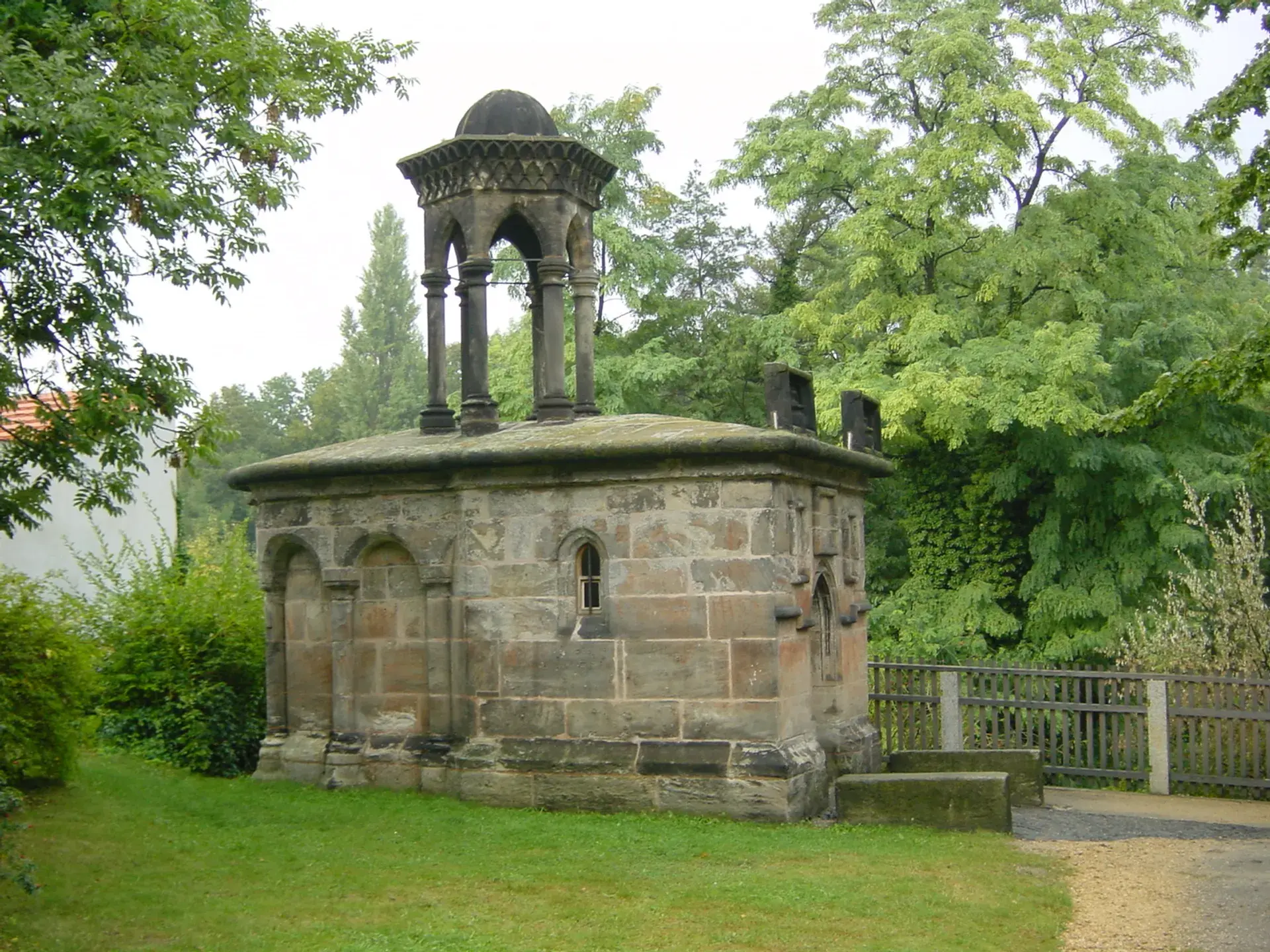
Because the original medieval Church of the Holy Sepulchre in Jerusalem was heavily altered following an 1808 fire, the Görlitz complex remains one of the most accurate surviving spatial records of the Crusader-era tomb. The site features three primary stone structures: the two-story Double Chapel of the Holy Cross, the Anointing House, and the Holy Sepulchre Chapel.
Master builders Conrad Pflüger, Blasius Börer, and Urban Laubanisch oversaw the construction. The site is known for its austere atmosphere. Entering the windowless inner tomb chamber of the Grabkapelle requires stooping low through a narrow, dark stone doorway, creating a stark contrast with the open, terraced orchard meadows outside. Inside the Anointing Chapel, an original sandstone sculpture depicting the Lamentation of Christ, crafted around 1500 by Hans Olmützer, remains preserved.
A Symbolic Landscape
The complex anchors the northern end of a late-medieval sacred urban axis that begins at St. Peter and Paul Church, which represents Pilate’s courthouse. A 1,000-pace Via Dolorosa stretches from the church through the Nikolaivorstadt neighborhood to the replica tomb. Along this path, a bakery known as the Jesusbäcker marks the traditional station where Christ was imagined to have collapsed under the weight of the cross.
The surrounding topography was seamlessly integrated into a sacred "Lusatian Jerusalem" landscape. The local Lunitz brook represents the biblical Brook Kidron, flanked by the Disciples' Meadow and a Mount of Olives. Visitors transition from these green spaces into an enclosed, quiet late-Gothic stone courtyard.
Historical Origins and Survival
Görlitz merchant and mayor Georg Emmerich financed the site following his 1465 pilgrimage to Jerusalem. The complex was built to allow believers who could not travel to the Holy Land to experience the physical stations of Christ's Passion. A persistent civic legend claims Emmerich conceived the project as penance after impregnating a local woman and refusing to marry her, though modern research classifies this romanticized backstory as a myth.
Unlike many medieval Catholic pilgrimage destinations, the Görlitz complex survived the Protestant Reformation almost entirely intact after the city adopted Lutheranism. Its precision established it as an architectural benchmark, heavily influencing other Holy Grave replicas across Central Europe.
Current Administration and Use
Today, the active heritage monument is managed by the Protestant Cultural Foundation Görlitz (Evangelische Kulturstiftung Görlitz). The site accommodates tourism, self-guided visits, and audio tours while continuing its function as a living liturgical space. The complex serves as the endpoint for an annual Good Friday procession and hosts ecumenical Easter dawn resurrection celebrations.
FAQ
When was the Holy Sepulchre in Görlitz built?
Construction of the complex began in 1481, and it was completed and consecrated by the Bishop of Meissen in 1504.
Why is the Görlitz replica historically significant?
The original Church of the Holy Sepulchre in Jerusalem was partly rebuilt and heavily altered following a fire in 1808. As a result, the Görlitz replica is now considered one of the most accurate surviving spatial records of the Crusader-era tomb.
Who financed the construction of the Holy Sepulchre in Görlitz?
The complex was conceived and financed by Georg Emmerich, a prominent merchant and mayor of Görlitz, following his pilgrimage to Jerusalem in 1465.