Goslar Marktbrunnen: Historic Bronze Eagle Fountain
A Masterpiece of Romanesque Bronze
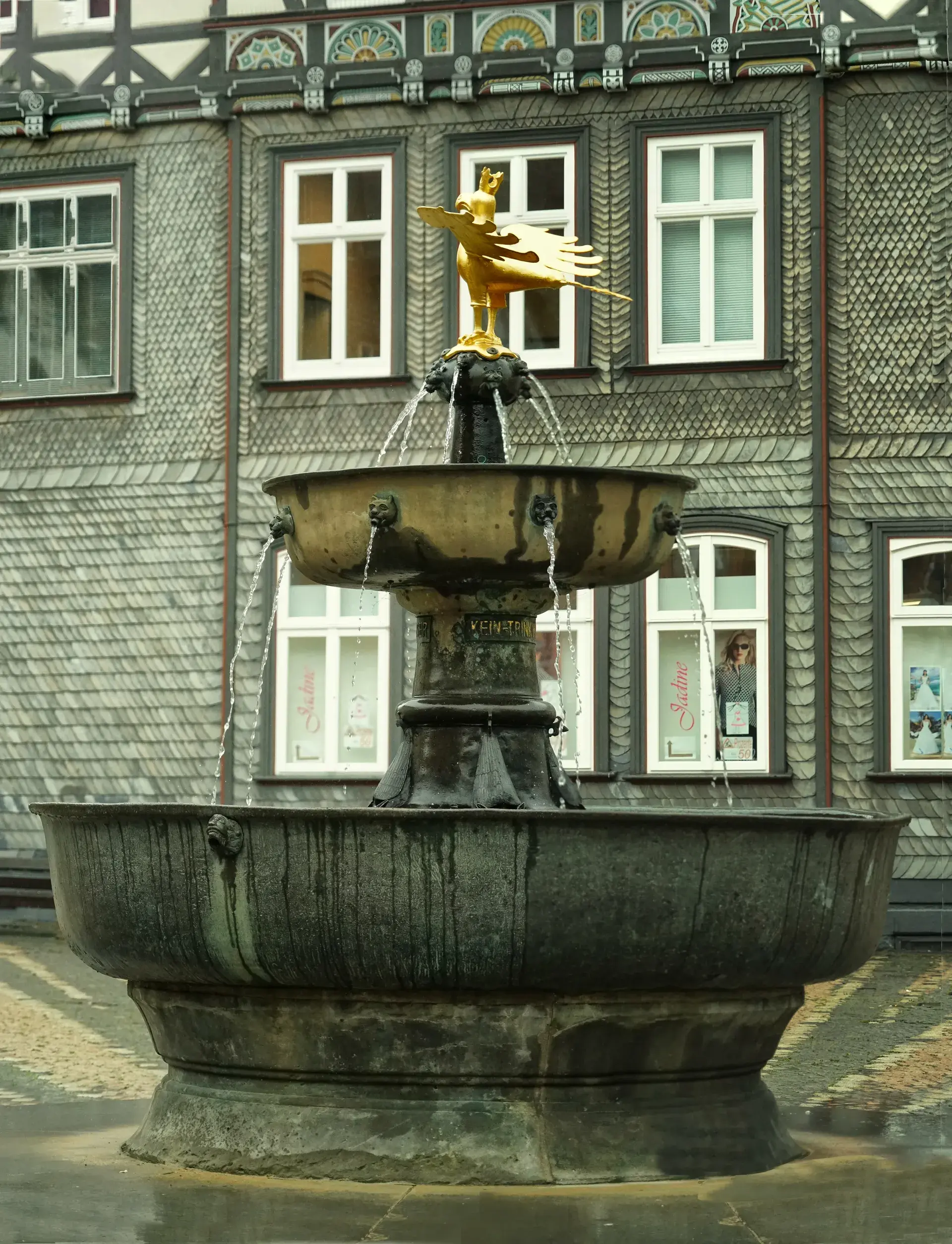
Examine the historic Marktbrunnen fountain right in the center of the square, a key landmark of the city. Measuring approximately four meters in height with a 4.8-meter basin diameter, this two-tiered structure is regarded as the oldest and largest preserved Romanesque bronze market fountain in Germany.
The dark, heavy cast bronze features centuries of weathering and patina, creating a sharp visual contrast with the bright gilded finish of the eagle at the summit. The monumental lower basin dates back to the 12th century and holds the distinction of being the largest single bronze casting of the Romanesque era. This exceptional metallurgical craftsmanship serves as a tangible link to the wealth extracted from the nearby Rammelsberg ore deposits.
Imperial Symbolism and Assembly
Rather than being created in a single phase, the Marktbrunnen was assembled over centuries. The smaller upper basin was created between 1200 and 1230 as an independent fountain before being joined with the 12th-century lower basin on a central column.
The fountain is crowned by a gilded imperial eagle, or Reichsadler, which symbolizes Goslar's medieval status as a Free Imperial City directly subordinate to the Holy Roman Emperor. The eagle's body dates to the early 13th century, while its current crown was added around the 18th century. Today, the gilded eagle perched atop the fountain is a replica, while the original medieval bronze eagle is safely preserved indoors at the Goslar Museum.
Myths, Monsters, and Folklore
The fountain features an array of medieval zoomorphic and grotesque decorations. Notably, it is adorned with four dragon heads sporting donkey-like ears, two of which are sculpted in the act of swallowing small human figures.
The advanced technical skill required to cast the bronze gave rise to local folklore. According to one legend, locals believed human hands could not have crafted the basin alone, claiming the devil brought it from nearby Gittelde. The myth suggests that striking the bowl three times will summon him. Another tradition claims that during times of civic danger, striking the resonant bronze basin produced a chime loud enough to reach the Rammelsberg mines, alerting miners to come defend the city.
The Civic Heart of Goslar
Throughout its history, the fountain occupied various positions on the market square before being moved to its current central location in 1834. Standing opposite the Gothic Town Hall and historic guild houses, it anchors the geographic and civic core of Goslar's UNESCO World Heritage Old Town.
Today, the Marktbrunnen continues to serve as a central landmark, meeting point, and popular photo spot. It also acts as the illuminated centerpiece for major civic events, most notably the annual Goslar Christmas Market.
FAQ
How old is the Marktbrunnen in Goslar?
The fountain was assembled over several centuries. Its monumental lower bronze basin dates to the 12th century, the upper basin was created between 1200 and 1230, and the eagle's body dates to the early 13th century.
Is the eagle on top of the Marktbrunnen the original?
No, the gilded imperial eagle currently standing atop the fountain is a replica. The original medieval bronze eagle is kept indoors at the Goslar Museum.
What do the decorations on the fountain represent?
The fountain features medieval zoomorphic and grotesque figures, including four dragon heads with donkey-like ears. Two of these dragons are depicted swallowing small human figures.
What is the legend of the Devil's Basin?
Local folklore claims the bronze casting was so advanced that people believed the devil brought it from the town of Gittelde, and that striking the bronze bowl three times would summon him.