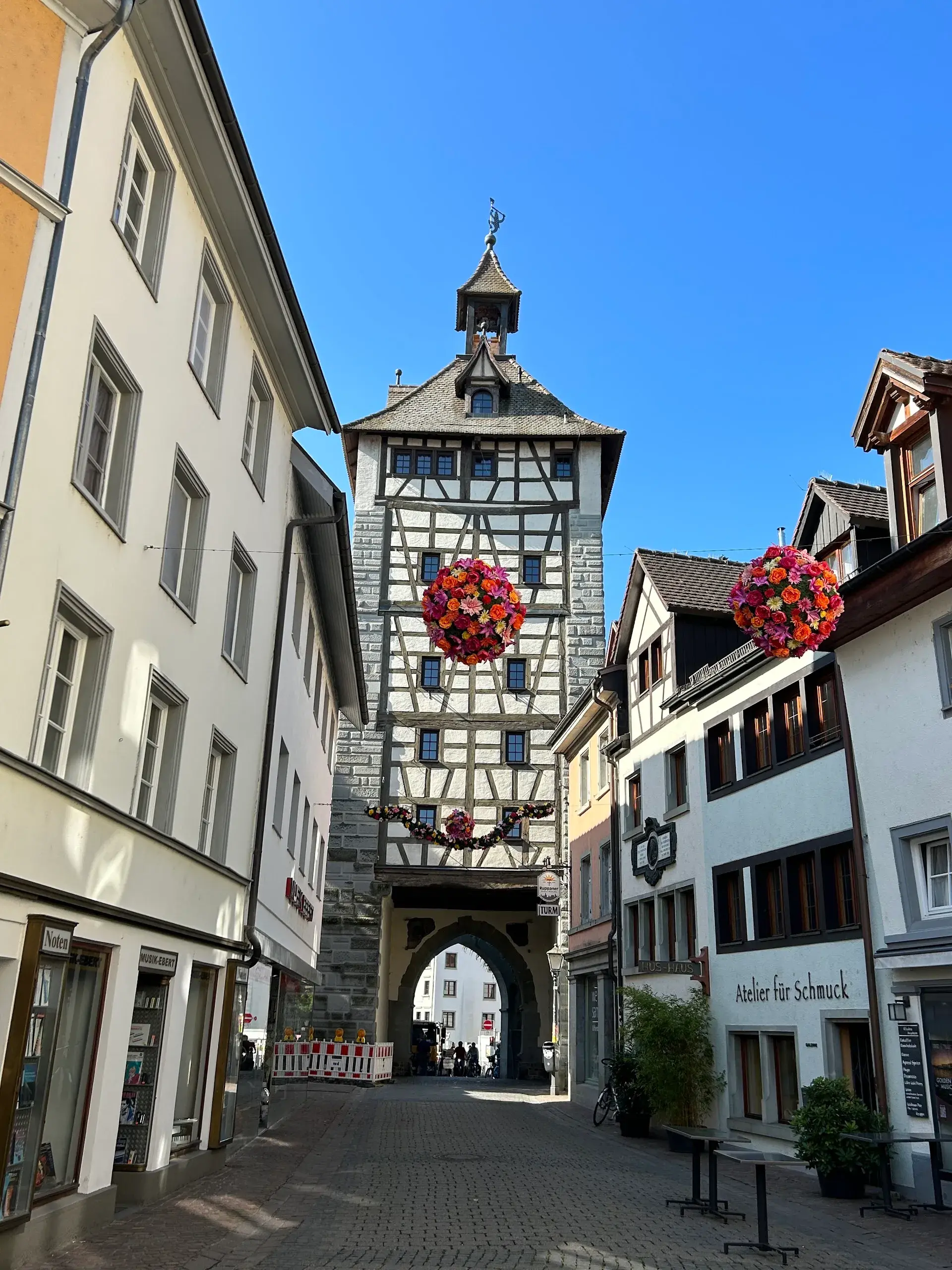
Schnetztor: Konstanz's Historic 14th-Century City Gate
Stand beneath one of Konstanz's last surviving medieval gates, a formidable defensive tower rescued from ruin by local carnival fools. The Schnetztor stands as a monument to the city's medieval past, marking the southern boundary of the historical inner ring wall. Constructed with timbers dendrochronologically dated to the winters of 1325 to 1328, it is one of only three surviving fortified towers from Konstanz's original defenses, alongside the Rheintorturm and Pulverturm.
A Medieval Defensive Stronghold
Built during a 14th-century expansion of the city's fortifications, the Schnetztor secured the vital trade route leading from the Rhine toward Switzerland. Initially functioning as a purely defensive structure, the six-story stone tower later evolved to include an outer bailey and a watchman's apartment. During the 19th century, Konstanz dismantled most of its medieval ring wall, which once featured over twenty towers and gates, to allow for urban expansion. Fortunately, the Schnetztor was spared. While older folklore suggested the gate was named after a local term for small fish, modern historians attribute the name to the medieval Schnetz family.
Architectural Contrasts
The Schnetztor presents a striking visual dichotomy. The outward-facing southern facade, directed toward the Swiss border, consists of heavy, imposing stonework designed to repel invaders. Conversely, the inward-facing northern side overlooks the pedestrianized Hussenstraße with vibrant red-and-white exposed timber framing. The structure is crowned by a pyramidal hip roof and a roof lantern, which houses a 700-kilogram, 14th-century bell. In late 2022, this historic bell broke loose from the belfry but was carefully restored and reinstalled in December 2025.
Saved by Carnival Fools
Despite being declared a monument of national importance in 1978, the tower had spent much of the 20th century degrading into a neglected storehouse and pigeon roost. The structure was ultimately saved by the Konstanzer Blätzlebuebe-Zunft, a traditional Swabian-Alemannic carnival guild. These local volunteers raised seed funds and performed extensive labor to rebuild the interior. Today, the tower serves as the guild's headquarters, opening for seasonal events, private rentals, and guided tours, while the central arched passageway remains an active thoroughfare for pedestrians.
Surrounding Historical Footprints
The area surrounding the Schnetztor is steeped in broader city history. In the adjacent Löwenplatz, the paving stones physically delineate the former footprint of the tower's demolished outer defensive bailey walls. Just steps inside the city gate sits the Hus-Haus. According to local tradition, this building is where the Bohemian reformer Jan Hus lodged in 1414 before his arrest and execution at the Council of Constance.
FAQ
Why is the Schnetztor historically significant?
The Schnetztor is a 14th-century gate tower and one of only three surviving fortified towers from Konstanz's medieval ring wall. It historically marked the southern boundary of the old town and secured the trade route to Switzerland.
What is the building used for today?
Today, the tower serves as the headquarters for the Konstanzer Blätzlebuebe-Zunft, a traditional Swabian-Alemannic carnival guild. The guild restored the interior and uses it for meetings, events, and guided tours.
Where did the name Schnetztor come from?
Modern historians attribute the name to the medieval Schnetz family of Konstanz, disproving old folklore that linked the name to a local term for small fish.
Discover Konstanz like never before
Dive into Konstanz hidden stories and secret spots with Ciceru interactive tours.
Explore tour
Audioguide
Quizzes
Maps
Solo
Couples
Groups & families

© Photo by Michael Weber via Google Maps · Google Places