Mangturm: Lindau’s Medieval First Lighthouse
Lindau’s Medieval Signal Beacon
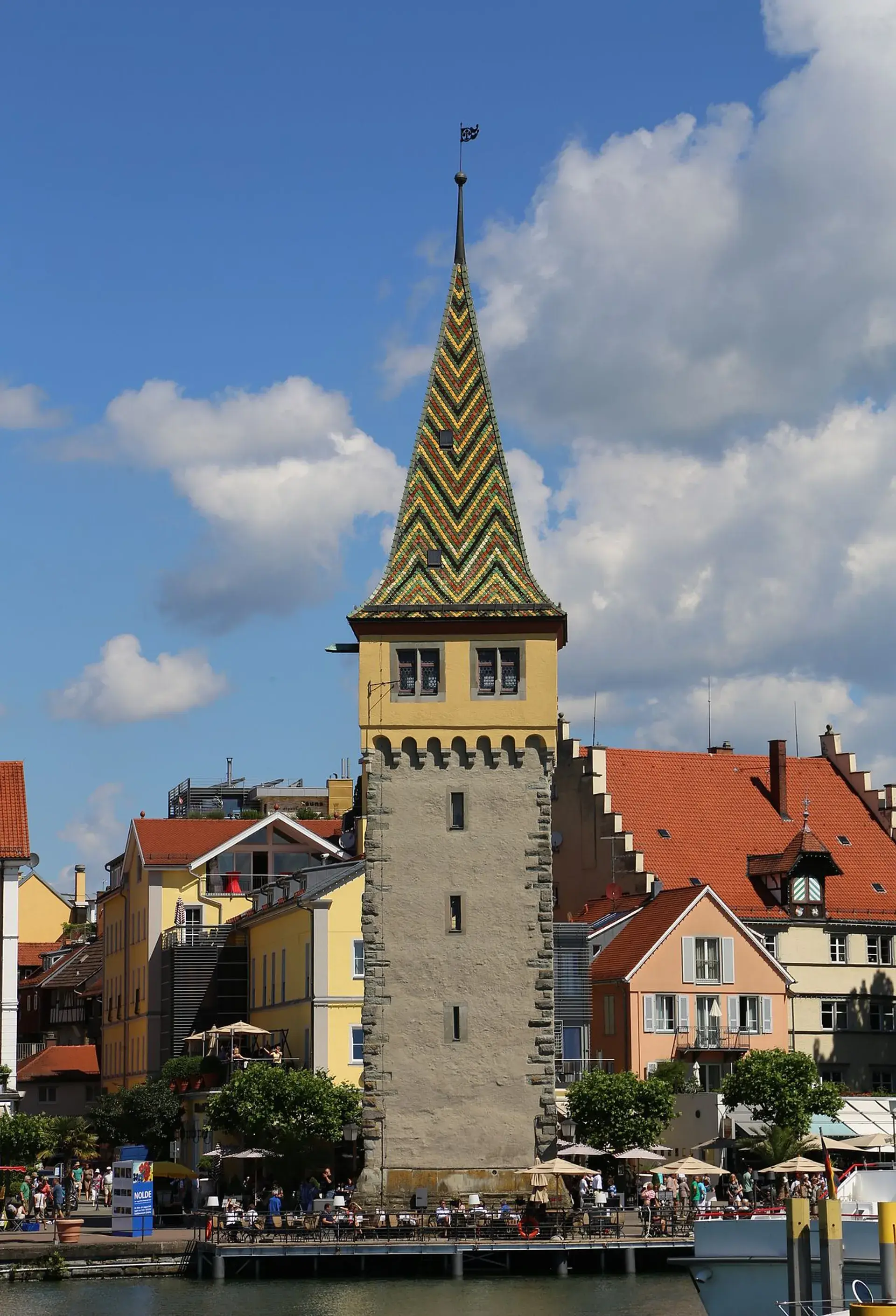
Standing along the harbor promenade (Hafenpromenade) on Lindau Island, the Mangturm is a square medieval stone watchtower that served as the harbor's first lighthouse. Constructed between the late 12th and early 13th centuries—with historical records variously noting dates around 1180, the 12th century, or 1230—the tower formed an essential anchor of the island’s southern defense wall alongside fortified structures such as the Peters- and Diebsturm.
At the time of its construction, the tower did not sit on a paved waterfront promenade. Instead, it was erected as a freestanding stone fortification completely encircled by the waters of Lake Constance. Accessible solely across a wooden drawbridge, the bastion guarded the maritime edge of the Free Imperial City of Lindau. For more than six centuries, it functioned as the port's primary signaling beacon, guiding approaching merchant and transport boats across the lake by hoisting iron fire baskets from exterior poles.
Architecture and 19th-Century Evolution
The Mangturm reflects the physical transformation of Lindau's port. In 1856, the construction of the New Lighthouse (Neuer Leuchtturm) and the Bavarian Lion monument reshaped the harbor entrance, pushing port infrastructure farther outward into the lake. With its maritime navigation duties rendered obsolete, the Mangturm was retired from active signaling service.
Rather than facing demolition, the medieval tower underwent a significant architectural remodel. Builders added an upper level and topped the stone structure with a steeply pitched roof paved in colorful, glossy glazed tiles. Official monument registries record the total height of the tower at 35 to 37 meters, though various travel guides often cite a lower figure of 20 meters. Inside, a tight staircase of 89 to 91 hollow wooden steps leads up through the stone masonry. In 1914, the former tower keeper's quarters were converted into a viewing salon embellished with a painted historical frieze depicting Lindau's transition from an imperial convent town to an integrated Bavarian city.
Name Origins and Local Lore
A carved stone tablet mounted on the tower's facade commemorates its historic role with the German inscription: "Dieser Turm der Mangenturm genannt ward im XII. Jahrhundert erbaut zu Leuchte, Schutz und Trutz unseres Seehafens; ein kräftig Wahrzeichen der ehemaligen freien Reichsstadt Lindau." (This tower called the Mangenturm was built in the 12th century for the light, protection, and defense of our seaport; a mighty landmark of the former Free Imperial City of Lindau).
Despite alternative local folklore associating the structure with Saint Magnus, the name Mangturm stems from a commercial root. It derives from the medieval Tuch- und Mangenhaus (cloth warehouse) that once operated nearby, where weavers and merchants used a mechanical press, known as a Mange, to smooth textiles.
Modern Role and Rapunzel Hours
Operated in partnership with Lindau Tourismus und Kongress GmbH, the Mangturm functions today as a seasonal cultural site and viewing platform. Visitors who climb the wooden steps reach an observation point offering wide panoramas across Lake Constance, the harbor basin, and the surrounding Alps, occasionally serving as an alternate viewpoint during repair work on the New Lighthouse.
The tower also hosts regular cultural readings and storytelling sessions (Märchenstunden). During these fairy-tale hours, an artificial blonde braid is suspended from an upper arrow slit, hanging down against the weathered stone masonry and temporarily styling the medieval military bastion as Lindau's own Rapunzel tower.
FAQ
How was the Mangturm used as a lighthouse?
For over 600 years, the tower signaled approaching boats on Lake Constance by hoisting burning fire baskets from exterior poles, serving as Lindau's main navigational aid until 1856.
Where does the name Mangturm come from?
The name originates from the historic Tuch- und Mangenhaus, a nearby textile warehouse that housed a mechanical cloth-smoothing press called a Mange.
Why is there sometimes a hair braid hanging from the tower?
During scheduled fairy-tale storytelling sessions, staff hang a long artificial blonde braid from an upper arrow slit down the stone facade, staging the tower as a real-world Rapunzel tower.