Marktplatz in Lindau: History, Churches, & Sights
The Architectural Pair: St. Stephan and the Münster
Marktplatz serves as the historical civic and religious counterpart to Lindau Island's maritime harbour district. Located on the eastern side of the island adjoining Stiftsplatz, the square terminates the eastern end of Maximilianstraße and forms an essential anchor along the historic route connecting the island's harbour, the Old Town Hall, and the eastern quarter.
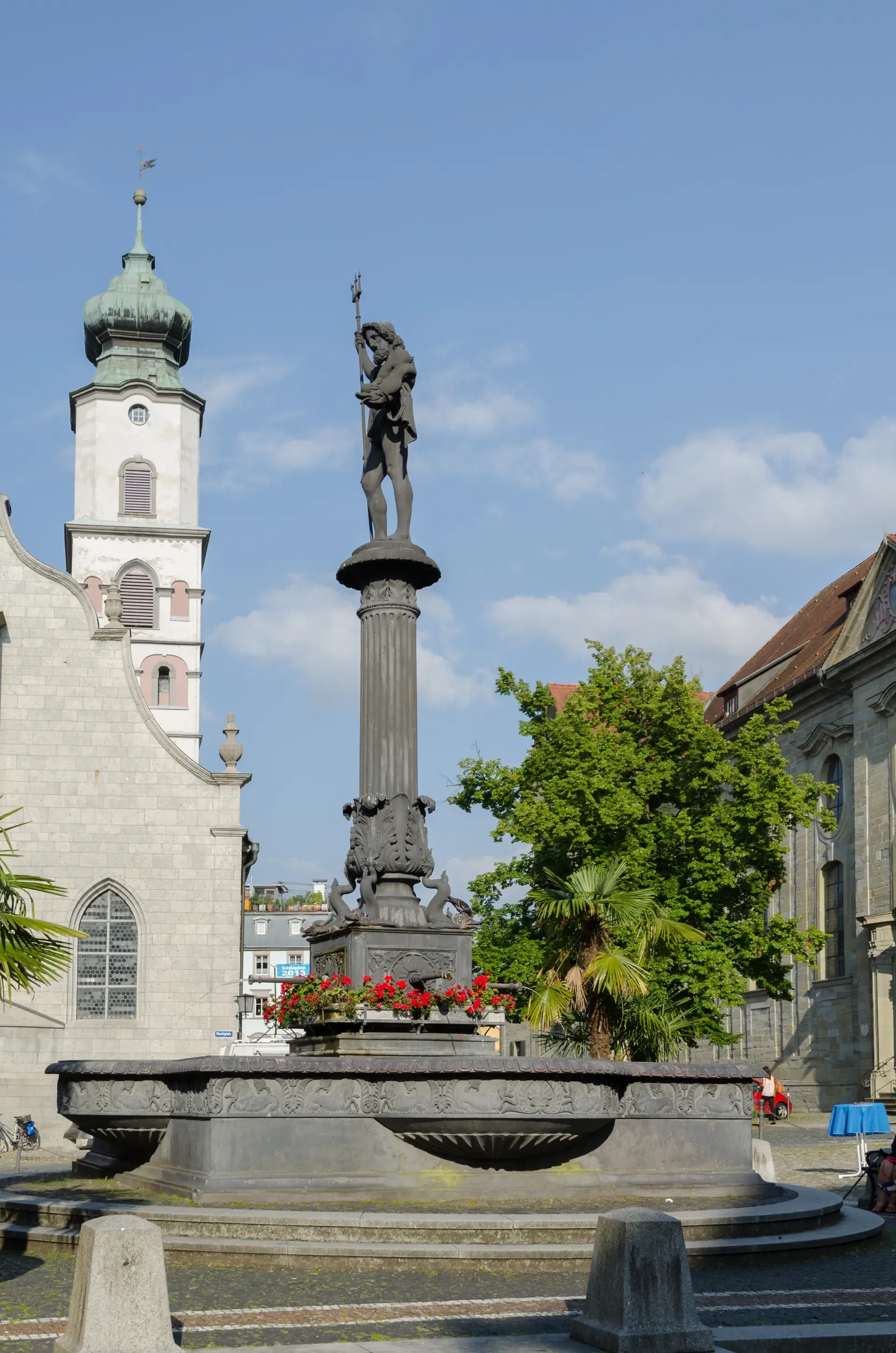
The eastern perimeter of the square is defined by two adjacent church belfries representing centuries of intertwined religious history. The municipal parish church, the Protestant Church of St. Stephan, features a 58-meter tower crowned with a late-baroque onion dome added in 1781. Standing immediately beside it is the Roman Catholic Münster of Our Lady, formerly the convent's collegiate church, which features a square-plan tower topped by a low octagonal cap.
Centuries of Confessional Coexistence
Urban settlement around the square began with the founding of a noblewomen's canoness convent between 810 and 817. In 1079, amid the conflict of the Investiture Controversy, the regional market was transferred from mainland Aeschach to the fortified island for defensive security, establishing the site as an economic hub. Around 1180, local citizens erected St. Stephan directly adjacent to the abbey grounds to serve as their civic parish church.
When the city adopted the Lutheran Reformation in 1528, St. Stephan converted to the Protestant faith. However, the neighbouring convent retained its status and Catholic imperial immediacy. For centuries, Protestant burghers and Catholic canonesses operated their principal places of worship side by side across the same square. This arrangement persisted until the convent was secularized in 1802.
Reconstruction and the 1987 Münster Collapse
A devastating fire swept through the collegiate and market district in 1728, prompting a wave of reconstruction in Baroque and Rococo forms. Master builder Johann Caspar Bagnato rebuilt the Catholic collegiate church between 1748 and 1752, creating an interior defined by pastel and gold stuccowork.
More than two centuries later, this delicate plasterwork suffered a dramatic accident. On the night of September 27–28, 1987, the massive stucco ceiling of the Münster collapsed into the nave. The falling debris crushed rows of wooden pews and damaged the church's 1926 pipe organ. Because evening mass had concluded hours earlier, the nave was empty, and no injuries occurred.
Haus zum Cavazzen and the Neptune Fountain
The western edge of Marktplatz is anchored by the Haus zum Cavazzen, an imposing baroque townhouse erected between 1729 and 1730 by Swiss master builder Jakob Grubenmann. Celebrated for his expertise in bridge design, Grubenmann implemented wooden-truss bridge engineering techniques to build the home's immense curved hipped roof frame without the need for interior support pillars. The building also features expansive facade frescoes. Local tradition attributes the name "Cavazzen" to a sixteenth-century Lombard merchant family named de Kawatz who had previously occupied the site. Today, the building houses the Lindau Municipal Museum, which reopened in May 2025 following a comprehensive six-year structural renovation.
At the center of the square stands the Neptune Fountain, installed around 1840. The fountain consists of a stone basin centered on a column topped with a cast-iron statue of Neptune bearing his trident.
Civic Atmosphere and Modern Use
Today, Marktplatz functions as a pedestrian civic square lined with outdoor café and restaurant seating. The ambient soundscape is characterized by the trickle of water from the Neptune Fountain and the bells of both church belfries echoing against the high baroque rooflines. While the island's primary weekly food market has moved nearby to Therese-von-Bayern-Platz, Marktplatz hosts occasional open-air gatherings, and both St. Stephan and the Münster of Our Lady remain active parish churches that regularly host religious services, recitals, and classical concerts.
FAQ
Why are there two different church towers standing side by side at Marktplatz?
When the city of Lindau embraced the Protestant Reformation in 1528, the municipal church of St. Stephan became Lutheran. However, the adjacent noblewomen's canoness convent retained its Catholic imperial immediacy, leaving two distinct confessions operating churches right next to each other on the square for centuries.
What is unique about the construction of the Haus zum Cavazzen?
Swiss builder Jakob Grubenmann utilized wooden-truss bridge construction techniques when erecting the Haus zum Cavazzen in 1729–1730. This engineering method allowed the building's massive, curved hipped roof to stand completely self-supported without interior pillars.
What happened inside the Catholic Münster in 1987?
On the night of September 27–28, 1987, the church's massive Rococo stucco ceiling collapsed directly onto the nave floor, smashing pews and damaging its 1926 pipe organ. No one was injured, as the evening mass had ended hours before the incident.
Is the weekly market held on Marktplatz today?
Although the square historically hosted the regional market after it moved from mainland Aeschach in 1079, Lindau Island's regular weekly food market now takes place nearby at Therese-von-Bayern-Platz.