Münster Unserer Lieben Frau: Lindau Island
The Baroque Landmark on Marktplatz
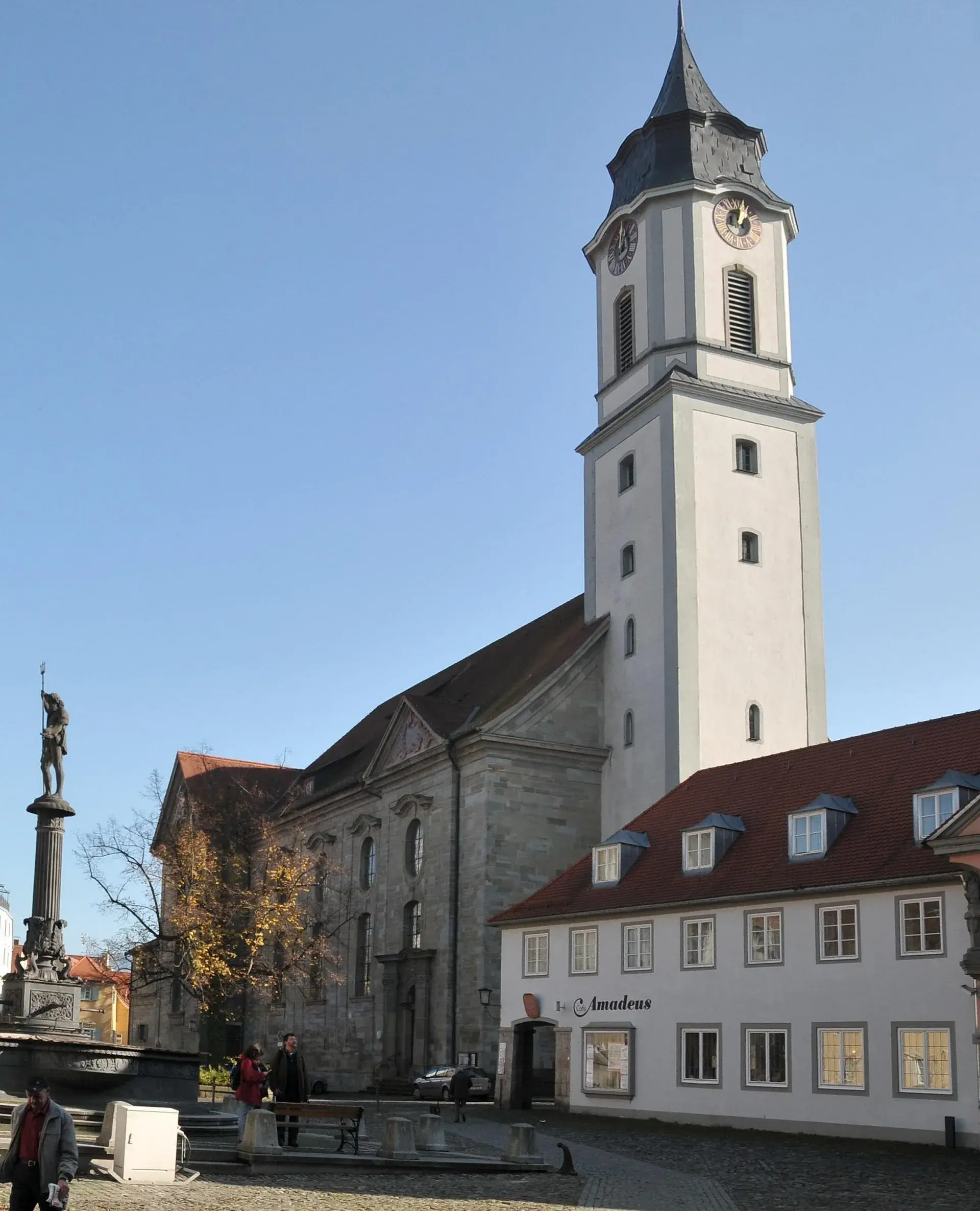
Münster Unserer Lieben Frau, historically known as St. Marien or the Stiftskirche, is the Roman Catholic parish church of Lindau. Located on the eastern side of Lindau Island on Marktplatz, the church stands directly opposite the Protestant church of St. Stephan. Together, these two facing landmarks reflect Lindau's dual confessional history, marking the close coexistence of an imperial Catholic convent and a Reformation-era imperial city parish within the same island footprint.
In 2002, Bishop Viktor Josef Dammertz of Augsburg elevated the church to the formal ecclesiastical status of a Münster. Today, the building serves as an active parish within the Roman Catholic Diocese of Augsburg and remains open daily to visitors outside scheduled service times.
From Medieval Convent to Bagnato's Design
The origins of the site trace back to approximately 810–820, beginning as a Benedictine nunnery. Over time, it developed into an imperial collegiate church (Kanonissenstift) for aristocratic women, maintaining that role for nearly a millennium. The 12th-century Romanesque convent church that once stood here was destroyed during the Lindau island fire of 1728.
Between 1748 and 1752, the master builder Johann Caspar Bagnato constructed the present Baroque hall church over the footprint of the earlier medieval structures. Bagnato's rebuilding was funded largely by dowager Prince-Abbess Therese Wilhelmine von Pollheim-Winkelhausen, whose coat of arms remains above the chancel arch. From Marktplatz, the exterior presents a pale facade and a restrained tower profile. This exterior contrasts with an interior marked by white stuccowork, pastel ceiling paintings, and gilded rococo altarpieces.
Disasters and Twentieth-Century Restorations
The church underwent significant damage and reconstruction twice during the 20th century. In 1922, a major roof fire tore through the attic, destroying the roof framework, the organ, and original 1749 ceiling frescoes painted by Giuseppe Appiani. A subsequent 1920s restoration replaced the lost artwork, featuring ceilings repainted in the Baroque style by Waldemar Kolmsperger the Elder.
Disaster struck again in the early morning hours of September 28, 1987, when the entire nave ceiling and its plaster frescoes detached from the wooden framing and crashed into the nave. The collapse damaged historic furnishings and the church's 1926 Steinmeyer organ. The accident occurred only hours after congregants had cleared the pews following an evening service. After a five-year restoration process, the church reopened in 1992 and was reconsecrated in 1993.
The Belfry and Island Bell Casters
The Münster's bell tower contains a six-part bronze ringing chime tuned to the chord des¹–f¹–g¹–as¹–b¹–des². Four of these ringing bells were cast in 1772 by the Lindau founder Johann Heinrich Ernst, and two supplementary bells were cast in 2000 by Albert Bachert in Heilbronn. The tower also houses two dedicated clock striking bells cast in 1751 by Peter Ernst.
Both Johann Heinrich Ernst and Peter Ernst belonged to the Ernst family, an 18th-century dynasty of gun and bell casters (Stück- und Glockengießer) based directly on Lindau Island. The family supplied bells throughout the Lake Constance and Alpine regions, and several of their instruments continue to ring from the Münster today.
Sacred Music and Organs
In addition to daily worship, Münster Unserer Lieben Frau serves as a venue for choir performances and classical organ recitals. The building houses two working instruments: the restored 1926 Steinmeyer organ situated on the west gallery and the 1993 Marien organ positioned on the side gallery.
FAQ
When was Münster Unserer Lieben Frau built?
The current Baroque hall church was constructed between 1748 and 1752 by master builder Johann Caspar Bagnato, replacing a Romanesque collegiate church destroyed in the 1728 island fire.
What happened to the church ceiling in 1987?
In the early morning of September 28, 1987, the nave ceiling and its plaster frescoes collapsed into the empty interior, damaging the historic 1926 Steinmeyer organ and furnishings before being restored between 1987 and 1992.
Who cast the bells in the tower?
The tower's chime includes four 1772 ringing bells and two 1751 clock bells cast on Lindau Island by the local Ernst family of bell founders, as well as two bells cast in 2000 by Albert Bachert.