Marktplatz Marburg: Historic Square & Rathaus
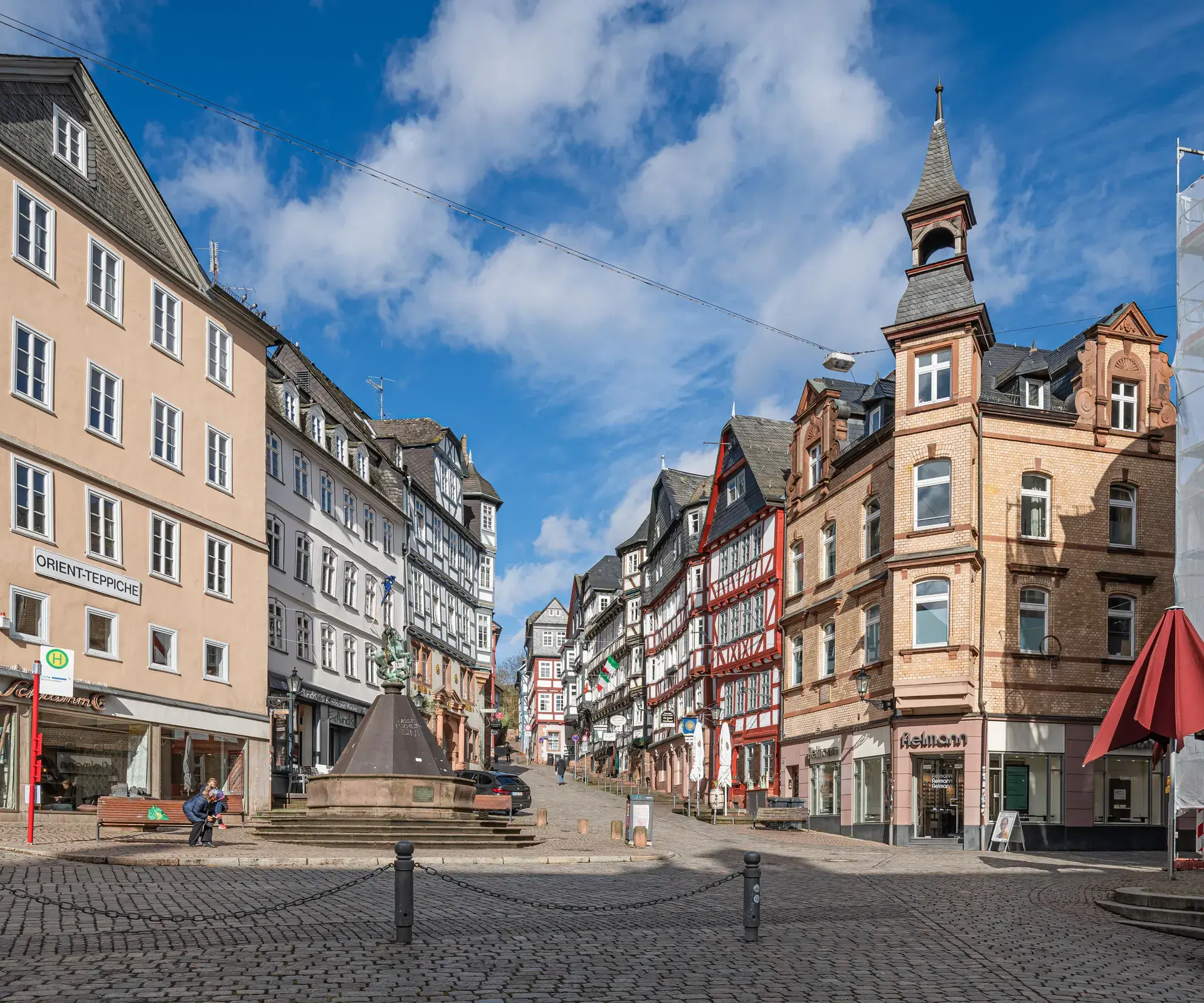
The historic heart of Marktplatz Marburg features charming surrounding architecture and a lively cobblestone square. Situated midway along the classic pedestrian route through the medieval alleys of the Oberstadt, the Marktplatz serves as a crucial link connecting the valley floor and Elisabethkirche below with the Landgrafenschloss above.
The Historic Rathaus
The dominant building on the square is the late-Gothic Rathaus, built between 1512 and 1527 to assert civic pride and local self-governance. Master builders Klaus von Wetzlar and Hans aus Lich supervised its construction. In 1581 and 1582, Renaissance architect Eberhard Baldewein expanded the structure by adding a stepped clock gable and a prominent hexagonal central staircase tower.
Before the Rathaus was completed, the Marburg city council held its meetings in locations such as the Marienkirche, the Teutonic Order's Kerner building, and a former city school. Today, the Rathaus remains an active seat of municipal administration and serves as the office of Marburg's Lord Mayor. The historic council chamber frequently hosts official city receptions, civil weddings, and civic honors.
The Mechanical Clock and Justitia
The Rathaus gable is famous for its intricate clock mechanism, manufactured and installed behind a blue dial in 1889 by the J. F. Weule clock factory. The facade displays a unique cast of moving mechanical figures, including a trumpeter and a figure of Death turning an hourglass.
Every hour on the hour, chiming bells and trumpet notes sound from the tower mechanism as a mechanical rooster flaps its metal wings from the roof pinnacle. Positioned directly beneath the clock is a statue of Justitia (Lady Justice). Unusually, she was sculpted without a blindfold, a detail traditionally interpreted as representing the open-eyed, direct scrutiny and fairness of the Marburg magistracy.
Historic Monuments and Architecture
The Marktplatz is framed by historic half-timbered merchant buildings and the Steinerne Haus, a stone townhouse constructed between 1319 and 1323. The square also features the Marktbrunnen, a fountain crowned by a 1951 sculpture by Rudolf Breidenbach that depicts Saint George slaying a dragon.
Nearby stands a 1989 bronze monument by Ivan Theimer, illustrating Sophie of Brabant holding her infant son. According to local historical tradition, Sophie presented her four-year-old son Heinrich at the Marktplatz in 1248 to be proclaimed Landgrave, marking the foundation of the Landgraviate of Hesse.
A Lively Community Hub
The cobblestone square continues to function as a central gathering space for the city. The Marktplatz provides open-air dining for surrounding cafes and restaurants and hosts annual festivities, including the local Christmas Market. It also maintains its traditional commercial roots by holding regular weekly farmers' markets on Wednesdays and Saturdays.
FAQ
When was the Marburg Rathaus built?
The late-Gothic Rathaus was built between 1512 and 1527 by master builders Klaus von Wetzlar and Hans aus Lich. A Renaissance stepped clock gable and hexagonal tower were later added in 1581 and 1582.
What happens when the Rathaus clock strikes the hour?
Every hour on the hour, a mechanical rooster on the roof pinnacle flaps its metal wings, synchronized with chiming bells and trumpet notes from the clock's tower mechanism.
Why does the Lady Justice figure on the Marburg Rathaus lack a blindfold?
The unblindfolded Justitia beneath the Rathaus clock is interpreted as a representation of the open-eyed, direct scrutiny and fairness of the historic Marburg magistracy.
What events take place at the Marktplatz today?
The square serves as a community gathering space featuring open-air dining, weekly farmers' markets on Wednesdays and Saturdays, and annual celebrations like the Christmas Market.