St. Elizabeth's Church Marburg: Early Gothic Marvel
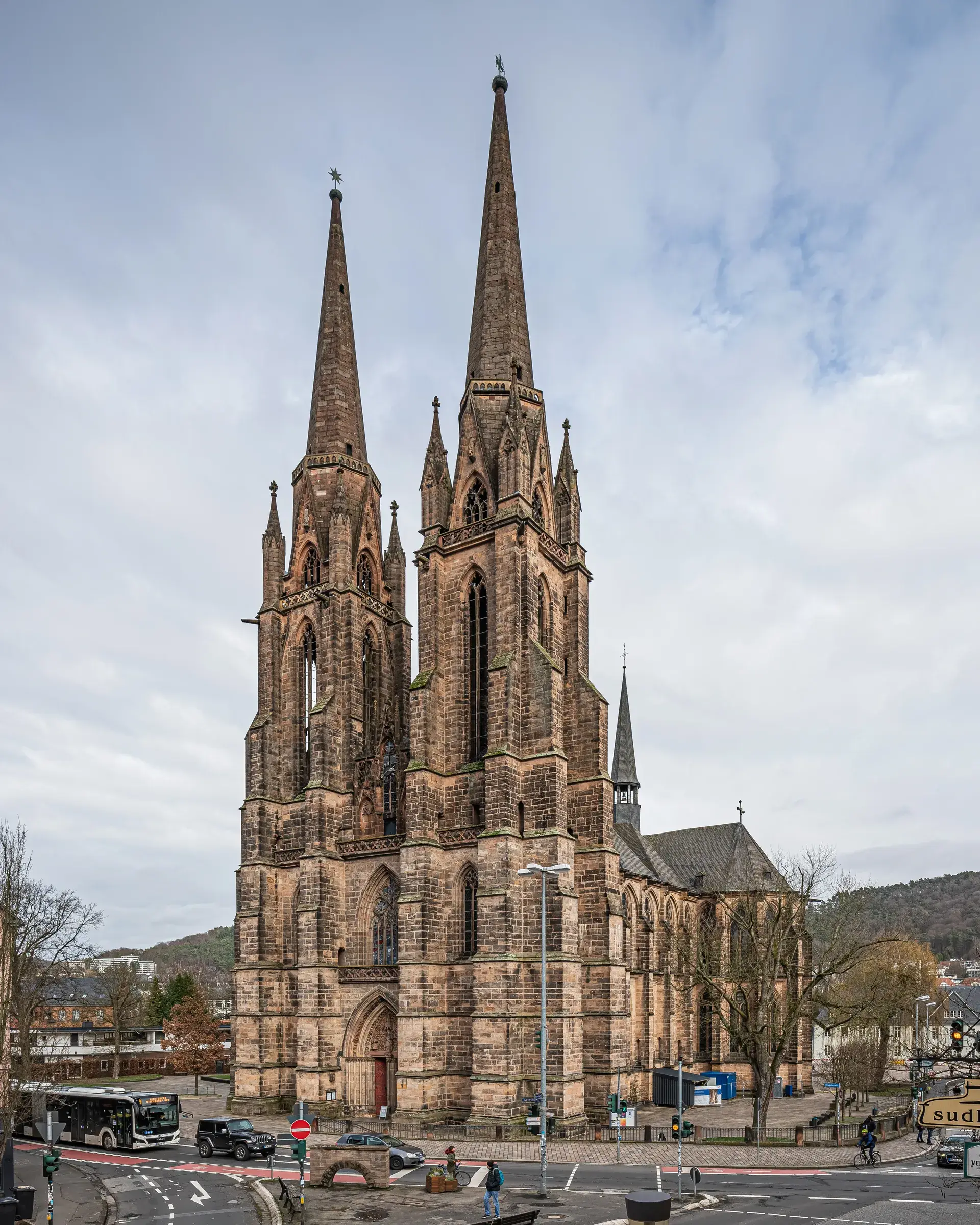
St. Elizabeth's Church is a landmark recognized for its soaring twin spires, intricate Gothic architecture, and centuries of sacred art. Situated on the valley floor near the river Lahn, the church functions as the architectural anchor and natural starting point of the classic Marburg itinerary, which ascends through medieval lanes to the Landgrave Palace.
Architectural Brilliance
Recognized as Germany's oldest Gothic hall church, the building is constructed from local sandstone in a cruciform layout. Construction was initiated by the Teutonic Order in 1235, and the church was consecrated in 1283. The roughly 80-meter-high spires were completed around 1340.
The interior presents an unusually wide and uniform space, created by side aisles that match the central nave's 20-meter height. Daylight filters through high, pointed Gothic lancet windows, illuminating the distinctive triconch (three-lobed) choir arrangement at the east end. Even the exterior hides subtle details; the two western spires feature different crowning symbols, with a star on the north spire and a Teutonic Knight holding a shield on the south.
The Legacy of Saint Elizabeth
Saint Elizabeth (1207–1231) founded a hospital for the poor in Marburg in 1228. Following her canonization in 1235, her brother-in-law Conrad of Thuringia transferred the site to the Teutonic Knights. The order built the church directly over her grave, establishing a major medieval pilgrimage center.
The church's religious focus shifted in 1539 when Landgrave Philip the Magnanimous converted Hesse to Protestantism. To end saint veneration, he ordered Elizabeth's relics removed, shifting the church to Lutheran worship. Today, while the 13th-century golden reliquary remains, Saint Elizabeth's physical bones were dispersed across Europe during the Reformation and subsequent wars.
Treasures and Historical Curiosities
The choir area houses the 13th-century Elisabeth Shrine, which glistens with chased gilded copper, silver filigree, and antique cameos. Another notable artistic feature is an Expressionist bronze crucifix by Ernst Barlach. Installed in 1931, it was removed by the Nazi regime in 1936 as "degenerate art" but was successfully preserved and reinstalled after World War II.
The church also holds surprising 20th-century history. The north tower chapel contains the heavy stone sarcophagi of Weimar Reich President Field Marshal Paul von Hindenburg and his wife. Following an evacuation to a Thuringian salt mine in 1945, advancing U.S. troops discovered the caskets and moved Hindenburg to the church for permanent burial.
A Living Landmark
Operating as an active Evangelical parish church, the building attracts roughly 100,000 visitors annually. The nave is freely accessible to daily sightseers and pilgrims, while a small admission fee is required to view the choir area and the Golden Shrine. Beyond religious services, it serves as a prominent cultural venue for classical music, choral concerts, and university ceremonies.
FAQ
Is there an admission fee to enter St. Elizabeth's Church?
The nave is freely accessible to the public, but a small admission fee is required to view the choir area and the Golden Shrine.
What crowns the top of the two spires?
The western spires feature different symbols: the north spire is topped with a star, while the south spire displays a Teutonic Knight holding a shield.
Where are the relics of Saint Elizabeth?
While the 13th-century golden reliquary remains inside the church, Saint Elizabeth's physical bones were dispersed across Europe during the Reformation and subsequent wars.