Alter Hof: Munich's Medieval Imperial Castle
The First Wittelsbach Residence and Imperial Seat
Located along Burgstraße in Munich's Altstadt, the Alter Hof represents the foundation of dynastic rule in Munich. The settlement originally originated around 1158 as a market outpost on the salt road near an Isar river crossing. Archaeological excavations trace fortified predecessors on the site to the late 12th century, defended by a moat and a 1.8-meter-thick brick wall. In 1255, the First Partition of Bavaria divided the territory between brothers Duke Heinrich XIII and Duke Ludwig II, known as "the Strict." Ludwig II chose Munich as his principal capital, turning the complex—then known as the Alte Veste or Ludwigsburg—into the Wittelsbach dynasty's first permanent seat. This move initiated 738 years of continuous Wittelsbach rule over Bavaria, lasting until 1918.
Under Ludwig II's son, Holy Roman Emperor Ludwig IV ("the Bavarian"), the castle gained continental importance. Between 1314 and 1347, Ludwig IV established the Alter Hof as the late medieval empire's first stationary imperial residence (Kaiserresidenz). During this era, the castle's St. Lorenz Chapel housed the Imperial Regalia until the chapel's eventual demolition in 1816. The imperial period permanently integrated the Holy Roman Empire's black and gold colors into Munich's civic identity.
Intellectual Refuge and Dynastic Relocation
During his rule, Emperor Ludwig IV engaged in a protracted standoff with the Avignon Papacy. Consequently, the Alter Hof became a diplomatic center and an intellectual sanctuary for prominent dissidents. Ludwig IV sheltered thinkers facing papal heresy accusations, including the English Franciscan philosopher William of Ockham and the legal scholar Marsilius of Padua.
As Munich grew during the 14th century, the castle became hemmed in by surrounding municipal developments, leaving the ducal family vulnerable to civic uprisings. Following local revolts, Duke Johann II founded the Neuveste in 1385 along the city's perimeter. Duke Wilhelm IV permanently transferred the court to the Neuveste in the 16th century, reducing the Alter Hof to an administrative and logistical hub. It subsequently housed the tax bureau (Rentamt) and, beginning in 1591, served as the initial production site for Duke Wilhelm V's Hofbräu brewery before operations relocated.
The Surviving Wings and the Affenturm
Only the western sections of the historic complex retain late-medieval fabric, specifically the Zwingerstock and the Burgstock with its gate tower. Passing from the bustling street into the interior courtyard reveals a sudden acoustic contrast provided by the surrounding stone architecture.
Prominently positioned on the Burgstock facade is a Gothic wooden bay window locally known as the Affenturm (Monkey Tower). Munich folklore attributes the name to an incident where a ducal pet monkey reportedly snatched the infant Ludwig the Bavarian from his cradle, carried him onto the roof, and later returned the child unharmed. However, architectural dating indicates that the bay window was constructed around 1480—roughly two centuries after Ludwig's infancy—demonstrating that the legend was attached to the structure long after the event allegedly took place.
Modern Preservation and the Münchner Kaiserburg
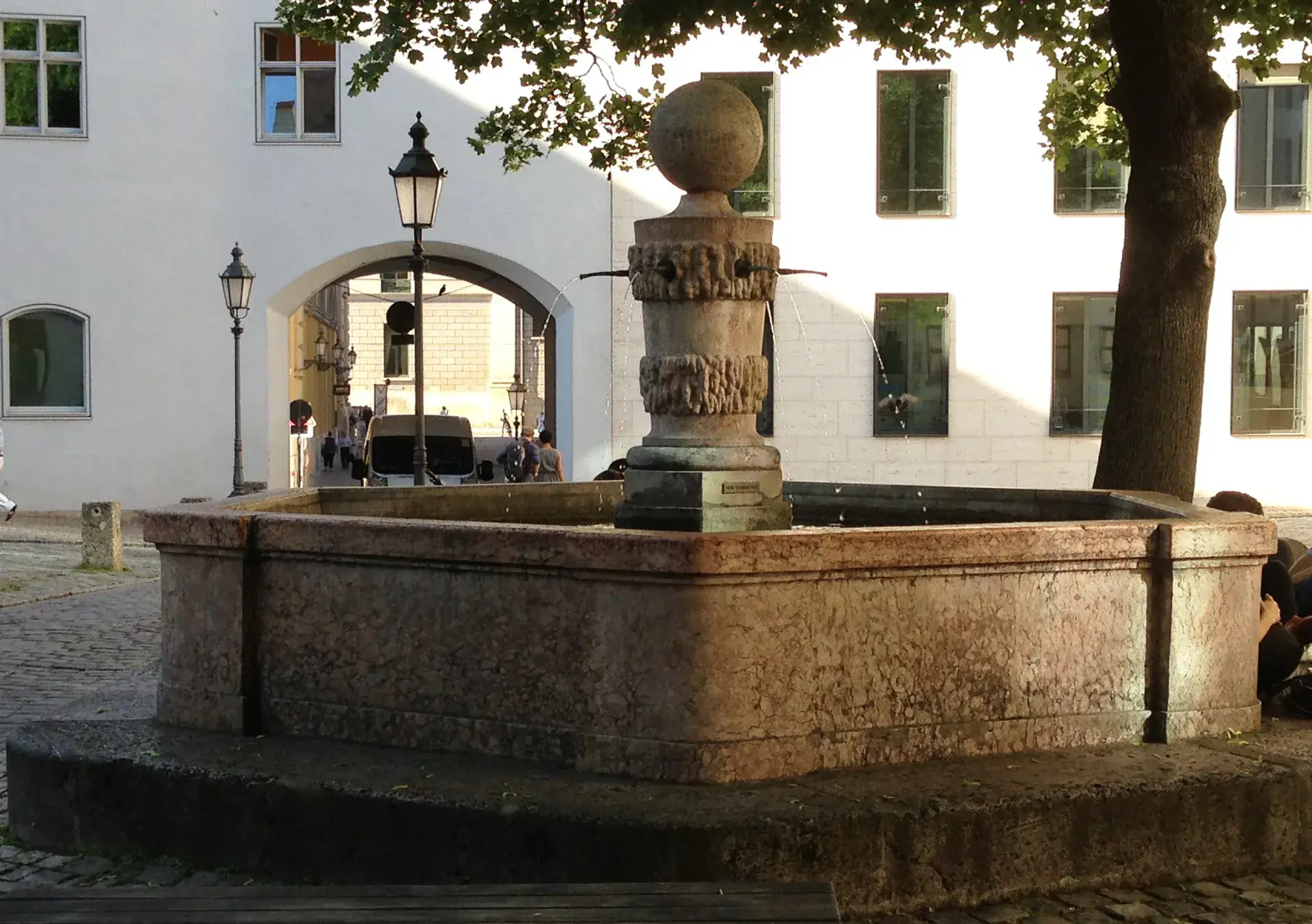
Today, the Alter Hof operates as a mixed-use historic complex. While the Lorenzistock, Pfisterstock, and Brunnenstock wings were reconstructed in the 2000s to accommodate offices, gastronomy, and retail, the cobblestone courtyard remains open to the public and serves as a gathering space with benches, a fountain, and seasonal events.
The Burgstock houses the Infopoint Museen & Schlösser in Bayern, which provides information and advisory services for approximately 1,300 museums and palaces across Bavaria. In the building's cool, vaulted Gothic cellar, visitors can access the free permanent multimedia exhibition "Münchner Kaiserburg." The installation displays early municipal history alongside exposed sections of the original late-medieval castle foundations.
FAQ
What is the legend behind the Affenturm at Alter Hof?
Local folklore claims that a pet monkey belonging to the ducal court snatched baby Ludwig the Bavarian from his cradle, carried him onto the roof, and returned him unharmed. However, architectural evidence shows the Gothic bay window was built around 1480, roughly two centuries after Ludwig's infancy.
Why was the Alter Hof significant to the Holy Roman Empire?
From 1314 to 1347, Emperor Ludwig IV used the Alter Hof as the late medieval empire's first stationary imperial residence (Kaiserresidenz). It also stored the Imperial Regalia in the St. Lorenz Chapel and brought the imperial black and gold colors to Munich's civic identity.
Which philosopher sought sanctuary at the Alter Hof?
The English Franciscan philosopher William of Ockham was sheltered at the Alter Hof by Emperor Ludwig IV after fleeing heresy charges from the Avignon Papacy.
What public attractions exist at the Alter Hof today?
The Burgstock wing features the Infopoint Museen & Schlösser in Bayern and the free "Münchner Kaiserburg" exhibition in its Gothic vaulted cellar, which displays early municipal history and exposed original foundations. The central courtyard also hosts seasonal events.