Rathaus-Glockenspiel: Munich's Iconic Clock
The Rathaus-Glockenspiel and the New Town Hall
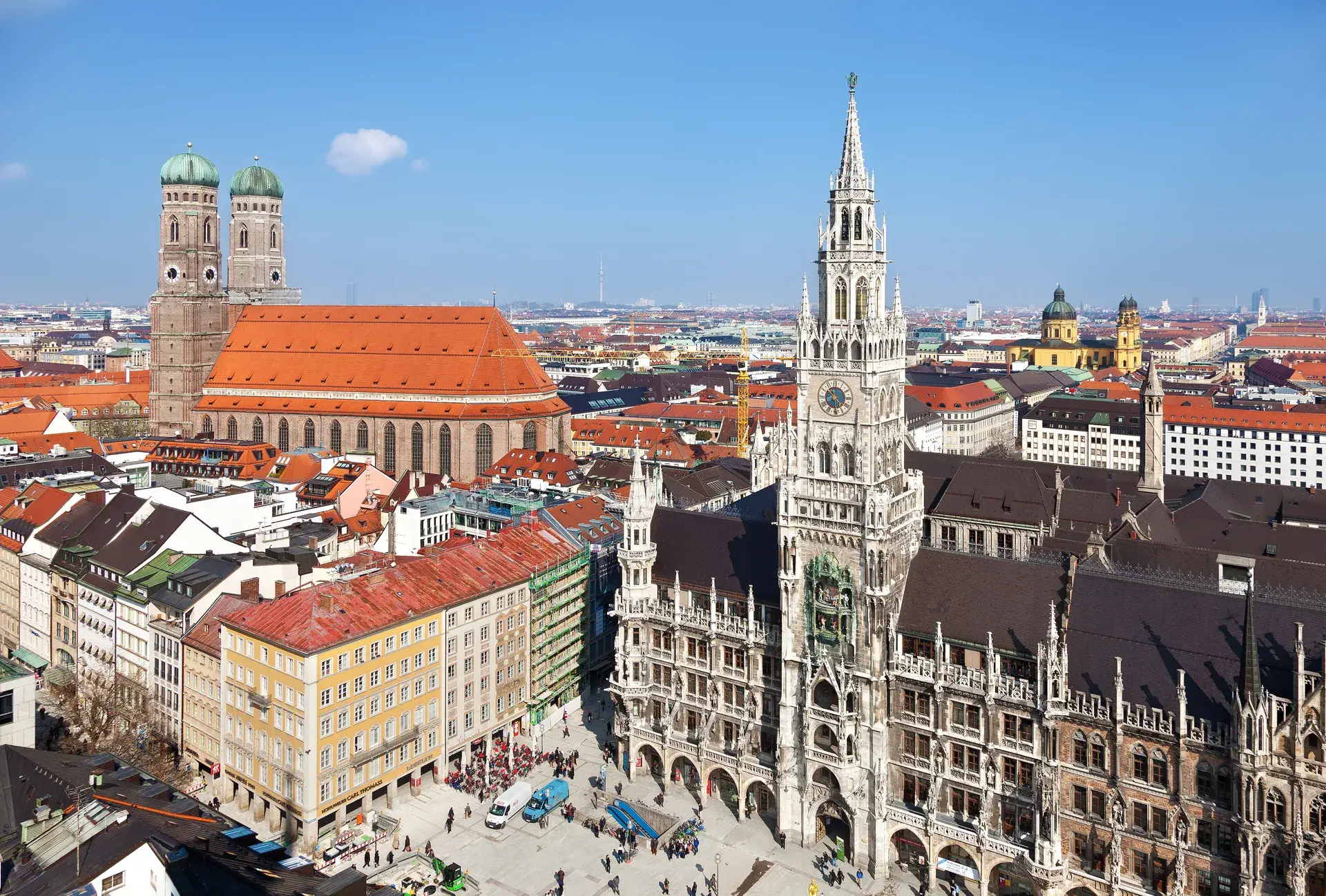
The Rathaus-Glockenspiel is set into the ornate facade of the New Town Hall (Neues Rathaus), which dominates the northern edge of Marienplatz in central Munich. Designed by architect Georg von Hauberrisser in the Neo-Gothic style, the limestone complex was constructed in three phases between 1867 and 1905. Civil authorities cleared existing residential blocks to make way for the expansive building after the nearby medieval Old Town Hall could no longer accommodate the city's expanding administrative needs.
Glockenspiel Performances and Mechanical Chimes
The clock tower attracts gatherings each day for its mechanical Glockenspiel performances, which run daily at 11:00 am and 12:00 pm, with an additional seasonal show at 5:00 pm. The mechanical figures reenact historical events across two tiers.
In addition to the daytime shows, a quieter tradition occurs at roughly 9:00 pm each evening. The clock plays Johannes Brahms' Lullaby and Richard Wagner's Die Meistersinger von Nürnberg while mechanical night watchmen and angel figures appear to escort the Münchner Kindl to bed.
Monastic Origins and the Salt Road Dispute
The site of Marienplatz represents the historical core of Munich's urban development. Munich derives its name from the Middle High German apud Munichen, meaning "by the monks," referring to eighth-century monastic settlements connected to Tegernsee or Schäftlarn Abbeys near Petersbergl. Before the mid-12th century, the area was an unfortified river-crossing point rather than a formal town.
In the 1150s, lucrative alpine salt trade routes from Bad Reichenhall and Berchtesgaden crossed the Isar River at Oberföhring, an outpost controlled by Bishop Otto of Freising. Around 1156, Duke Heinrich the Lion destroyed the bishop's bridge and market to seize the trade tolls. Heinrich diverted the wagons south, erecting a replacement bridge, marketplace, and mint at the monastic settlement. Bishop Otto appealed to Holy Roman Emperor Frederick I Barbarossa, who resolved the conflict at the Diet of Augsburg on June 14, 1158. In the resulting Augsburger Schied, Barbarossa upheld Heinrich’s market and mint rights, but mandated that one-third of all mint and toll revenues be paid to the Bishopric of Freising in perpetuity. The market, initially known as Schrannenplatz, later evolved into Marienplatz.
Tower Iconography and Architectural Detail
Rising 85 metres above the square, the central limestone tower is crowned by the Münchner Kindl (Munich Child). The emblem traces back to the monk depicted on the city's medieval coat of arms. The bronze statue atop the spire wears flowing monastic robes and holds a Gospel book. When the statue was cast for the tower's completion in 1905, sculptor Anton Schmid used his nine-year-old son, Ludwig Schmid-Wildy, as the model. Schmid-Wildy later became a well-known Munich comedian and folk actor.
The facade beneath the tower features detailed stone carvings and life-size statues commemorating key leaders from Bavarian history. These include Munich's founder, Duke Heinrich the Lion, as well as rulers from the Wittelsbach dynasty. Although Heinrich is immortalized on the building's front, Barbarossa deposed him in 1180 and transferred rule over Bavaria to Otto I of Wittelsbach.
Current Civic Role
The Neues Rathaus remains the active seat of local government, housing the Munich City Council (Stadtrat), the Lord Mayor (Oberbürgermeister), and two deputy mayors. Beyond governance, the building contains the municipal Law Library (Juristische Bibliothek) and the historic Ratskeller restaurant set within its vaulted basement, while an elevator provides access to the tower observation deck.
FAQ
What times does the Rathaus-Glockenspiel run?
The Glockenspiel chimes daily at 11:00 am and 12:00 pm, with an additional seasonal performance at 5:00 pm. A night watchman routine also occurs nightly around 9:00 pm.
What is the statue at the top of the tower?
The top of the 85-metre tower features the Münchner Kindl (Munich Child), a bronze figure based on the monk from Munich's medieval coat of arms. The 1905 statue was modeled on nine-year-old Ludwig Schmid-Wildy, who later became a Munich folk actor and comedian.
What is the New Town Hall used for today?
The Neues Rathaus is the working headquarters of Munich's city administration, housing the City Council, the Lord Mayor, and two deputy mayors. It also features the municipal Law Library, the Ratskeller restaurant in the basement, and a public tower observation deck.