St. Michael's Church Munich: History & Architecture
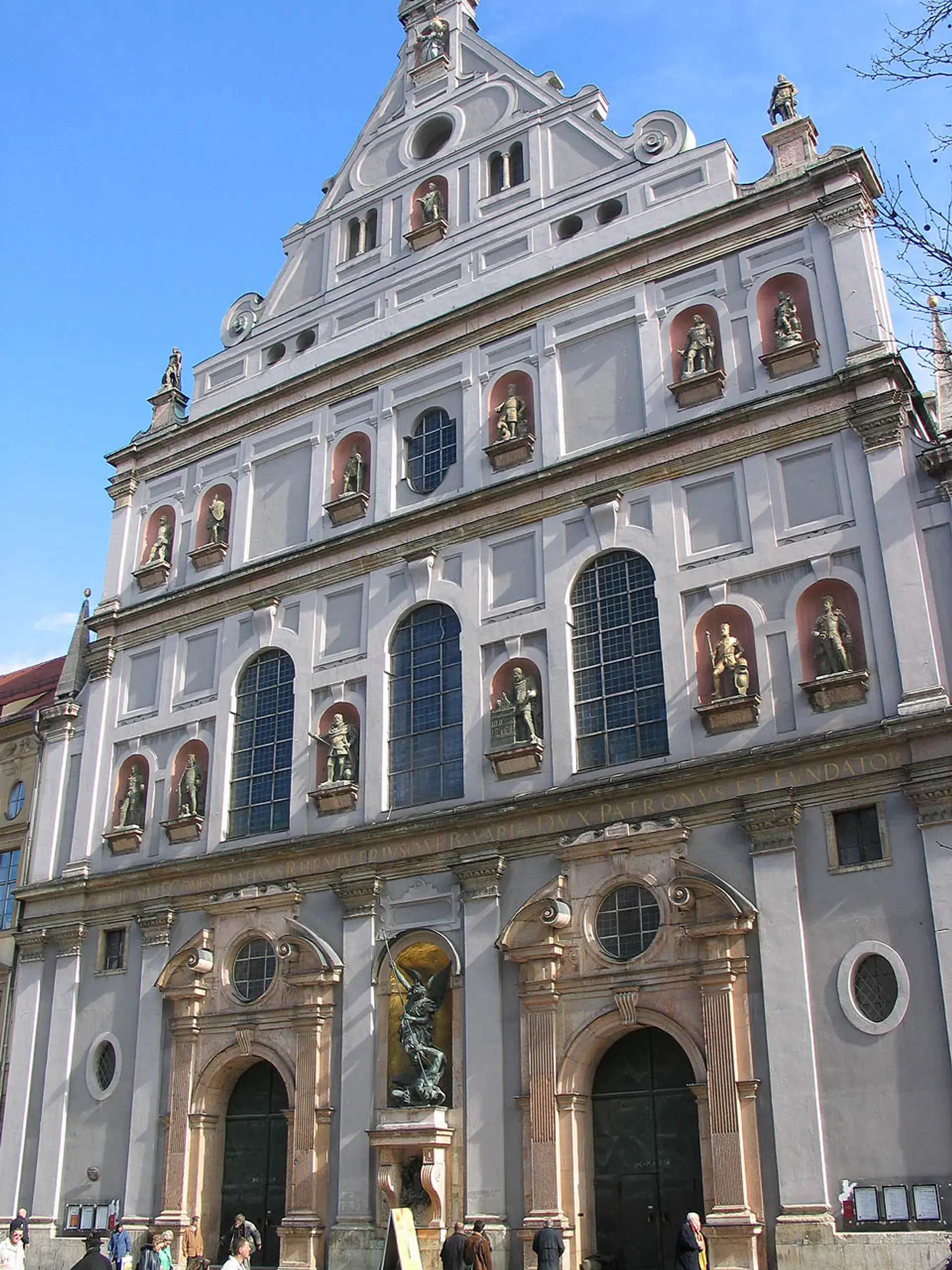
St. Michael's Church (Jesuitenkirche St. Michael) in Munich stands as one of the most significant monuments of the Counter-Reformation in Central Europe. Commissioned by Duke William V of Bavaria for the Society of Jesus, the structure was envisioned as an architectural declaration of Catholic resolve. Consecrated on July 6, 1597, the church broke with traditional medieval town planning by aligning a monumental, palace-style façade directly with the Neuhauser Straße thoroughfare.
Renaissance Architecture and the Great Barrel Vault
Designed under the direction of court artist Friedrich Sustris and architect Wendel Dietrich, St. Michael is modeled partly after the Church of the Gesù in Rome. Measuring approximately 78.2 meters in length, 20.3 meters in width, and 28.2 meters in height, the building ranks among the largest Renaissance churches north of the Alps.
The church's most notable structural feat is its continuous, column-free barrel vault. Spanning more than 20 meters without interior support columns, it was recognized at the time of its completion as the second-largest unsupported vault in the world, surpassed only by St. Peter's Basilica in Rome. High clerestory windows illuminate the white stucco interior, creating an acoustic hush that contrasts with the exterior city center.
The exterior presents a three-tiered street façade adorned with 15 statues representing Wittelsbach and Bavarian rulers who defended the Catholic faith. Between the two main entrance portals stands a bronze sculpture of the Archangel Michael, cast in 1588 by Hubert Gerhard, depicting the archangel defeating a demonic figure.
Counter-Reformation Origins and the 1590 Collapse
The construction of St. Michael formed the centerpiece of Duke William V’s religious policy, building upon Duke Albrecht V's 1556 invitation to the Jesuits. To secure sufficient space along Neuhauser Straße for the church and accompanying college, the Bavarian state demolished 87 burgher houses despite intense local opposition.
Groundbreaking took place in 1583, followed by the laying of the foundation stone in 1585. In 1590, the church's newly completed tower collapsed, crushing the original choir. Rather than scaling back the design, William V interpreted the disaster as a mandate to expand. He directed Friedrich Sustris to incorporate an expansive transept, an enlarged choir, and the monumental front seen today. The staggering financial costs of the building campaign depleted the ducal treasury, directly contributing to William V's abdication in 1597 in favor of his son, Maximilian I, who would later lead the Catholic League in the Thirty Years' War.
The Wittelsbach Crypt
Beneath the choir lies the Wittelsbach Crypt, an important royal burial site open to visitors for an admission fee. The vault holds the remains of numerous Bavarian rulers, including Duke William V, Elector Maximilian I, and King Ludwig II of Bavaria.
King Ludwig II is interred in a massive dark zinc sarcophagus that regularly receives floral tributes from visitors. In keeping with Wittelsbach dynastic tradition, both Ludwig II and Duke William V were buried here without their hearts, which were removed and preserved in silver urns at the Shrine of Our Lady of Altötting.
Active Worship and Choral Tradition
St. Michael remains an active Roman Catholic church and spiritual center administered by the Jesuit order. In addition to daily religious services, confessions, and pastoral care, the church functions as a prominent cultural venue, regularly hosting classical and liturgical choral and organ concerts that take advantage of the nave's expansive acoustics.
FAQ
When was St. Michael's Church built?
Groundbreaking took place in 1583, the foundation stone was laid in 1585, and the church was formally consecrated on July 6, 1597.
Why is the barrel vault of St. Michael notable?
The unsupported barrel vault spans over 20 meters without interior columns, making it the second-largest vault in the world at the time of its completion after St. Peter's Basilica.
Who is buried in the Wittelsbach Crypt at St. Michael's?
The crypt contains the tombs of key Bavarian rulers, including church founder Duke William V, Elector Maximilian I, and King Ludwig II.
Why was the church named after Archangel Michael?
Duke William V selected Archangel Michael as the patron saint partly because the duke was born on Michaelmas, celebrated on September 29.