Hofbräuhaus Munich: History of the Duke's Wheat Beer
The Origins of the Ducal Brewery
In 1589, Duke Wilhelm V established a court brewery at the Alter Hof in Munich. At the time, the ducal court faced high expenses importing beer from Einbeck in Lower Saxony, while local Munich brews suffered from low quality. Wilhelm's initial facility focused entirely on producing dark brown beer to meet the demands of the court.
The Wheat Beer Monopoly and the 1607 Expansion
Under the 1516 Bavarian Beer Purity Law (Reinheitsgebot), brewing with wheat was prohibited to protect bread grain reserves from shortages. The only exception was an exclusive privilege granted to the counts of Degenberg. When the Degenberg male line died out in 1602, Wilhelm's son and successor, Duke Maximilian I, claimed the brewing right for the ruling Wittelsbach dynasty.
Maximilian recognized the surging popularity of wheat beer (Weißbier) as an opportunity to address heavy state debts. As wheat beer production quickly exceeded the capacity of the Alter Hof, Maximilian commissioned the construction of a dedicated wheat beer brewery, the Weißes Hofbräuhaus, at the Platzl in 1607. The Alter Hof facility continued to brew brown beer alongside it for nearly two centuries.
Financing the State and the Thirty Years' War
In 1610, Maximilian expanded the commercial reach of the brewery by permitting private Munich innkeepers to purchase ducal beer and serve it to townspeople. The ducal monopoly on wheat beer, combined with centralized alcohol taxation, became an essential financial pillar for Bavaria. In the 17th century, revenue from the trade accounted for between 30% and 50% of the state treasury's total income.
This capital directly funded Maximilian's Catholic League forces during the Thirty Years' War. The brewery also entered civic folklore during the conflict. When Swedish forces under King Gustavus Adolphus occupied Munich in May 1632, the city avoided destruction—an outcome local tradition attributes to a payment of tribute accompanied by 1,000 buckets or barrels of court beer.
Brewing Traditions and the Fire of 1823
Brewing developments at the Hofbräuhaus shaped Bavarian beer styles. In 1612, Maximilian brought brewmaster Elias Pichler from Einbeck to recreate strong northern-style beer in Munich. Over time, the local dialect adapted the name Ainpöckisch into Oanbock, giving rise to the Munich Maibock style.
Beer also played a unique role in public emergencies. In January 1823, Munich's National Theatre caught fire during sub-zero temperatures that had frozen the city's water reservoirs solid. Firefighters rolled out barrels of beer from the nearby Hofbräuhaus to battle the flames. Although the theatre suffered heavy damage, its reconstruction was funded by an emergency tax levied on every mug of Hofbräu beer sold.
Architectural Evolution and Modern Operations
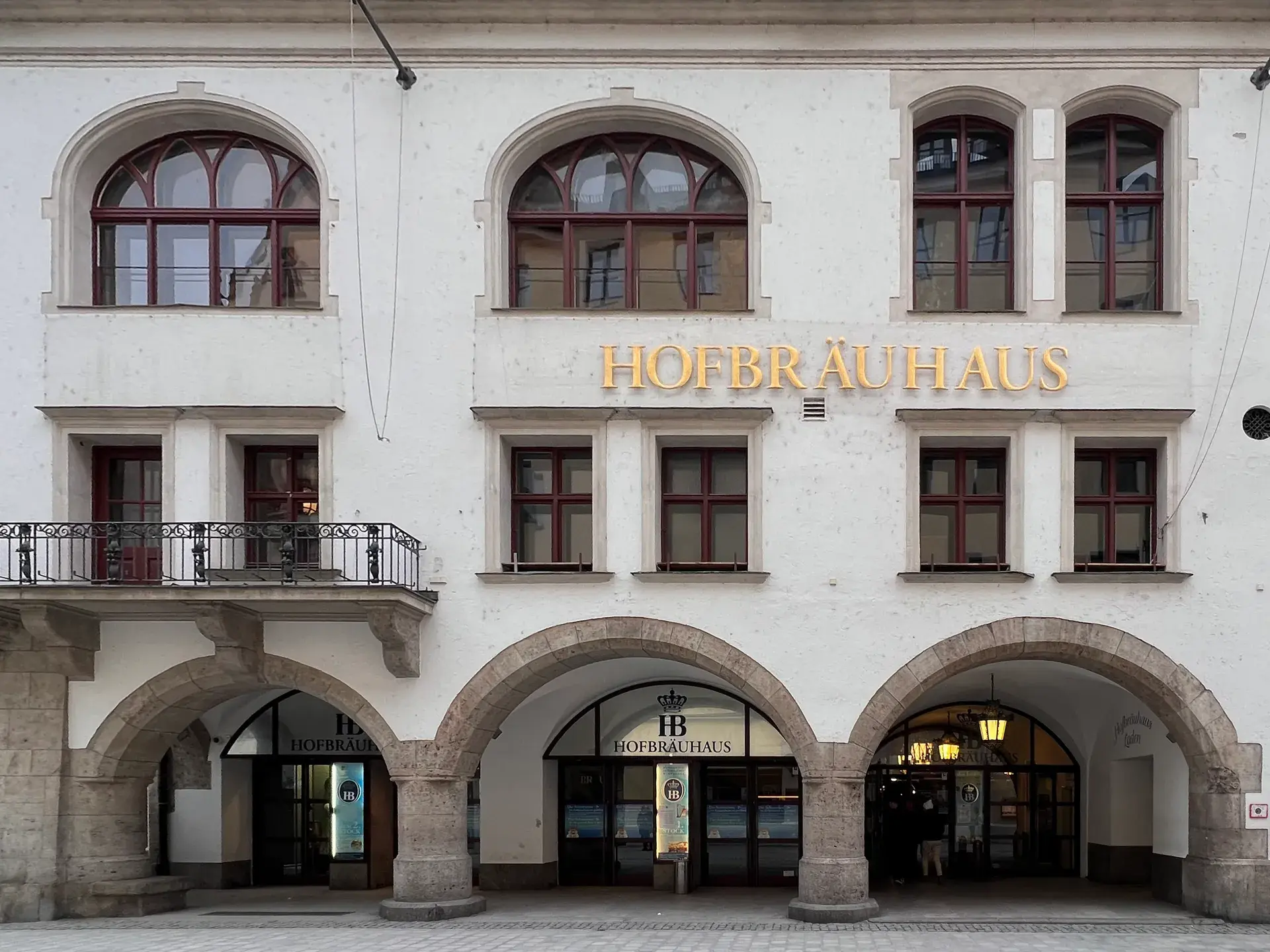
King Ludwig I officially opened the tavern to the public in 1828. By the late 19th century, commercial brewing operations required more space, leading to their relocation to the Haidhausen district in the 1890s. Between 1896 and 1897, architect Max Littmann redesigned the Platzl site into a Neo-Renaissance beer palace. Following extensive damage during World War II, the historic ground floor was preserved, and the complex was fully restored by 1958.
Today, the Hofbräuhaus am Platzl operates as a restaurant and tavern owned by the Free State of Bavaria (Staatliches Hofbräuhaus in München). Inside the ground-floor Schwemme, thousands of guests sit beneath painted vaulted ceilings among the sound of brass instruments and communal wooden tables. Long-standing patrons maintain established traditions, including storing personal steins in locked on-site safes (Maßkrugtresor) and using bulk-purchased metal beer tokens (Bierzeiterl) at regular tables (Stammtische).
FAQ
Why was wheat beer originally restricted under Bavarian brewing law?
The 1516 Bavarian Beer Purity Law banned wheat in brewing to safeguard grain supplies for bread baking. An exclusive exemption was held only by the counts of Degenberg until Duke Maximilian I claimed it for the state in 1602.
How did the Hofbräuhaus help fund the Thirty Years' War?
Duke Maximilian I's state wheat beer monopoly and beer sales to public innkeepers generated 30% to 50% of the Bavarian state treasury's revenue, which was used to fund the Catholic League military forces.
What is the Maßkrugtresor at the Hofbräuhaus?
The Maßkrugtresor is a set of locked safes inside the beer hall where regular patrons store their personal glass and stoneware one-liter beer steins.