Mariensäule: Munich’s Historic Marian Column
Origins of the Mariensäule
The Mariensäule stands at the center of Marienplatz in Munich, rising 11 meters above the stone-paved square. The monument owes its existence to the events of the Thirty Years' War. In 1632, Swedish forces led by King Gustav II Adolf captured and occupied Munich. Fearing the widespread destruction that cities like Magdeburg had suffered, Elector Maximilian I of Bavaria vowed to perform a pious work if the ducal residential cities of Munich and Landshut were spared.
Although Swedish commanders argued for the city's destruction, Gustav Adolf spared Munich in exchange for a substantial financial tribute—an outcome contemporary residents referred to as the "Miracle of Munich." To fulfill his vow, Maximilian I commissioned the column, which was consecrated on November 7, 1638, by Prince-Bishop Veit Adam von Gepeckh of Freising. The consecration was deliberately held on the eve of the anniversary of the Catholic League's decisive 1620 victory at the Battle of White Mountain.
Modeled on the 1614 column outside the Basilica of Santa Maria Maggiore in Rome, the Mariensäule was the first freestanding Marian column erected north of the Alps. It subsequently served as an architectural prototype for similar monuments across Central Europe, including those in Vienna and Prague.
Design and Symbolism
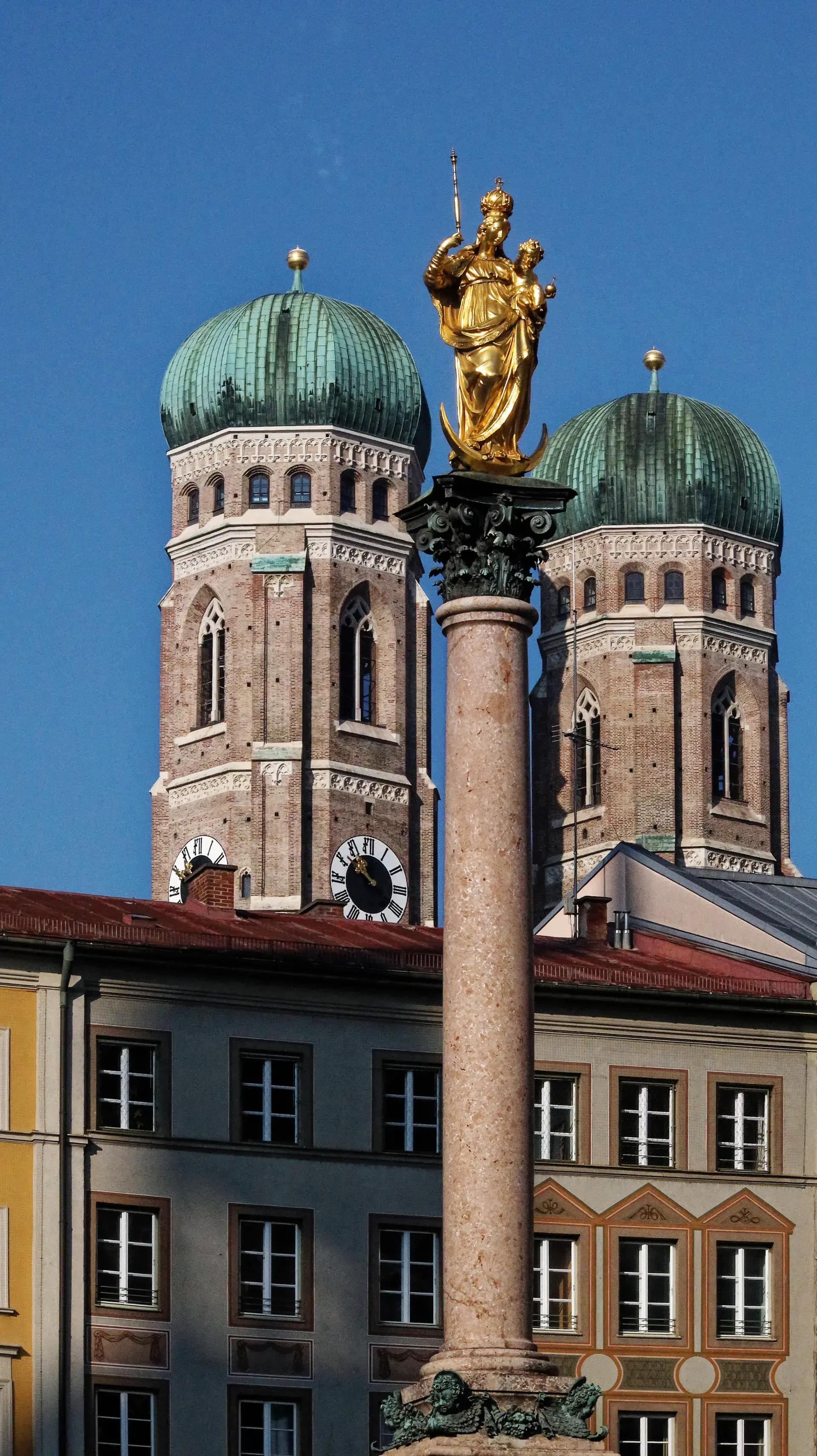
At the top of the column stands a gilded bronze statue of Mary as Patrona Bavariae (Patroness of Bavaria). Depicted standing on a crescent moon, Mary holds a scepter and wears a crown while the Christ Child holds an imperial orb. The statue predates the column itself; sculpted around 1590–1593 and widely attributed to Hubert Gerhard, it originally stood on the high altar of Munich's Frauenkirche.
In 1641, four bronze figures of armored putti were added to the corners of the stone pedestal. Cast by Munich court founder Bernhard Ernst and attributed to sculptor Ferdinand Murmann, the figures engage in dramatic combat with four beasts representing the scourges of the era: war (a lion), pestilence (a basilisk), famine (a dragon), and heresy (a serpent). The putti hold shields inscribed with a passage from Psalm 91:13: "Super aspidem et basiliscum ambulabis et leonem et draconem conculcabis" ("Thou shalt tread upon the adder and basilisk; the lion and the dragon shalt thou trample under foot"). The putti displayed on the square today are late-20th-century copies; the 1641 originals are preserved in the Münchner Stadtmuseum.
Civic Authority and the Naming of Marienplatz
The site chosen for the monument carried deep political significance. When the column was built in 1638, the square was known as Schrannenplatz, functioning as the city's civic grain market. In 1315, Holy Roman Emperor Ludwig the Bavarian had granted this ground to Munich's burghers as perpetual civic property. By unilaterally erecting a ducal monument in the center of the communal market, Maximilian I asserted sovereign Wittelsbach authority over the municipal city council.
The square retained the name Schrannenplatz for more than two centuries after the column's installation. It was officially renamed Marienplatz on October 9, 1854, in an appeal for the Virgin Mary's intercession during a severe cholera epidemic.
The Geographic and Civic Landmark
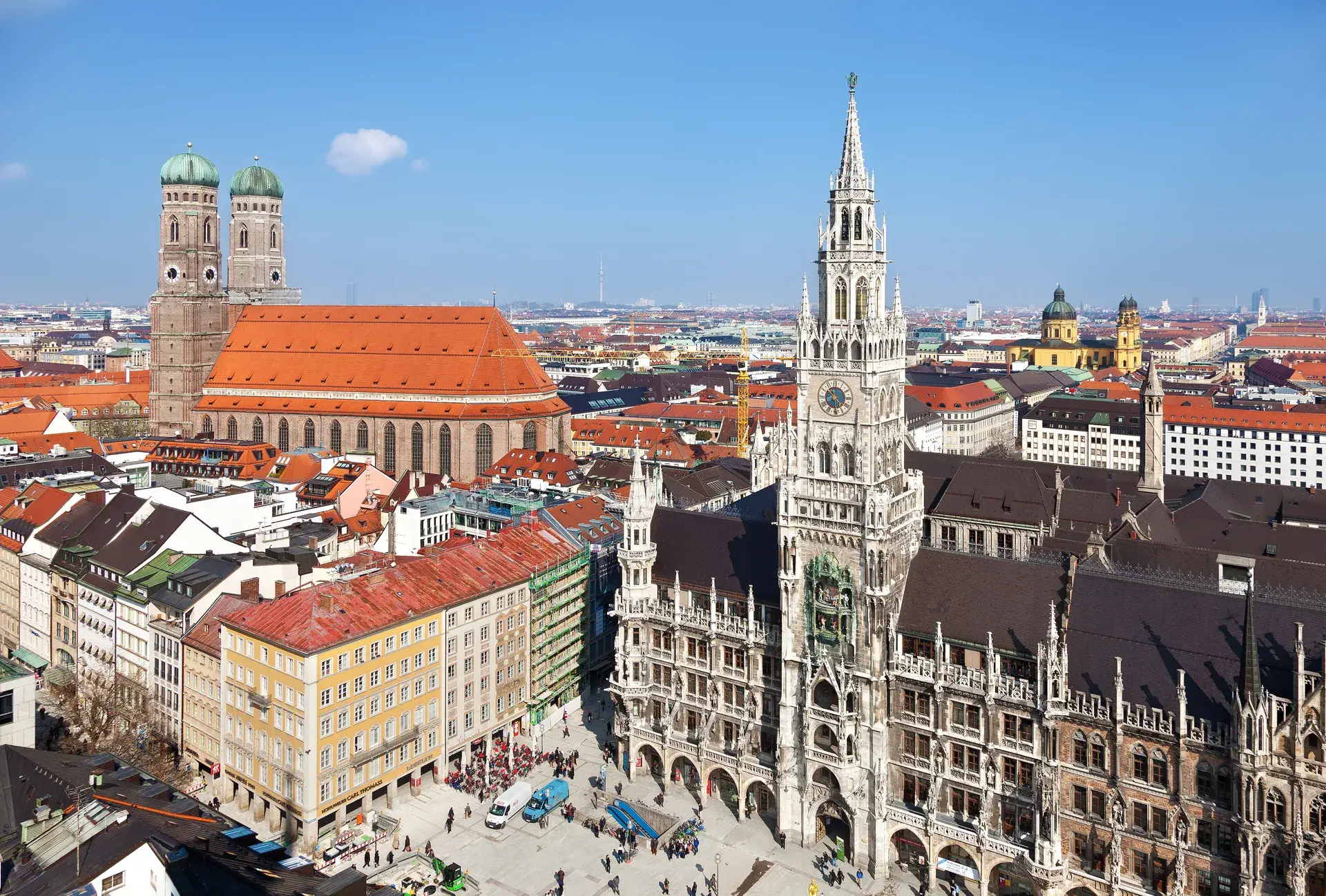
Beyond its religious and political symbolism, the Mariensäule held official civic significance as the geographical point zero (Nullpunkt) for Munich and Bavaria. Road signposts and regional transit routes historically measured their distances to and from the column. The monument also marks the historical crossing of the medieval 1158 salt road, visually connecting nearby landmarks including the Old Town Hall, St. Peter's Church, and the Munich Residenz.
Today, the Mariensäule is the centerpiece of the Marienplatz pedestrian zone directly in front of the New Town Hall (Neues Rathaus), where crowds assemble daily to hear the adjacent tower Glockenspiel. The column was shifted slightly during 20th-century pedestrian zone redesigns to align with modern street layouts. It remains an active site of Roman Catholic devotion, hosting regular public prayers and rosaries, framed by a balustrade with seasonal floral displays maintained by the city. Inscriptions on its pedestal also commemorate historical visits by three popes: Pius VI in 1782, John Paul II in 1980, and Benedict XVI in 2006.
FAQ
Why was the Mariensäule built?
Elector Maximilian I of Bavaria commissioned the column to fulfill a religious vow made in 1632 during the Thirty Years' War, giving thanks after Munich was spared destruction during Swedish occupation.
What do the four putti at the base of the column represent?
Added in 1641, the four bronze putti depict allegorical battles against four major scourges of the era: war (represented by a lion), pestilence (a basilisk), famine (a dragon), and heresy (a serpent).
Are the putti on Marienplatz the original 17th-century sculptures?
No, the bronze putti currently on the square are late-20th-century copies. The original 1641 bronze figures are preserved in the Münchner Stadtmuseum.
Why was the square renamed from Schrannenplatz to Marienplatz?
Originally a civic grain market known as Schrannenplatz, the square was renamed Marienplatz on October 9, 1854, to seek protection from the Virgin Mary during a cholera epidemic.