Munich Residence: Seat of the Wittelsbach Dynasty
Standing as Germany's largest inner-city palace, the Munich Residence (Münchner Residenz) served for centuries as the political heart and principal seat of the Wittelsbach rulers of Bavaria. The sprawling complex showcases architectural layers spanning several eras, illustrating the dynasty's shift from medieval dukes to European electoral monarchs.
From Medieval Citadel to Ducal Palace
The Wittelsbach court originally governed from the Alter Hof in central Munich. Following urban uprisings in the late 14th century, the rulers sought a more secure fortress, leading to the construction of the moated Neuveste castle in 1385 in the city's northeastern corner.
By the 16th century, the fortified stronghold gave way to expansive courtly architecture. Dukes Albrecht V and Wilhelm V constructed additions outside the original castle perimeter, including the Renaissance Antiquarium. However, these lavish building projects brought the duchy to the brink of bankruptcy. When Duke Maximilian I assumed control in 1597, he instituted financial reforms that stabilized state resources, allowing him to launch an ambitious structural transformation that reflected his position as the leader of the Catholic League.
The 1616 Facade and the Kaiserhof
Between 1612 and 1616, Maximilian I dismantled sections of the Neuveste to erect the Maximilianische Residenz, a western palace wing designed primarily by court artist Hans Krumpper and court painter Peter Candid. Designed to accommodate visits from the Holy Roman Emperor, the complex included the Imperial Staircase (Kaisertreppe), the ceremonial Imperial Hall (Kaisersaal), and the opulent Steinzimmer (Stone Rooms).
The monumental exterior along Residenzstraße became a public proclamation of political authority and Counter-Reformation devotion. Two grand portals punctuate the facade: the northern entrance leading to the Kaiserhof (Imperial Courtyard), topped by bronze figures of Prudence and Justice, and the southern portal leading to the Kapellenhof (Chapel Courtyard), crowned by Fortitude and Temperance.
Set in a high central niche between these gates stands an over-life-size bronze statue of the Virgin Mary holding the Christ Child. Cast in 1616 by Hans Krumpper, this statue marked Maximilian I's official proclamation of Mary as the patron saint of Bavaria (Patrona Boiariae). The iconography of this facade directly foreshadowed the Mariensäule, later erected on Munich's Marienplatz in 1638 following the city's survival during the Thirty Years' War.
The Guarding Bronze Lions and Local Lore
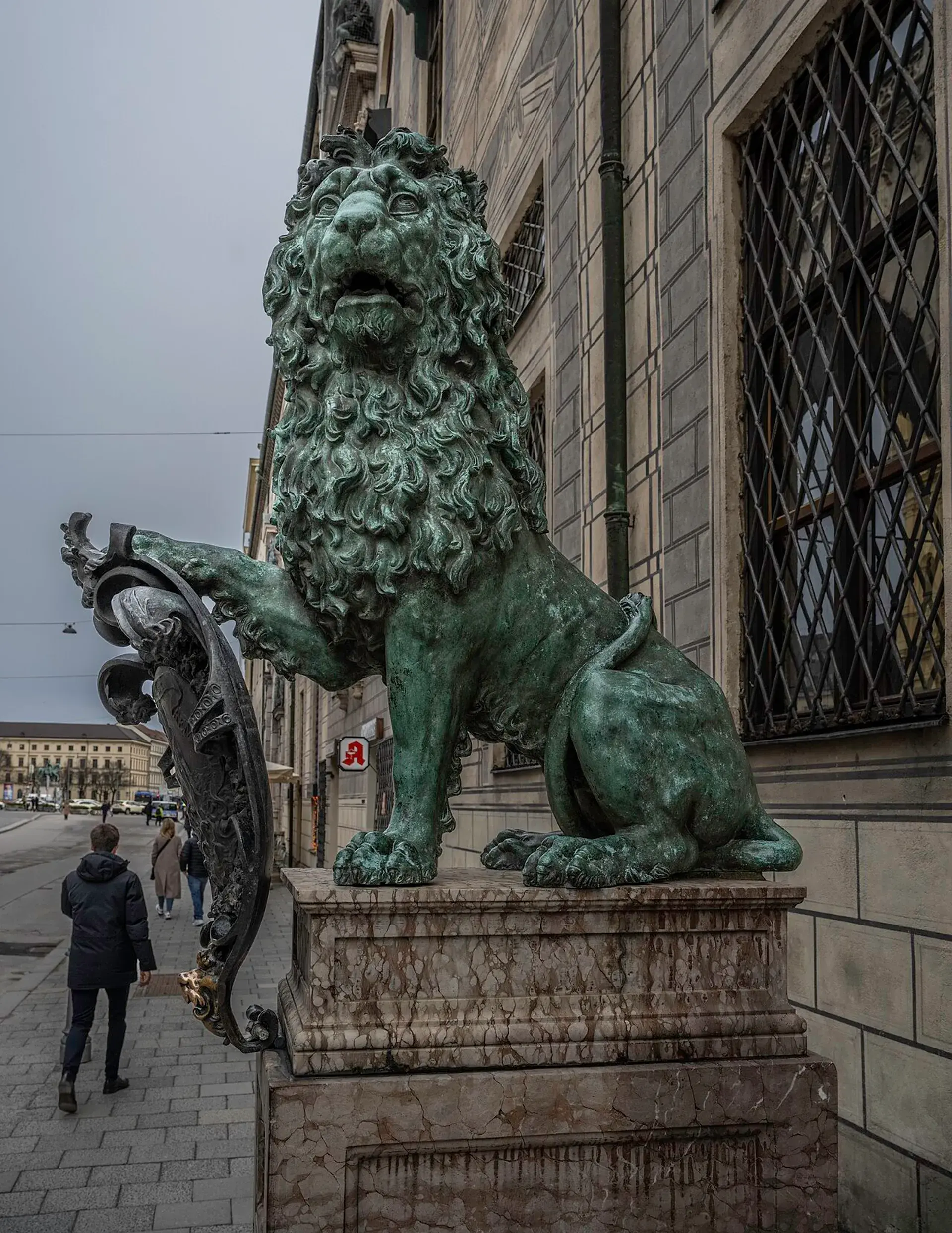
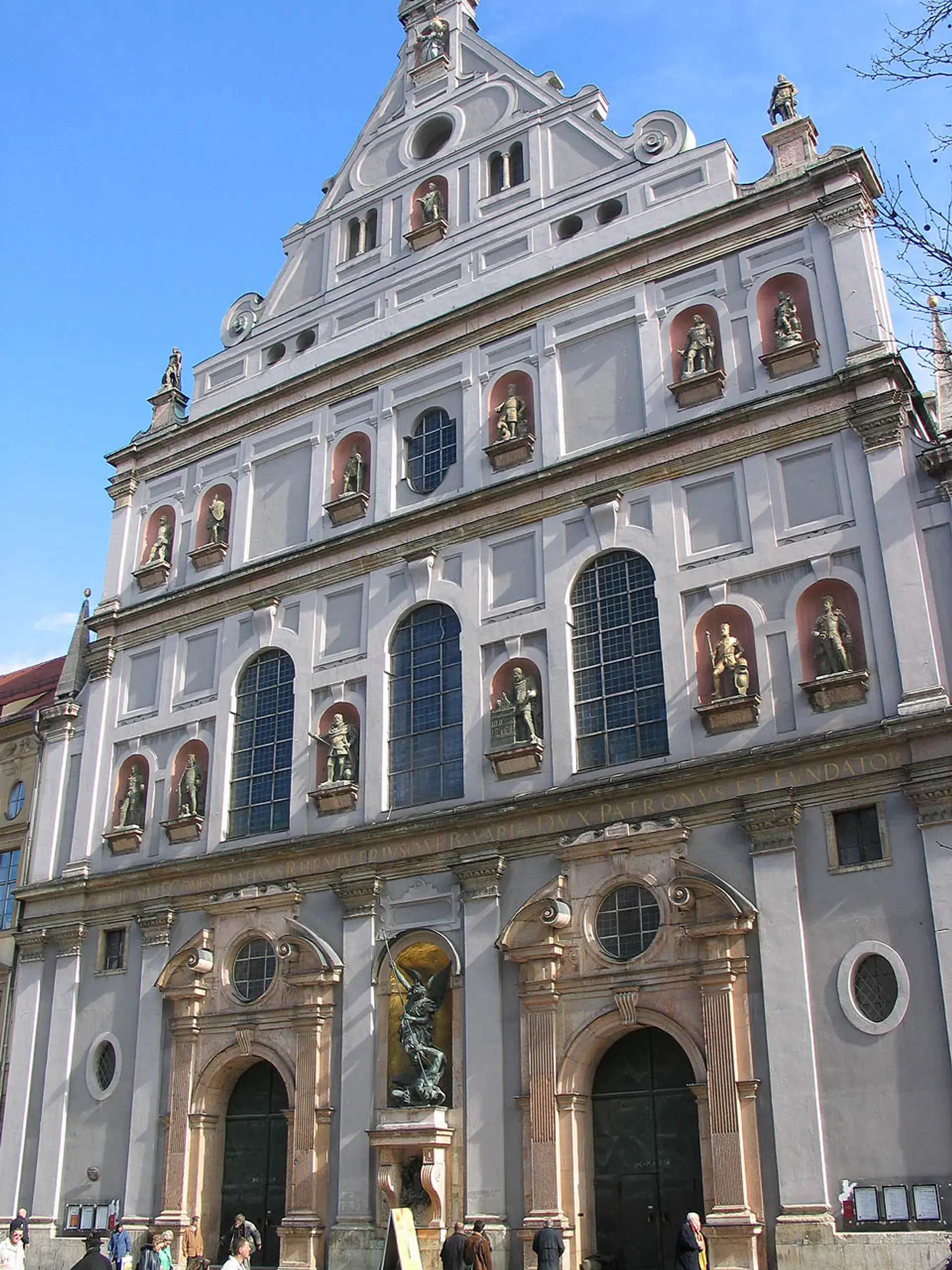
The Residenzstraße portals are flanked by four monumental bronze lions. Originally, these sculptures were not intended for the palace. Artists Hubert Gerhard and Carlo di Cesare del Palagio cast the figures between 1594 and 1596 for an elaborate tomb planned for Duke Wilhelm V in St. Michael's Church, an installation that was never assembled.
Today, the dark, weather-oxidized patina of the lion pedestals contrasts with the gleaming brass shine of the small snout masks attached to the heraldic shields. A persistent local tradition holds that rubbing the noses of these smaller lion heads brings good fortune, wealth, or safe travels. Munich folklore frequently ties this custom to an 1840s student who published satirical verses criticizing King Ludwig I; after turning himself in, he received an unexpected royal pardon and touched the lion's snout in relief upon departing the palace.
The Modern Museum Complex
Administered by the Bavarian Palace Department (Bayerische Schlösserverwaltung), the Munich Residence operates primarily as the Residenzmuseum. The public complex features more than 130 preserved and reconstructed historical rooms, displaying centuries of decorative arts and royal interiors.
In addition to the state rooms, the Residence houses the Treasury (Schatzkammer) and the State Coin Collection (Staatliche Münzsammlung). The historic structure also remains an active cultural center, hosting performances in the Rococo Cuvilliés Theatre and serving as the primary concert hall for the Bavarian Radio Symphony Orchestra in the neoclassical Herkulessaal.
FAQ
Why is the Virgin Mary statue on the palace facade significant?
Cast in 1616 by Hans Krumpper, the bronze statue commemorates Duke Maximilian I's declaration of Mary as Patrona Boiariae (patron saint of Bavaria). It fused political governance with Counter-Reformation imagery and served as the direct model for the Mariensäule erected in Marienplatz in 1638.
What is the origin of the bronze lions on Residenzstraße?
The four large bronze lions were cast between 1594 and 1596 by Hubert Gerhard and Carlo di Cesare del Palagio. They were originally created for a never-assembled tomb for Duke Wilhelm V in St. Michael's Church before being repurposed to flank the palace portals.
Why do people rub the lion snouts outside the Residence?
A Munich tradition claims that rubbing the snouts on the heraldic shields brings good luck, prosperity, or safe travels. Local lore links the practice to an 1840s student who rubbed the snout in relief after receiving an unexpected pardon from King Ludwig I.
What institutions are housed within the Munich Residence today?
The complex houses the Residenzmuseum, the Treasury (Schatzkammer), the State Coin Collection, the Rococo Cuvilliés Theatre, and the Herkulessaal concert venue.