Munich Old Town Hall Gate and the Salt Road
The 1158 Salt Dispute and Munich's Origins
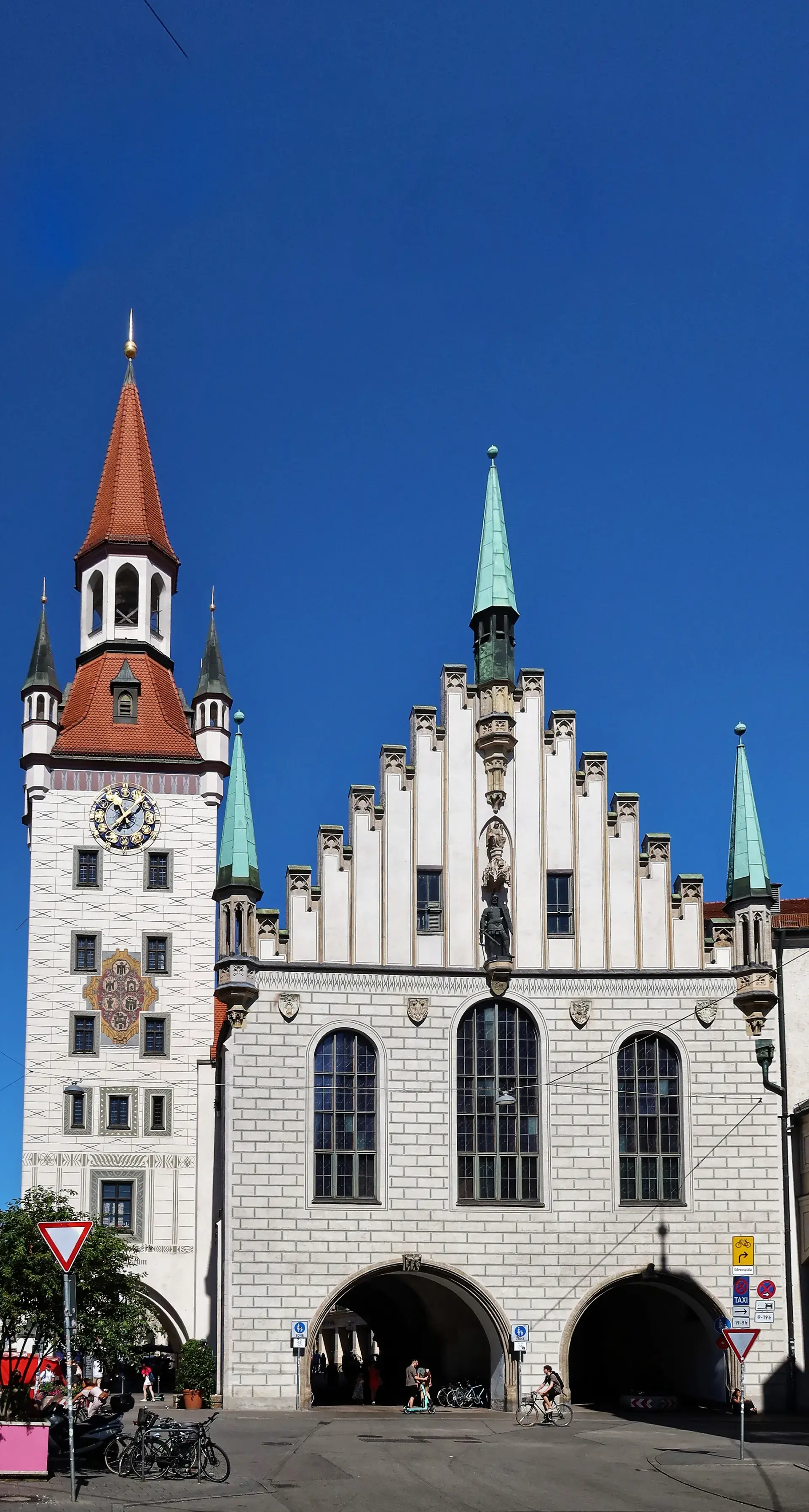
The passage through Munich’s Old Town Hall (Altes Rathaus) stands on the historic corridor that initiated the founding of the city. Between 1156 and 1158, Duke Heinrich der Löwe (Henry the Lion) destroyed the Isar River bridge, toll station, and market belonging to Bishop Otto of Freising at Oberföhring. Henry diverted the lucrative salt road (Salzstraße)—which transported valuable rock salt from Reichenhall and Hallein—across a bridge under his own control near the present-day Ludwigsbrücke.
This commercial conflict was resolved on June 14, 1158, when Emperor Friedrich I Barbarossa issued the Augsburger Schied (Arbitration of Augsburg). The ruling legally validated the market and customs rights of the settlement, known as forum apud Munichen, while granting Freising one-third of the customs revenue.
The Talburgtor as a Fortified Gateway
To enter the original 12th-century settlement footprint, known as Heinrichstadt, heavy wagons laden with salt climbed the river terrace from the Isar valley and entered through the Talburgtor. Also documented in 1301 as the porta inferior (Lower Gate) or Talbrucktor, it served as the eastern gate of Munich’s first defensive ring wall. From here, salt transports crossed directly through the central market square (now Marienplatz) before exiting the city via the western Kaufingertor (porta superior).
Statuary on the building’s exterior reflects this historical trade route. A statue of Henry the Lion stands on the eastern facade looking down toward the Isar valley, while Emperor Ludwig the Bavarian faces west across Marienplatz.
Evolution into the Civic Town Hall
During the early 14th century, Emperor Ludwig the Bavarian commissioned an expanded second ring of city walls anchored to the east by the Isartor. With the border fortifications moved farther outward, the Talburgtor lost its defensive mandate. Between 1392 and 1394, the gate tower was incorporated directly into the municipal council complex as the civic tower (Rathausturm).
Following a lightning-induced fire in 1460, master builder Jörg von Halsbach rebuilt the complex in late Gothic style between 1470 and 1480. Over the centuries, the tower's architectural profile evolved repeatedly: it received a Renaissance onion dome by the 1570s and a Neo-Gothic spire in the 19th century.
Structural Alterations and Reconstruction
The street-level arched portals visible today do not represent the original medieval gate. To accommodate increasing pedestrian and vehicular traffic, an opening was breached through the structure in 1877. Between 1934 and 1935, these passages were widened across the entire ground floor, permanently removing the historic ground-level interior that had once housed the medieval municipal bakery (Brothaus).
During World War II, bombing raids in 1944 gutted the complex and compromised the tower's structural stability, forcing the demolition of the ruins. Between 1971 and 1974, the 56-meter tower was rebuilt according to Jörg von Halsbach's 15th-century late-Gothic design, guided by historical illustrations from the 1493 Nuremberg Chronicle.
Present-Day Use and Curiosities
The wide vaulted arches continue to serve as a busy pedestrian thoroughfare, where the open light of Marienplatz gives way to a shadowed, echoing stone passage sloping downhill toward the street called Tal.
Inside the reconstructed 56-meter tower, the Munich Toy Museum (Spielzeugmuseum) occupies four floors, showcasing historic dolls, tin soldiers, and playthings. Above the thoroughfare, the Grand Hall (Großer Festsaal) is reserved by the City of Munich for official ceremonies, honorary citizenship awards, and civic receptions. Just outside the passage along the south exterior wall, a bronze statue of Juliet of Verona attracts visitors who participate in the tradition of rubbing her right breast for luck in love.
FAQ
What was the Talburgtor?
The Talburgtor was the late 12th-century eastern gate of Munich's first ring wall. It served as the entry point for salt wagons traveling up from the Isar valley into the central market before being converted into the Old Town Hall's civic tower in the late 14th century.
Are the arched ground-floor passages medieval?
No. The ground-floor arches were cut through in 1877 and enlarged in 1934–1935 to manage traffic flow, destroying the building's medieval ground floor that once contained the town bakery.
What is located inside the Old Town Hall tower today?
The reconstructed 56-meter tower houses the Munich Toy Museum across four floors, while the upper ballroom is used by the city for official civic receptions and ceremonies.