St. Peter's Church & Tower: Munich's Oldest Parish
Origins on the Petersbergl
St. Peter’s Church, affectionately known in Munich as Alter Peter (Old Peter), is the city's oldest recorded Roman Catholic parish church. Positioned on the Petersbergl, a natural moraine hill located southeast of Marienplatz, the church stands at the foundational heart of the Bavarian capital. While folklore once held that 8th-century Benedictine monks from Tegernsee Abbey established a settlement on the hill, archaeological excavations beneath the church disproved this myth, uncovering instead an early 12th-century stone structure and toll station.
When Duke Henry the Lion rerouted the regional salt trade across the Isar River, leading to the 1158 Augsburg Arbitration, St. Peter served as the fledgling market settlement's sole parish church. The building received its first formal documentary mention in 1225/1226 as ecclesia sancti Petri Muonichen during a pastoral visit by Duke Ludwig I.
Centuries of Architectural Transformation
A late 12th-century Romanesque church once occupied the site before it was rebuilt in a Gothic style and consecrated in 1294. Displaced by disaster, St. Peter was severely damaged during the devastating Munich city fire of February 14, 1327. Emperor Ludwig the Bavarian subsequently oversaw an extensive reconstruction, resulting in a three-aisled Gothic hall church with patrician-endowed side chapels that was consecrated in 1368.
During the early 17th century, St. Peter's twin Gothic spires were replaced with a single central tower capped by a Renaissance lantern. The interior underwent dramatic Baroque and Rococo redesigns over the 18th century, highlighted by monumental ceiling frescoes painted by Johann Baptist Zimmermann between 1753 and 1756. The high altar was conceived between 1730 and 1734 by a team of artists including Nikolaus Gottfried Stuber, Johann Georg Greiff, and Egid Quirin Asam.
Allied bombing during World War II nearly obliterated the sanctuary. Saved from total demolition, the church underwent a phased reconstruction from 1946 to 1954, with painstaking interior restoration efforts continuing through the year 2000.
The 91-Meter Tower
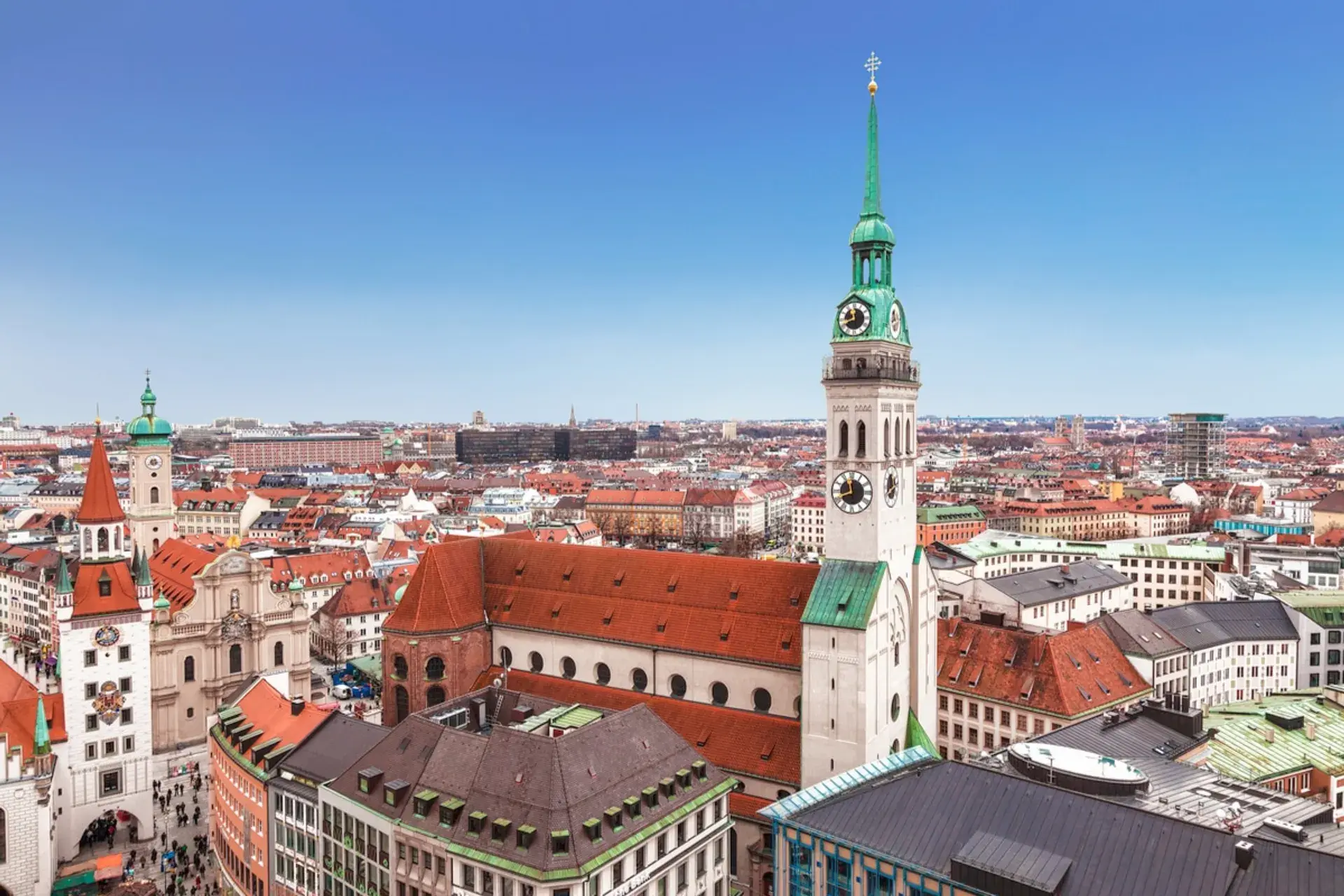
Dominating the Altstadt skyline, St. Peter's central tower reaches a height of 91 meters. An open-air observation platform sits 56 meters above street level, accessible by climbing 306 stone and wooden steps that thread past historic church bell chambers. From the narrow gallery, the platform provides 360-degree views stretching across Munich's red roofs toward the Bavarian Alps. At the summit of the spire, a nearly four-meter-tall weather cross is installed perpendicular to the prevailing west wind to withstand heavy Alpine gales.
Today, St. Peter continues to serve as an active parish within the Archdiocese of Munich and Freising, hosting daily liturgies, confessions, and choral performances alongside tourist visits.
Relics and Curiosities
Within the church walls are several historic curiosities dating from different eras of Munich's history:
- Papal Tiara of Saint Peter: The high altar features a late-Gothic wooden figure of Saint Peter carved around 1492 by Erasmus Grasser. The statue wears a gilded papal tiara that is physically removed upon the death of a reigning Pope and kept off throughout the sede vacante period until a successor is elected.
- Saint Munditia: A glass-fronted side altar displays the jewel- and gold-embellished skeleton of Saint Munditia, a Roman catacomb martyr brought to Munich in 1675. She holds a small glass vial said to contain dried martyr blood and is regarded as a patron saint for unmarried women.
- The Poor Sinner’s Bell: Known as the Arme-Sünder-Glocke, this bell was cast shortly after the 1327 blaze. It hangs in the tower basement behind an exterior iron-barred window and was historically tolled during executions conducted on the neighboring market square.
- 1796 Cannonball: Lodged in the exterior choir apse window sill is an iron cannonball fired from the Gasteig by Austrian troops during the War of the First Coalition. It breached the church during a service without causing casualties and was later cemented into the masonry.
FAQ
How many steps lead to the observation deck of St. Peter's Tower?
Visitors reach the open-air viewing platform, located 56 meters above the street, by ascending 306 wooden and stone steps through the tower.
Why is the tiara removed from the statue of Saint Peter?
According to tradition, the gilded papal tiara on Erasmus Grasser's 1492 high-altar statue is removed upon the death of a reigning Pope and remains off during the sede vacante until a new Pope is elected.
What is the Poor Sinner’s Bell at St. Peter's?
The Poor Sinner’s Bell (Arme-Sünder-Glocke), cast after the 1327 fire, hangs behind a barred basement window in the tower and was historically rung during public executions on Marienplatz.
Discover Munchen like never before
Dive into Munchen hidden stories and secret spots with Ciceru interactive tours.
Explore tour
Audioguide
Quizzes
Maps
Solo
Couples
Groups & families

© Photo by Pavel via Google Maps · Google Places