Oberhausblick: Passau's Fortress Viewpoint
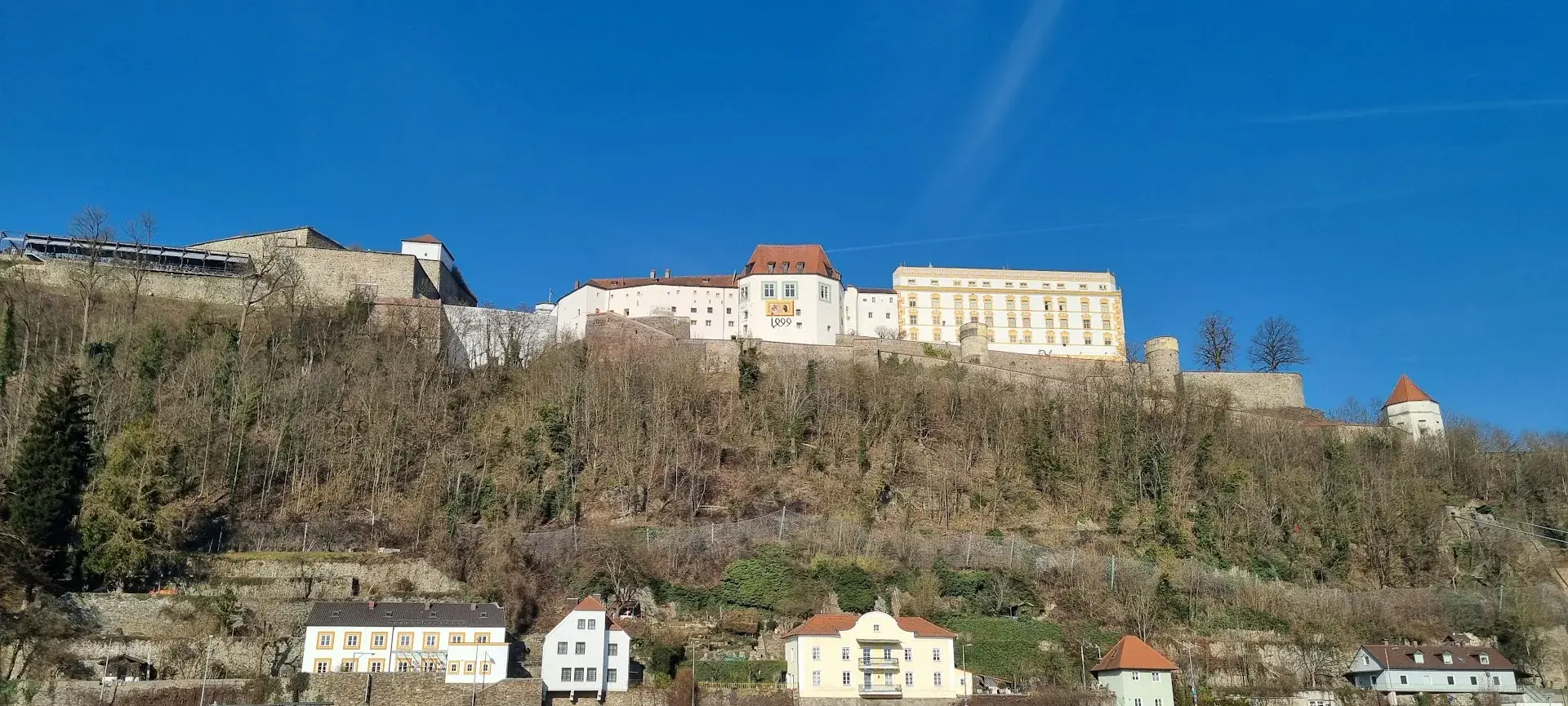
The best vantage point to understand Passau's unique geography reveals a fortress designed to threaten the very city it overlooks. Situated roughly 100 meters above the Danube on the Georgsberg ridge, the Oberhausblick provides the essential bird's-eye perspective that defines Passau as the "Three Rivers City." From this elevated height, observers can clearly see how the narrow Old Town peninsula is wedged between the waterways.
The Three Rivers Panorama
The Oberhaus viewpoint consists of two primary viewing spots within the expansive 65,000-square-meter Veste Oberhaus fortress complex. The first is an open panorama terrace located near the Rennweg car park, while the second is the historic Batterie Linde situated within the inner fortress walls.
From these vantage points, the distinct natural colors of the three merging water bodies become starkly apparent. The milky-green alpine waters of the Inn, the blue-brown Danube, and the dark, peaty water of the Ilz converge below. The auditory landscape is equally striking, as church bells from St. Stephen's Cathedral and river cruise ship horns frequently echo up the steep Georgsberg rock face. At the Batterie Linde, visitors observe the confluence from beneath a canopy of centuries-old linden trees, which are protected as living natural monuments.
A Fortress Built to Control
Founded in 1219 by Ulrich II, Passau's first Prince-Bishop, Veste Oberhaus grew from a Gothic core around a pre-existing St. George chapel into a massive Baroque military installation. While built to guard trade routes along the Danube, the stronghold served a dual defensive purpose. Unlike standard medieval fortresses oriented primarily outward, key artillery positions and defensive battlements at Veste Oberhaus were heavily fortified to face directly down into Passau to suppress urban uprisings against church rule.
The structure was also physically connected down the hillside via continuous fortified battlements to Veste Niederhaus, a smaller fort guarding the water junction below. Following secularization in 1802, the fortress was used as a Bavarian military prison until the City of Passau purchased the complex in 1931.
Historic Pathways and Modern Attractions
Today, the viewpoints are fully open to the public. The site can be accessed on foot from the Old Town via steep historic pathways, including the Ludwigsteig. This rocky cliff-face path was blasted in 1893 and named after Prince Regent Luitpold of Bavaria. Alternatively, a seasonal shuttle bus operates from the Rathausplatz to transport visitors to the summit.
Within the fortress grounds, the Oberhausmuseum features exhibits on regional trade and medieval history. The complex also houses a restored 18th-century Observation Tower with multimedia installations, a youth hostel located in the 16th-century General's Building, and an outdoor restaurant offering expansive views of the river valley.
FAQ
How do visitors access the Oberhausblick?
The viewpoints can be reached on foot via steep historic pathways like the Ludwigsteig, or by taking a seasonal shuttle bus that departs from the Rathausplatz in Passau.
What can be seen from the Oberhaus viewpoints?
The terraces offer sweeping views of Passau's Old Town, St. Stephen's Cathedral, and the confluence of the Danube, Inn, and Ilz rivers, highlighting the distinct natural colors of each waterway.
What is the historical significance of Veste Oberhaus?
Founded in 1219 by Prince-Bishop Ulrich II, the fortress guarded trade routes but was notably fortified to face inward toward Passau to suppress citizen uprisings against church rule.
Discover Passau like never before
Dive into Passau hidden stories and secret spots with Ciceru interactive tours.
Explore tour
Audioguide
Quizzes
Maps
Solo
Couples
Groups & families

© Photo by Tobias Monath via Google Maps · Google Places