Schaiblingsturm: Passau's Historic White River Tower
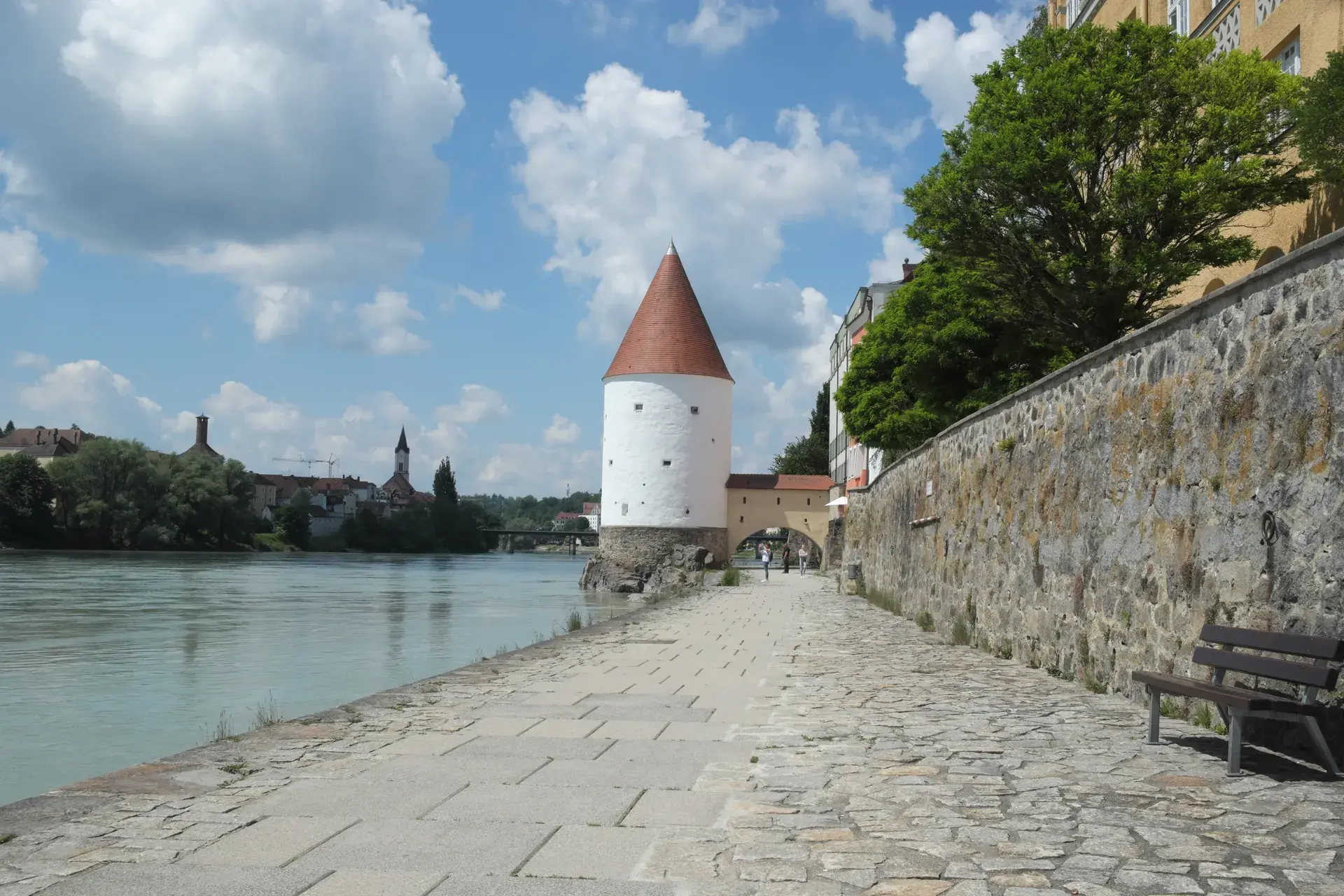
Standing detached on a rocky outcrop in the Inn River, a whitewashed round tower holds one of the only medieval structures in Passau to survive the city's catastrophic fires. Serving as the defining landmark of the Innpromenade walk, the Schaiblingsturm bridges the area between the Baroque Old Town and the Dreiflüsseeck confluence, standing as a pristine remnant of the city's medieval river defenses.
A Medieval Survivor on the Inn River
Built around 1250 as part of the medieval city fortification wall, the Schaiblingsturm was initially constructed as a defensive outpost. Its primary purpose was to guard Passau's riverfront against hostile approaches along the water and to protect docked river traffic from strong currents and waves. The tower's name derives from the German word "Scheibe" (disc), referring directly to its completely round floor plan.
Because of its detached position over the water on riverside rock, the structure survived Passau's devastating city fires in 1662 and 1680 completely unscathed. This geographical separation preserved the architecture while much of the surrounding city burned.
From Salt Storage to Cable Ferry
Following late medieval modifications, the tower evolved well beyond its defensive origins. It became a vital storage facility for gunpowder and salt. The natural stone base operated as a landing and mooring quay for wooden Inn salt barges, known as Hallaschen, which transported valuable salt from the Alpine region.
Over the centuries, the tower steadily adapted to the shifting needs of Passau. Between the 19th and 20th centuries, its multi-level interior provided housing for river watchmen, newspaper editors, and actors working at Passau’s Kammerspiele theater. Until 1957, it also served as the terminus for a cable ferry linking the Schaiblingsturm directly across the Inn River to the Innstadt district.
Architectural Details and Hidden Curiosities
The Schaiblingsturm presents a striking visual contrast against its environment. The smooth, bright whitewashed lime-sand plaster of the cylinder walls and the red roof contrast sharply against the rough, dark granite bedrock and the green and grey currents of the Inn River. The curved masonry is pierced by narrow arrow slits and keyhole embrasures that face the water.
Thanks to escaping the 17th-century fires, its 1481 double collar-beam timber conical roof remains one of the few surviving authentic medieval roof frameworks in the city. Also in 1481, large frescoes of Saint Christopher and Saint Nicholas were painted on the water-facing walls by Rueland Frueauf the Elder. Unfortunately, centuries of river floods and harsh weather have since erased the historic imagery.
The Schaiblingsturm Today
Today, the Schaiblingsturm is a protected historic monument owned by the City of Passau. It is affiliated with the neighboring secondary school, Gymnasium Leopoldinum, and the school director holds key authority over the building.
The tower is closed to regular tourism and public entry. This is largely due to strict fire and escape safety regulations, as it possesses only a single access route across a walled bridge connecting it to the school. Despite its medieval exterior, the tower is fitted with modern central heating and plumbing, making the interior entirely habitable. The school occasionally utilizes this heated space for small seminars, workshops, and reading nights.
FAQ
Can visitors go inside the Schaiblingsturm?
No, the interior is closed to regular tourism and public entry due to strict fire safety regulations. It has only a single access route across a walled bridge. The interior is occasionally used by the neighboring secondary school for small educational events.
Why did the Schaiblingsturm survive the Passau city fires?
The tower survived the devastating city fires of 1662 and 1680 completely unscathed because it was built on a detached natural rock outcrop jutting directly into the Inn River, keeping it safely separated from the burning city buildings.
How old is the Schaiblingsturm?
The tower was originally built around 1250 as part of Passau's medieval city fortifications. Its current conical timber roof frame dates to an extensive reconstruction completed in 1481.
What was the Schaiblingsturm used for in the past?
Originally a defensive outpost, it later served as a storage facility for salt and gunpowder, a mooring quay for Alpine salt barges, and the terminus for a cable ferry until 1957. Over the 19th and 20th centuries, it also provided housing for river watchmen, editors, and actors.