Marktkirche St. Benedikti: Quedlinburg Gothic Landmark
Admire the soaring architecture and historic facade of Marktkirche St. Benedikti from the cobblestone square. Tucked directly behind the historic Town Hall in Quedlinburg, this late Gothic hall church stands as a towering symbol of civic independence and merchant wealth.
A Symbol of Civic Independence
In the medieval topography of Quedlinburg, Marktkirche St. Benedikti represented the power of the local merchants and burghers, serving as a direct civic counterpart to the ruling aristocracy on Castle Hill. While a predecessor church existed at this trade route intersection in the 10th century, the site was first officially documented as a market church in 1233.
The structure embodies the city's turbulent social dynamics. During a failed revolt against Abbess Hedwig of Saxony in 1477, Saxon troops subdued the city. As a result of this subjugation, construction on the new southern nave wall was forcibly halted and did not resume until the 16th century.
Architectural Highlights and Hidden Details
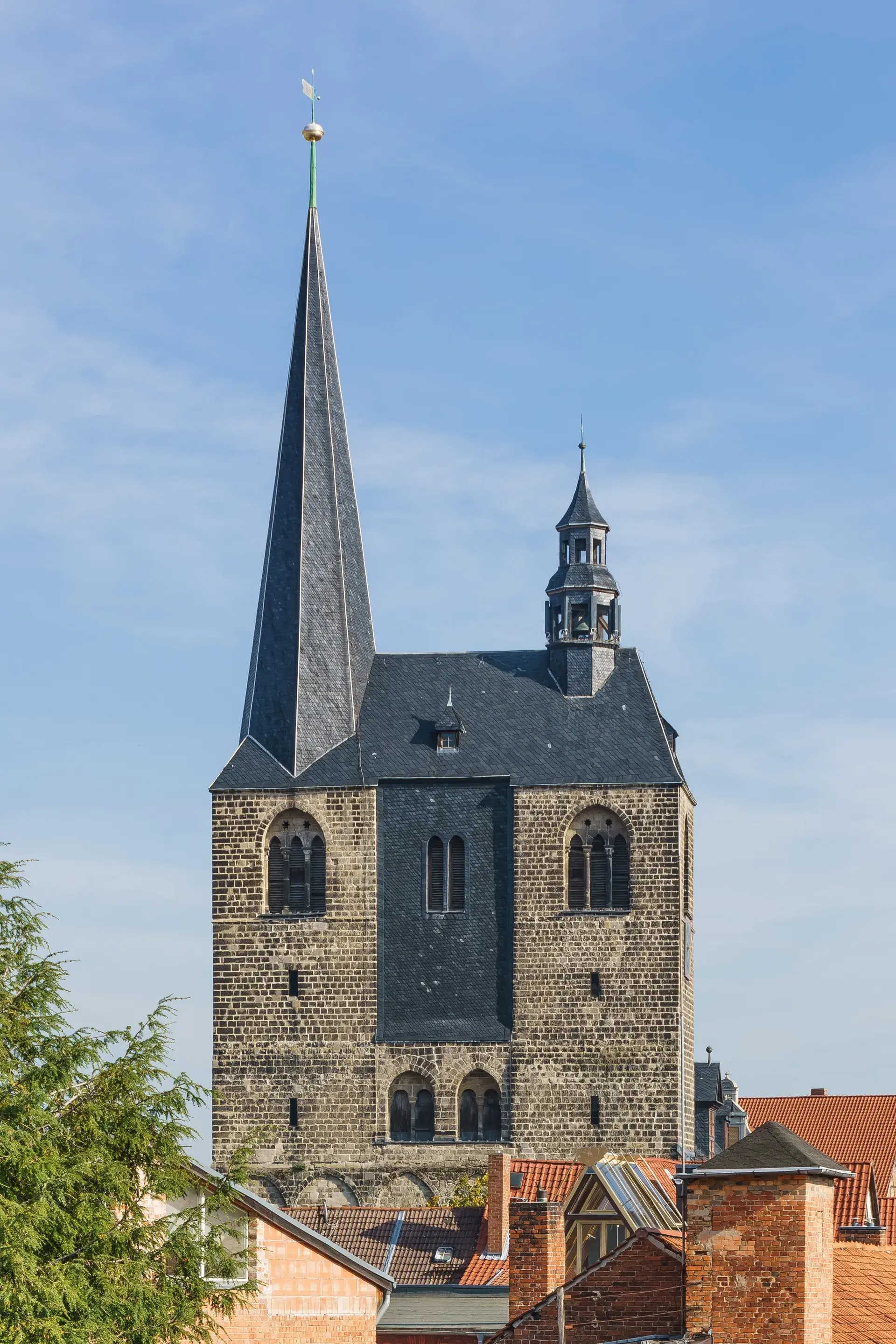
The physical transition from the open, bustling Marktplatz through a narrow passage reveals the enclosed and quiet Marktkirchhof churchyard. The building features a 13th-century western tower block with striking asymmetrical twin towers. The northern tower rises to approximately 60 meters, while the southern tower is notably lower. Following destructive fires in 1701 and 1901, the top of the southern tower was converted into an apartment for a municipal watchman who surveyed the city for smoke.
Inside, the light-filled Gothic interior is dominated by high pointed arches and a prominent wooden barrel vault added after 1663. The nave features rich Baroque furnishings, including a magnificent 1700 high altar designed by architectural theorist Leonhard Christoph Sturm, a carved 1595 Renaissance pulpit, and an intricate 1576 Renaissance stone relief epitaph dedicated to the Bortfeld family.
Musical Heritage and Notable Chapels
The church houses several significant historic and artistic treasures. The Kaland Chapel, built between 1410 and 1436 for a medieval charitable fraternity of prominent citizens and clergy, contains a beautiful winged altar of Mary dating from around 1480.
Music remains an integral part of the church's heritage. The building holds the largest surviving organ built by Ernst Röver in 1888. This monumental Late Romantic instrument boasts 52 stops and over 3,000 pipes.
Modern Role and a Surprising Sanctuary
Today, St. Benedikti serves as an active Evangelical parish church, regularly hosting services, choir performances, and organ concerts. It also houses a permanent exhibition detailing Quedlinburg's medieval urban history from an imperial palatinate to a Roland city.
High above the pews, the church holds a surprising ecological secret. The attic and roof timber structure serve as an officially designated Fauna-Flora-Habitat reserve, providing a safe shelter for a maternity colony of the Greater Mouse-Eared Bat.
FAQ
Why are the towers of Marktkirche St. Benedikti asymmetrical?
The northern tower reaches approximately 60 meters, while the southern tower is much lower. Following fires in 1701 and 1901, the top of the southern tower was converted into a specialized apartment for a municipal watchman to scan the city for fires.
What historical event delayed the construction of the church?
Construction on the southern nave wall was forcibly halted during a failed 1477 revolt by the town's citizens against Abbess Hedwig of Saxony. Work on the wall did not resume until the 16th century.
What animals live in the roof of Marktkirche St. Benedikti?
The church attic and roof timber structure are a designated Fauna-Flora-Habitat reserve that shelters a maternity colony of the Greater Mouse-Eared Bat.
What is notable about the church's organ?
The church contains the largest surviving organ built by Ernst Röver in 1888. It is a massive Late Romantic instrument featuring 52 stops and over 3,000 pipes.