Stiftskirche St. Servatius: Quedlinburg's Royal Church
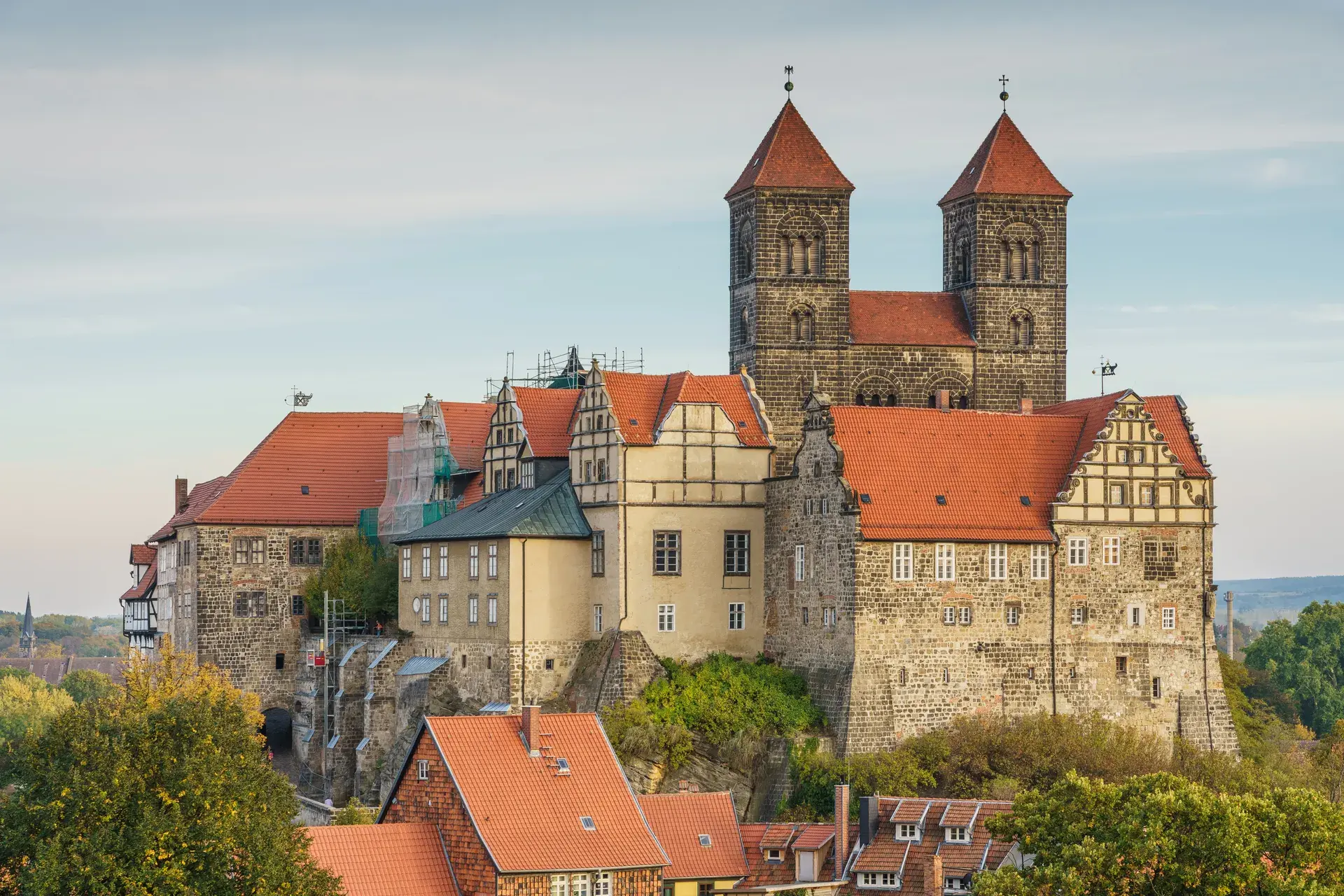
Perched high above a sea of red-tiled roofs, Stiftskirche St. Servatius serves as the visual and historical anchor of Quedlinburg. Overlooking the town from the hilltop, the imposing Romanesque structure encompasses nine centuries of female rule, an empty royal tomb, and the remnants of an audacious art heist.
A Masterpiece of High Romanesque Architecture
Located prominently on the sandstone Schlossberg (Castle Hill), Stiftskirche St. Servatius is recognized as a premier masterpiece of High Romanesque design. The current structure was built primarily between 1070 and 1129, replacing earlier Ottonian buildings that were destroyed by fire. The church features a classic basilical plan with a flat wooden ceiling spanning the nave and intricately carved stone capitals. The distinctive neo-Romanesque twin west towers were added later during 19th-century restorations. Today, it stands as a key component of the Quedlinburg UNESCO World Heritage site, which was inscribed in 1994.
Nine Centuries of Female Rule
In the early 10th century, King Henry I established a fortified stronghold and palatine chapel on the Schlossberg. Following his death in 936, his widow, Queen Mathilde, founded an imperial women's collegiate foundation on the site. For nearly 900 years, the abbesses of this foundation held imperial immediacy, allowing them to rule the town and its vast estates entirely independently under the direct protection of the Emperor. This continuous era of female leadership only ended with secularization in the early 19th century.
The Crypt and the Empty Royal Tomb
Beneath the main floor lies a dimly lit subterranean crypt, where vaulted chambers are illuminated to highlight ancient stone capitals carved with geometric patterns and animal motifs. The crypt holds the burial slabs of numerous noble abbesses, as well as the intact stone sarcophagus of Queen Mathilde, who died in 968. However, modern excavations revealed a surprising historical mystery: the adjoining burial vault belonging to King Henry I was found completely empty, fueling centuries of debate regarding the true location of his remains.
The Domschatz and the Texas Art Heist
The church houses the world-renowned Domschatz (Cathedral Treasury) exhibition in its historic annex rooms and crypt. The treasury is home to priceless medieval artifacts, including a knotted wool carpet dating to around 1200, celebrated as the oldest surviving knotted carpet in European history. It also features a late-antique alabaster vessel that local medieval tradition claimed was one of the actual water jugs used by Jesus at the wedding feast at Cana.
The treasury was also the target of an infamous post-war theft. In 1945, an American soldier named Joe Tom Meador stole several priceless pieces, including the 9th-century Samuhel Gospel, and mailed them home to Texas. The stolen artifacts remained hidden for decades before being rediscovered and repatriated to Quedlinburg in the early 1990s.
A Dark Chapter in the 20th Century
During the Nazi era, the church underwent a drastic appropriation. Between 1936 and 1945, Heinrich Himmler and the SS seized the building, stripped it of its Christian symbols, and attempted to repurpose the historic site into a Nazi ceremonial shrine dedicated to King Henry I. Following the end of World War II, normal functions and Christian worship were fully restored.
Modern Role
Today, Stiftskirche St. Servatius functions as an open monument and an active Protestant parish church holding regular religious services. Its exceptional acoustics also make it the primary venue for the annual Quedlinburger Musiksommer concert series, allowing its historic stones to continue resonating with life.
FAQ
Who is buried in the crypt of Stiftskirche St. Servatius?
The crypt contains the intact stone sarcophagus of Queen Mathilde (d. 968) and the burial slabs of numerous noble abbesses. While King Henry I was originally interred there, modern excavations revealed his adjoining burial vault to be completely empty.
What artifacts are in the Quedlinburg Cathedral Treasury?
The Domschatz houses priceless medieval pieces, including a knotted wool carpet from around 1200 that is considered the oldest in Europe, a 9th-century Samuhel Gospel, and an alabaster vessel traditionally claimed to be a water jug from the biblical wedding at Cana.
What happened to the church during the Nazi era?
From 1936 to 1945, Heinrich Himmler and the SS took over the church. They removed its Christian symbols and temporarily transformed the building into a Nazi ceremonial shrine dedicated to King Henry I, before Christian worship was restored after World War II.