Haidplatz Regensburg: History & Architecture
From Medieval Heath to Civic Center
Haidplatz originated as an uncultivated heath, or Heide, located just outside the perimeter of the ancient Roman legionary fortress Castra Regina. As Regensburg expanded westward around 920 AD, the area was formally incorporated into the urban fabric as an elongated triangular square positioned at a strategic street fork leading toward the western medieval city gates.
A persistent local tradition claims the square was named after a legendary judicial combat between the Regensburg knight Hans Dollinger and a pagan giant named Krako (der Heide). However, linguistic evidence confirms the name simply references the open meadowland that predated urban development.
Throughout the Middle Ages, the open expanse functioned as Regensburg's primary fairground and tournament arena. Historical records document spectacular displays of chivalry here, including a 1393 jousting tournament that drew more than 300 participating knights. By the 14th century, the grounds had also evolved into a central hub for wholesale trade.
Architectural Landmarks of the Square
Several historic structures define the perimeter of Haidplatz, reflecting Regensburg's past as a wealthy free imperial city:
-
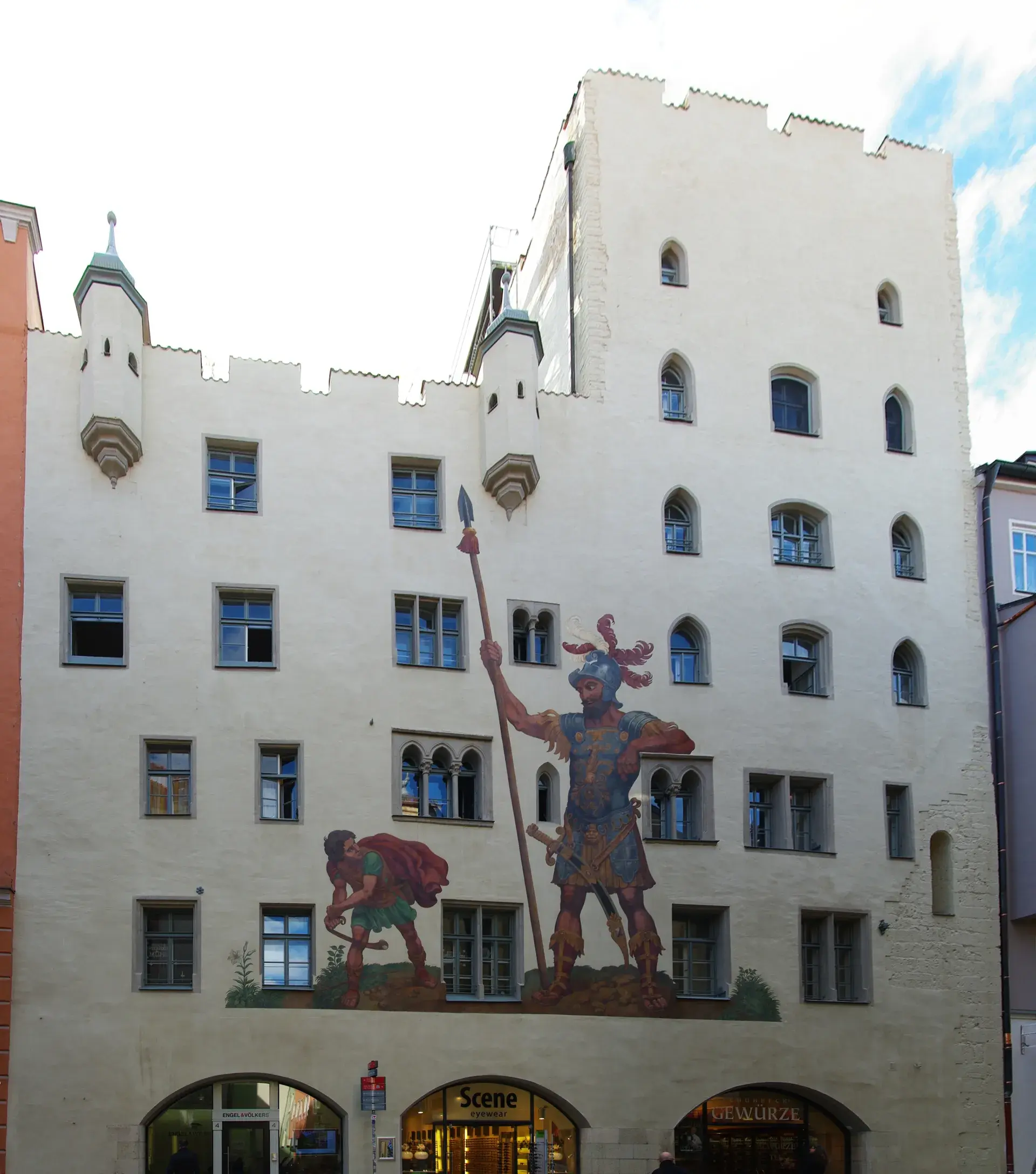
Haus Zum Goldenen Kreuz: Originally constructed around 1250 as a crenellated, fortress-like residence for the Weltenburger and Zeller patrician families, this building evolved into a prestigious imperial inn by the 16th century. Holy Roman Emperor Charles V lodged here during imperial diets held in 1532, 1541, and 1546. During his 1546 visit, Charles V engaged in a liaison with local resident Barbara Blomberg, resulting in the birth of Don John of Austria, the commander who led the Holy League fleet to victory at the Battle of Lepanto in 1571.
-
Neue Waag: Situated on the eastern side of the square, this four-winged patrician complex features a prominent residential tower. The city acquired the property in 1441 to house the municipal scale (Stadtwaage), where commercial goods were weighed and duties assessed. In 1541, its upper hall served as the stage for the Regensburg Colloquy, a high-profile theological debate between Protestant reformer Philipp Melanchthon and Catholic theologian Johannes Eck. Between 1663 and 1806, the building accommodated scribes who transcribed and dictated official protocols for the Perpetual Imperial Diet.
-
Thon-Dittmer-Palais: Bordering the southern flank, this classicist palace was rebuilt in the 19th century by architect Emmanuel d'Herigoyen for the prominent Dittmer merchant family. The complex integrates a Renaissance arcaded courtyard and the Gothic 14th-century Sigismund Chapel.
The Justitiabrunnen and Notable Events
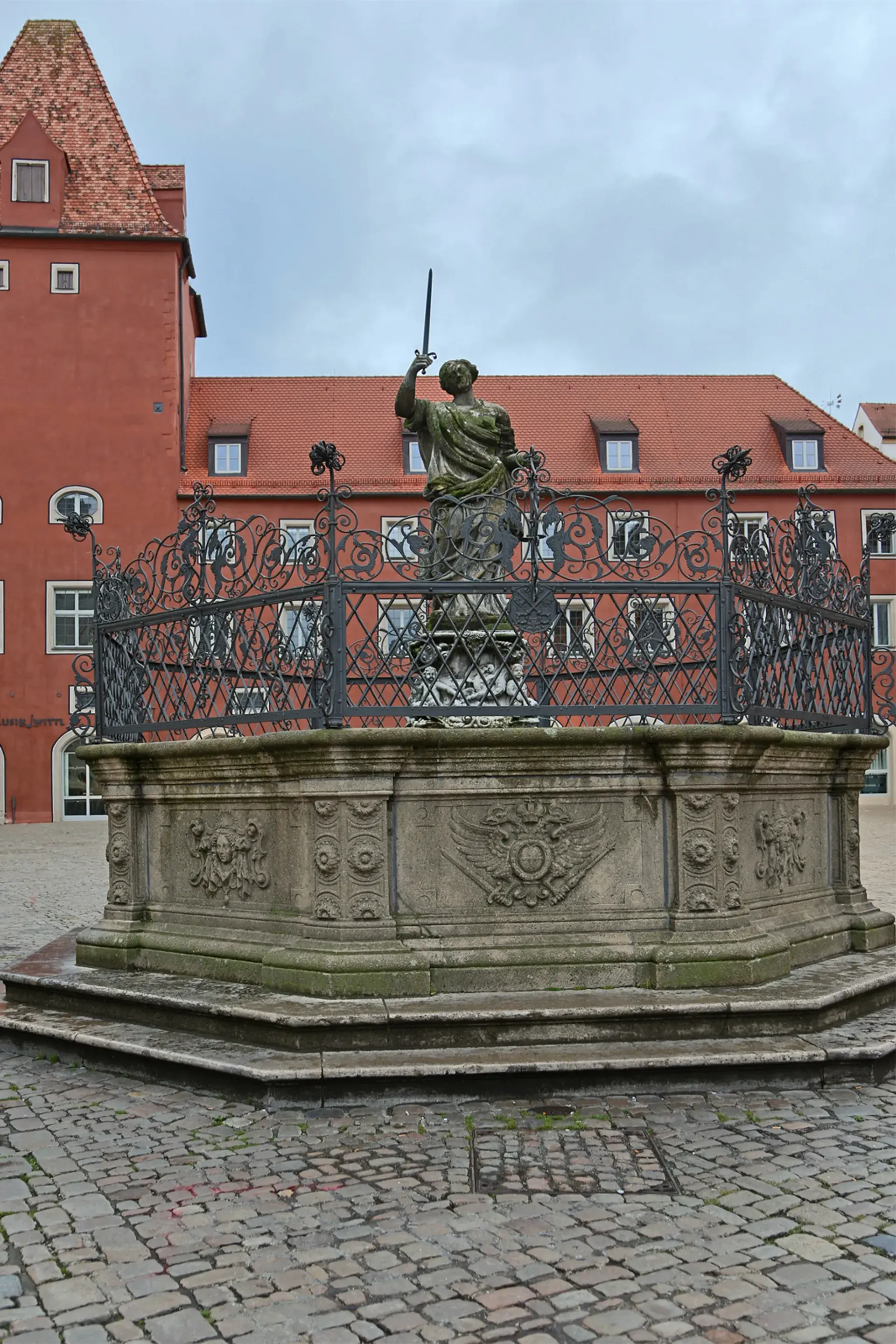
At the center of Haidplatz stands the Justitiabrunnen (Justice Fountain). Sculptor Leoprand Hilmer erected this Baroque sandstone monument in 1656 to replace an earlier 1551 wooden basin. Enclosed by an ornate wrought-iron grille crafted in 1592, the fountain is crowned by a statue of Lady Justice holding a sword and scales. At her feet, a sculpted crane holds a stone in its raised claw, serving as a traditional emblem of vigilance.
The square has also witnessed dramatic historical episodes. In 1635, Haidplatz served as the execution ground for Imperial General Hans Ulrich von Schaffgotsch, who was beheaded in an event contemporaries considered a political miscarriage of justice. In 1673, the visiting French acrobat and surgeon Charles Bernovin attempted a high-wire crossing over the square while covered in lit fireworks; mid-crossing, the pyrotechnics detonated prematurely, causing him to fall to his death.
Contemporary Life and Cultural Gatherings
After spending decades of the 20th century as a paved automobile parking lot, Haidplatz underwent extensive repaving and pedestrianization between 1982 and 1985. Situated west of the Altes Rathaus, the square now functions as a pedestrian thoroughfare lined with boutiques and outdoor café terraces, including Café Goldenes Kreuz.
Its historic landmarks have also transitioned into public roles. The Neue Waag serves as the seat of the Bavarian Administrative Court, while the Thon-Dittmer-Palais accommodates the municipal Department of Culture, the public library, an adult education center, and the Theater am Haidplatz. Throughout the year, the open plaza and palace courtyard host civic gatherings, including performances during the Bavarian Jazz Weekend, the biennial Bürgerfest, and an annual artisan Christmas market.
FAQ
What is the historical significance of the Haus Zum Goldenen Kreuz?
Built around 1250 as a fortified patrician residence, the Haus Zum Goldenen Kreuz later became an imperial inn hosting monarchs and diplomats. Holy Roman Emperor Charles V stayed here repeatedly in the 16th century, and his liaison here with Barbara Blomberg resulted in the birth of Don John of Austria.
What historic functions did the Neue Waag serve?
Acquired by the city in 1441, the Neue Waag served as the official municipal weighing office. It hosted the theological Regensburg Colloquy in 1541 and housed the dictation scribes of the Perpetual Imperial Diet from 1663 to 1806. Today, it houses the Bavarian Administrative Court.
What does the crane on the Justitiabrunnen represent?
At the base of the Lady Justice statue on the 1656 fountain, a sculpted crane holds a stone in its raised foot, which serves as a traditional symbol of alertness and vigilance.