Steinerne Brücke: Germany's Oldest Stone Bridge
A Romanesque Engineering Feat
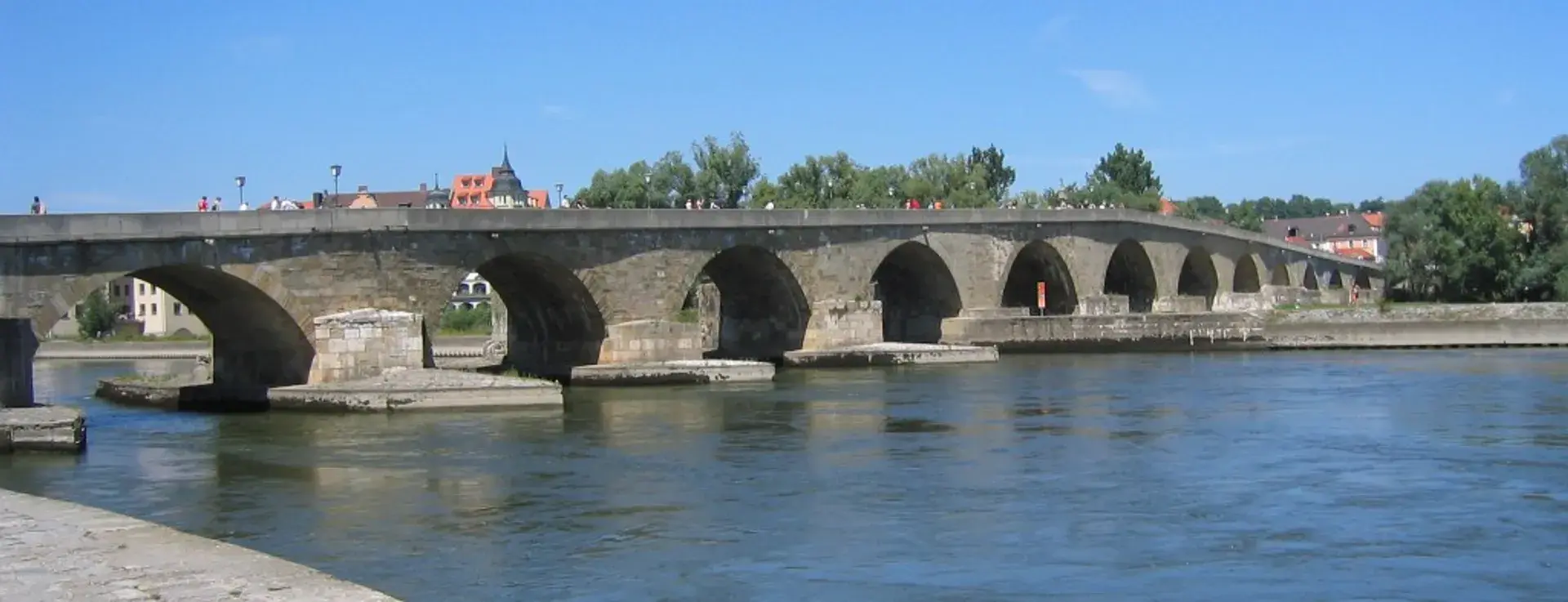
Built between 1135 and 1146 in the Romanesque style, the Steinerne Brücke (Stone Bridge) in Regensburg is Germany's oldest surviving stone bridge. Completed in just eleven years, the structure rests on massive stone-faced foundation piers that are supported by oak timber pilings set inside riverbed caissons.
Originally, the bridge stretched roughly 336 meters across 16 stone barrel-vault arches. In the early 17th century, the southernmost arch was integrated into the city’s municipal salt store (Salzstadel). Today, 15 arches remain visible, spanning approximately 309 meters. From 1146 until 1935, the bridge stood as the only permanent, solid crossing over the Danube in Regensburg. For centuries, it also served as the sole stone bridge over the river between Ulm and Vienna.
Crusades and European Influence
During the Middle Ages, the Steinerne Brücke was a pivotal transit point for major international expeditions. It served as the launch crossing for the Second Crusade under King Louis VII of France in 1147 and the Third Crusade led by Emperor Frederick Barbarossa in 1189.
The bridge’s Romanesque arch design also established an engineering blueprint across Europe. It provided a direct architectural model for other landmark medieval crossings, including Old London Bridge over the Thames, the Pont d'Avignon over the Rhône, and the Judith Bridge in Prague. Remarkably, the bridge was finished in 1146, more than 125 years before construction began on the Gothic Regensburg Cathedral in 1273.
Defenses and Changing Shorelines
Historically, traversing the bridge meant passing between distinct political entities. The south bank was governed as the Free Imperial City of Regensburg, while the northern bank at Stadtamhof fell under Bavarian rule.
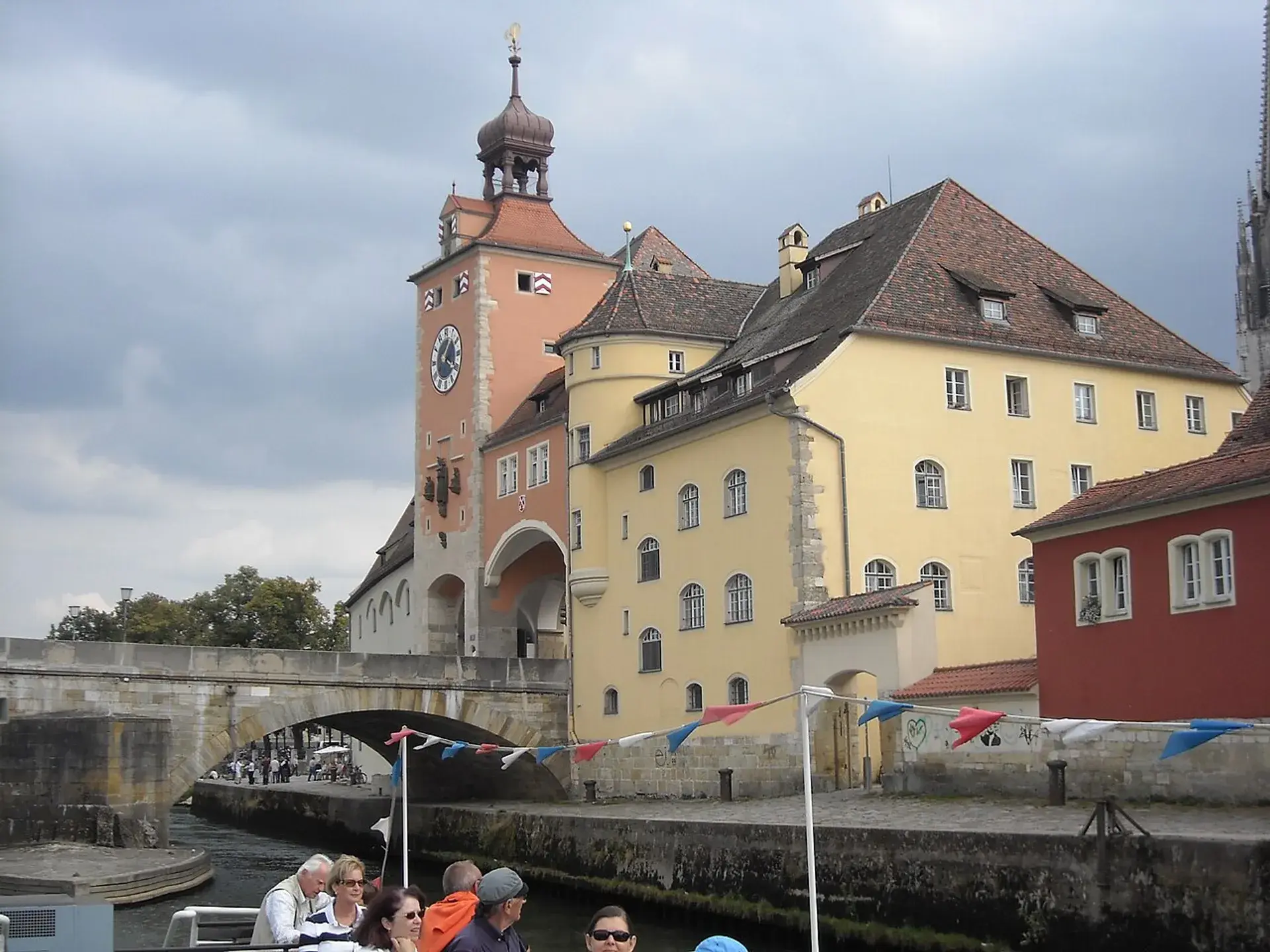
To safeguard this crossing, three fortified gate towers originally defended the structure. Only the southern Bridge Tower (Brückturm), which once functioned as a debtors' prison, still stands today. The middle tower was demolished following an ice flood in 1784, and the northern tower was dismantled in 1810 after sustaining severe damage during the 1809 Napoleonic siege.
River Currents and Cultural Lore
The construction of the bridge fundamentally altered the flow of the Danube. Because the massive stone piers compress the river channel by nearly two-thirds, the water accelerates dramatically, generating visible churning whirlpools known as the Donaustrudel. Directly beside the southern base sits the Historische Wurstkuchl. Established in 1135 as the site office and canteen serving boiled meat to the bridge stonemasons, it operates today as one of the world's oldest continuously running commercial kitchens, with charcoal smoke still rising from its open grill.
Perched atop the balustrade at the highest point of the bridge is the Bruckmandl (Bridge Man), a stone figure shielding his eyes toward the cathedral. While the tradition of the statue dates to the 16th century, the present sculpture was carved in 1854. Local folklore attributes the bridge's distinctive central hump to a wager between the bridge builder and the cathedral master. According to the tale, the bridge builder made a pact with the Devil to finish first, promising the first three souls to cross. When the builder cheated the pact by sending a dog, a rooster, and a hen across, the enraged Devil kicked the structure, leaving an enduring bend.
Modern Preservation and World Heritage
Today, the Steinerne Brücke is closed to motorized vehicles, functioning exclusively as an elevated promenade for pedestrians and cyclists. It provides a primary link between Regensburg’s historic city center and the colorful riverside district of Stadtamhof.
As a core element of the UNESCO World Heritage site designated as the "Old Town of Regensburg with Stadtamhof," the bridge underwent an extensive eight-year restoration between 2010 and 2018. This multi-year initiative stabilized the aged limestone piers and repaved the upper surface, safeguarding the medieval crossing for future generations.
FAQ
Why are only 15 arches of the Steinerne Brücke visible today?
Although the bridge was originally constructed with 16 arches, the southernmost arch was incorporated into the municipal salt store in the early 17th century, leaving 15 arches exposed.
Which historic military campaigns used the Steinerne Brücke?
The bridge served as a crossing point for medieval expeditions, including the Second Crusade led by King Louis VII of France in 1147 and the Third Crusade led by Emperor Frederick Barbarossa in 1189.
What is the origin of the Historische Wurstkuchl near the bridge?
The Historische Wurstkuchl opened in 1135 as an administrative office and food canteen that served boiled meat to the laborers and stonemasons building the Steinerne Brücke.