Kepler Monument: Honoring Johannes Kepler in Regensburg
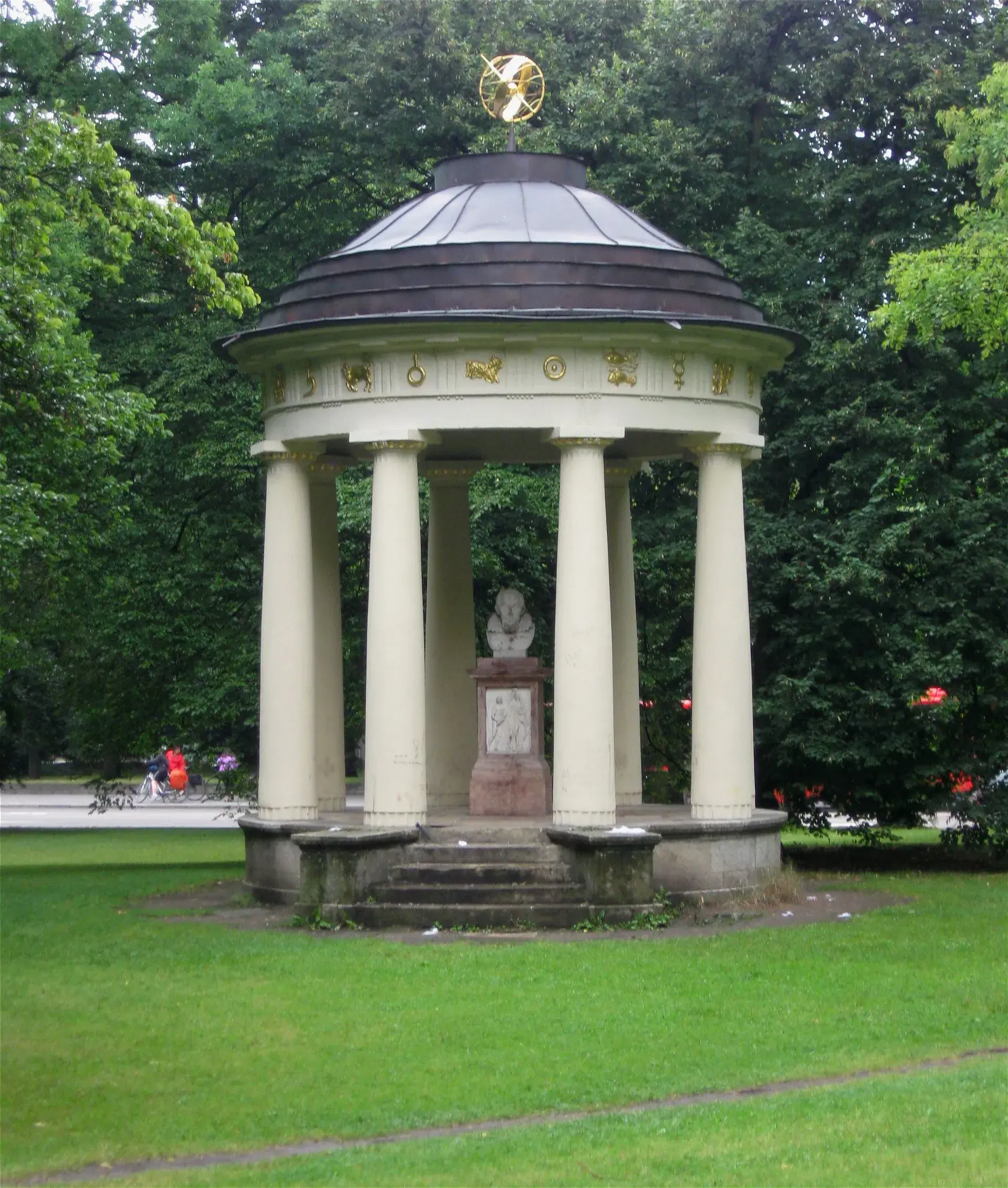
Johannes Kepler arrived in Regensburg chasing years of unpaid imperial wages, only to die penniless before his grave was wiped out by war. Today, the Kepler Monument stands as a tribute to the stargazer's enduring legacy.\n\n## A Neoclassical Tribute\nConstructed between 1806 and 1808, the Kepler Monument (Keplerdenkmal) is a Neoclassical Doric monopteros. Designed by court architect Emanuel Joseph von Herigoyen, the open circular temple features pale limestone columns and a conical roof adorned with astronomical motifs. Commissioned by Prince-Primate Karl Theodor von Dalberg and Count Kaspar von Sternberg, it was dedicated on December 27, 1808.\n\nThe monument is situated in the Fürst-Anselm-Allee, an English-style landscaped parkway built over the city's medieval ramparts. Shaded by mature deciduous trees, the classical structure contrasts against the green park lawn, serving as a prominent waypoint between the historic Old Town and the main railway station.\n\n## The Tragic Final Days of Johannes Kepler\nIn the autumn of 1630, Kepler traveled from Sagan to Regensburg to petition the Imperial Diet for over 12,000 guilders in unpaid salary accumulated as Imperial Mathematician. Severely weakened by the journey, he fell ill with an acute fever and died on November 15, 1630, in the home of merchant Hillebrand Hering.\n\nKepler was buried in the Protestant St. Peter's cemetery outside the southern town walls. However, in 1633, during the Thirty Years' War, a Bavarian garrison leveled the cemetery to clear defensive lines against approaching Swedish troops. This military action permanently eradicated Kepler's grave.\n\n## Relocation and Preservation\nGymnasium rector Philipp Ostertag first proposed a memorial in 1785, an initiative Dalberg finally realized more than two decades later near Kepler's estimated burial ground. Remarkably, just months after its dedication, the monument emerged completely undamaged from intense French and Austrian artillery barrages during the 1809 Battle of Ratisbon.\n\nBetween 1858 and 1859, the temple was dismantled and shifted slightly west to accommodate new rail lines for Regensburg's Central Station.\n\n## Artistic Features and Surviving Words\nThe monument houses a central replica bust of Kepler atop a red marble plinth, alongside a replica marble relief depicting the astronomer contemplating celestial spheres. The originals, sculpted by Friedrich Döll and Johann Heinrich von Dannecker, are preserved in the city's Historical Museum and the Keplergedächtnishaus—the surviving merchant house where Kepler died.\n\nThough Kepler's physical burial site was destroyed, his self-written Latin epitaph survived in historical records: 'Mensus eram coelos, nunc terrae metior umbras. Mens coelestis erat, corporis umbra iacet' ('I measured the heavens, now the shadows I measure. Skybound was the mind, earthbound the body rests').
FAQ
Where is the original bust of the Kepler Monument located?
The outdoor bust and relief are replicas installed in the 1980s. The original marble sculptures by Friedrich Döll and Johann Heinrich von Dannecker are preserved in Regensburg's municipal museum collections, including the Keplergedächtnishaus and Historical Museum.
What happened to Johannes Kepler's original grave?
Kepler was buried in St. Peter's cemetery in 1630. During the Thirty Years' War in 1633, the Bavarian garrison leveled the burial ground to clear defensive lines against Swedish forces, permanently destroying the grave.
Why was Johannes Kepler in Regensburg when he died?
In the autumn of 1630, Kepler traveled to Regensburg to petition the Imperial Diet for over 12,000 guilders in overdue salary accumulated during his time as Imperial Mathematician.