Neupfarrplatz: Regensburg's Layered History
The Multi-Layered Heart of Regensburg
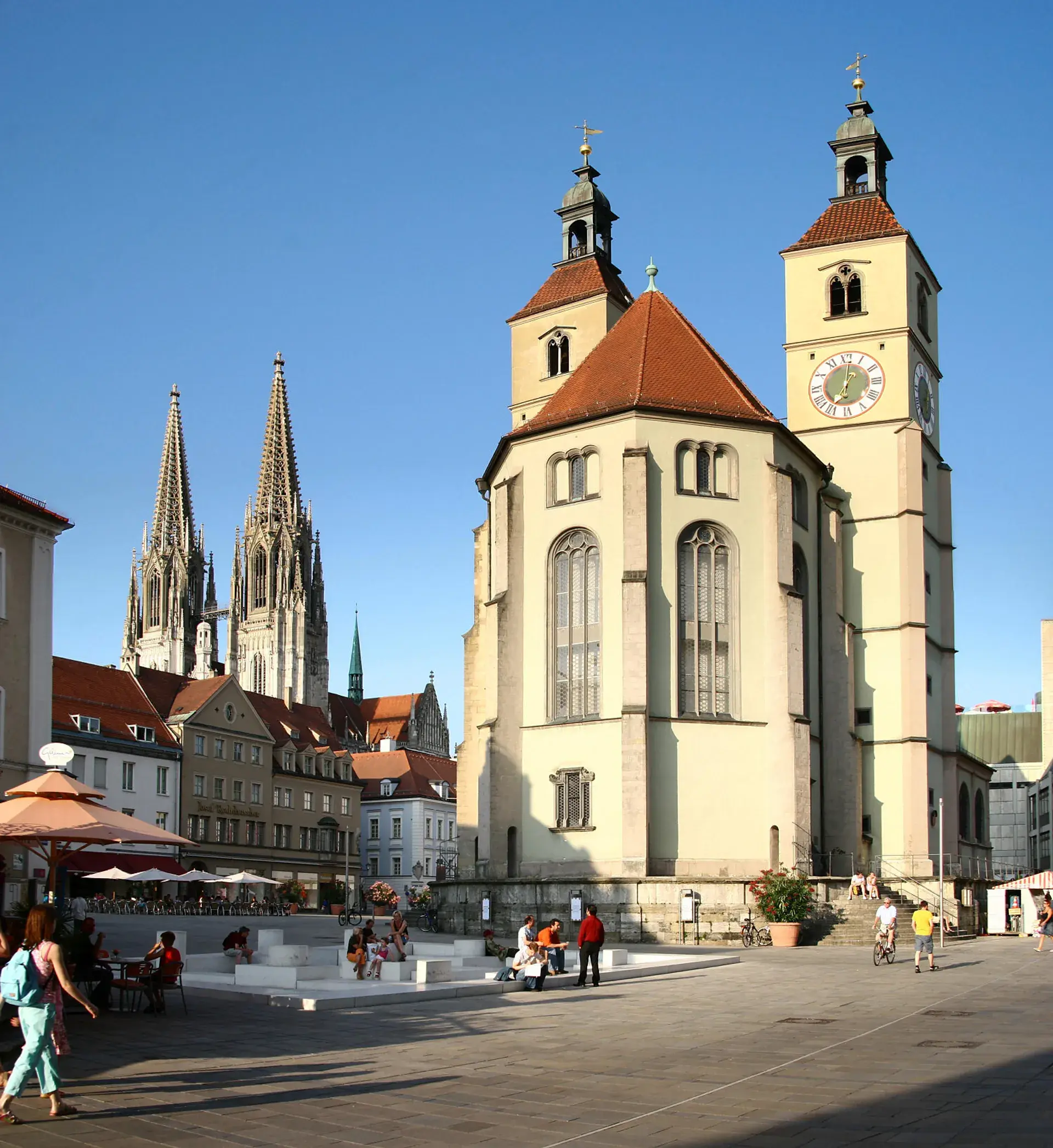
Neupfarrplatz is a central pedestrian square located in the heart of Regensburg's UNESCO World Heritage Old Town. Positioned along the primary path connecting St. Peter's Cathedral to the east and the Old Town Hall to the west, the plaza functions as a lively commercial hub, retail corridor, and weekly marketplace. It also serves as the host site for the city's annual Christkindlmarkt. Beneath its contemporary surface, however, lies an extraordinary physical timeline that vertically compresses nearly two millennia of urban history.
From Roman Fortress to Medieval Settlement
The earliest structural traces beneath Neupfarrplatz date to 179 AD, when the Roman legionary fortress Castra Regina was established under Emperor Marcus Aurelius. Located approximately six meters below the modern pavement, excavations revealed officer quarters that once flanked the fortress's main thoroughfare, the via principalis, featuring mortar walls and brick slab floors.
Centuries later, this same ground developed into Regensburg's medieval Jewish quarter (Judengasse). Documented as early as 981 AD, it grew into an important intellectual and religious center consisting of roughly 40 residential houses, communal buildings, and a stone synagogue. During periods of turmoil, residents took measures to protect their valuables; among the cellar remains, archaeologists discovered a hidden late 14th-century hoard of 624 gold coins and a seal ring belonging to the Jewish community, both untouched for six centuries.
The 1519 Expulsion and the Neupfarrkirche
Following the death of Holy Roman Emperor Maximilian I, who had historically protected the settlement, the Regensburg city council ordered the expulsion of the Jewish community in February 1519. The entire quarter was systematically razed and the synagogue demolished. During the demolition, master mason Kern fell from the scaffolding without sustaining injuries. Clergy seized upon this event as a Marian miracle to legitimize converting the destroyed synagogue into a pilgrimage site dedicated to the "Beautiful Mary" (Zur Schönen Maria).
A temporary wooden chapel was quickly erected, followed by ambitious construction on a stone pilgrimage church. Financial exhaustion halted the build in 1528, leaving only the choir and two towers. In 1542, when Regensburg embraced the Lutheran Reformation, the unfinished shell was repurposed as the city's first Protestant parish church, the Neupfarrkirche, which gave the surrounding open space its name: Neupfarrplatz. Today, the church continues to serve as an Evangelical Lutheran university parish church.
Subterranean Discoveries: document Neupfarrplatz
The extensive physical remains below the plaza came to light in 1995. Routine municipal utility work—originally aimed merely at laying electrical cables for Christmas market stalls—unexpectedly broke into historic strata, launching a 3,000-square-meter excavation that lasted until 1998.
Today, the site operates as "document Neupfarrplatz," an underground museum curated by the Museums of the City of Regensburg. Preserved beneath low lighting, visitors inside the excavation encounter the scent of aged mortar and cool limestone alongside exposed Roman brickwork and medieval vaulted cellars. The site also reveals World War II history: rather than digging new shelters from scratch, wartime authorities retrofitted the sturdy medieval cellars into a concrete-reinforced air-raid tunnel network.
The Misrach Surface Memorial
History remains tangible on the surface of Neupfarrplatz through Dani Karavan's 2005 white relief monument, titled Misrach. Traced directly onto the dark paving stones of the square, the walkable sculpture replicates the precise floor plan and column bases of the destroyed medieval synagogue. At the eastern niche of the monument, the Hebrew word "Misrach" (East) is carved into the stone, designating the directional orientation toward Jerusalem where the synagogue's Torah ark once stood.
FAQ
How can visitors access the underground excavations at document Neupfarrplatz?
The subterranean museum site is accessible exclusively via organized guided tours managed by the Museums of the City of Regensburg, which can be arranged through the Old Town tourist information center.
What is the significance of the white stone monument on the square?
Installed in 2005 by Israeli sculptor Dani Karavan, the relief sculpture 'Misrach' outlines the footprint of the medieval synagogue that was demolished during the expulsion of the Jewish quarter in 1519.
What prompted the major archaeological excavation at Neupfarrplatz?
The 1995–1998 excavation was triggered accidentally by routine municipal trenching intended to install electrical wiring for Christmas market stalls and pedestrian infrastructure.