Porta Praetoria: Regensburg's Ancient Roman Gate
The Roman Fortress of Castra Regina
Constructed around 179 AD during the reign of Roman Emperor Marcus Aurelius, the Porta Praetoria originally served as the northern gate (porta praetoria) of the legionary fortress Castra Regina. Built in the wake of the Marcomannic Wars to accommodate the Third Italian Legion (Legio III Italica), the gateway operated as a fortified sally port pointing north toward unconquered Germanic territory along the Danube frontier.
Along with the Porta Nigra in Trier, the monument is one of the only surviving Roman stone city gates north of the Alps. Originally, the structure was a symmetrical dual portal flanked by semicircular towers estimated at 20 meters in height. Archaeological excavations in 1971 confirmed this dual-arch design and indicated that the western half was likely destroyed during Alemannic incursions around 280 AD.
Construction and Architectural Form
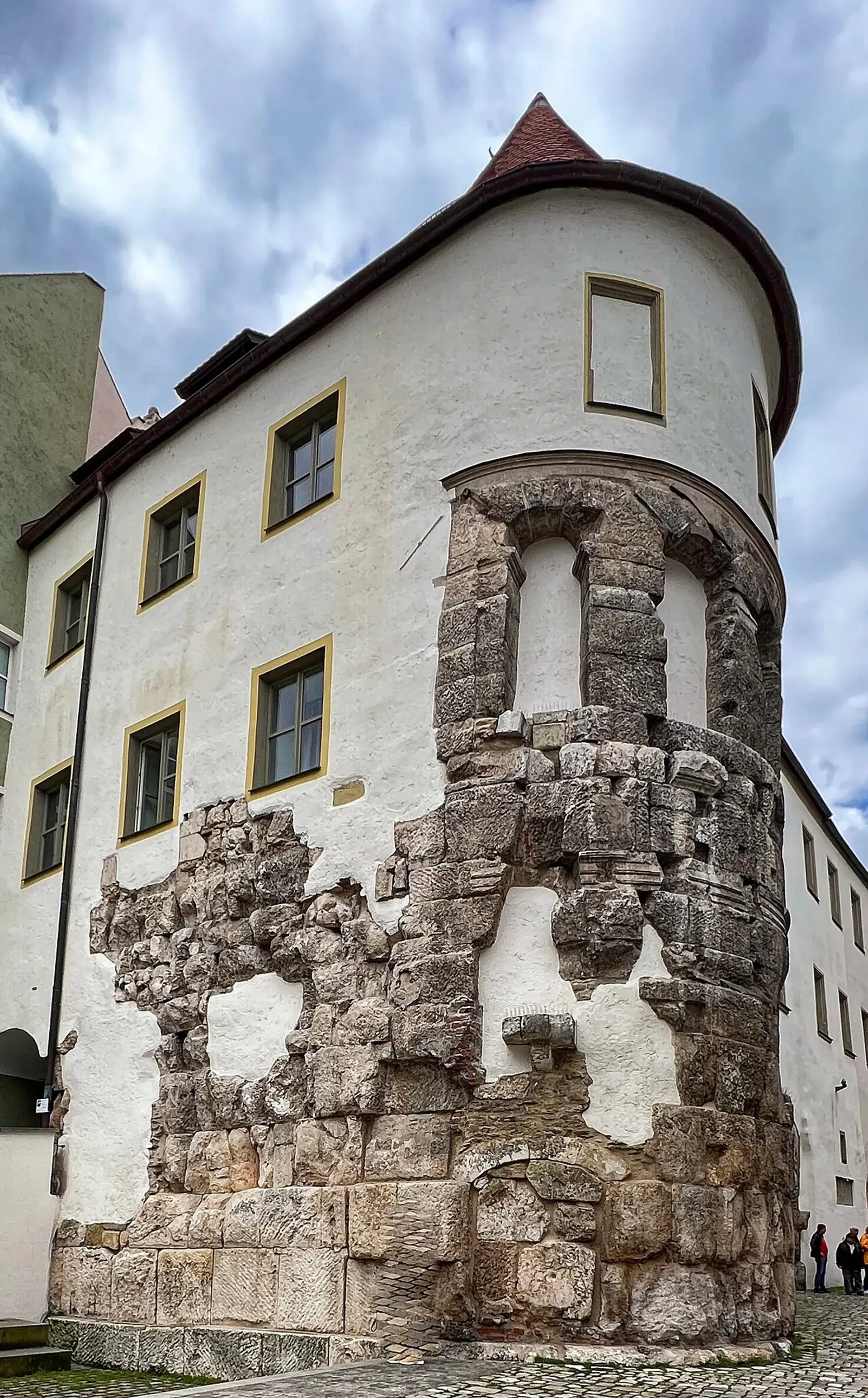
The surviving gate complex reaches roughly 11 meters in height, making it the tallest partially upright Roman structure in Bavaria. It consists of the eastern tower, preserved across its ground and upper levels, alongside a surviving rounded archway. Roman builders constructed the gateway using massive, dry-laid limestone ashlar blocks joined entirely without mortar.
Centuries of urban development have visibly elevated the surrounding ground. Today, the original Roman plinth rests approximately one meter below the current street surface of Unter den Schwibbögen, providing a physical cross-section of Regensburg's two millennia of habitation.
Medieval Use and the Brewery Enclosure
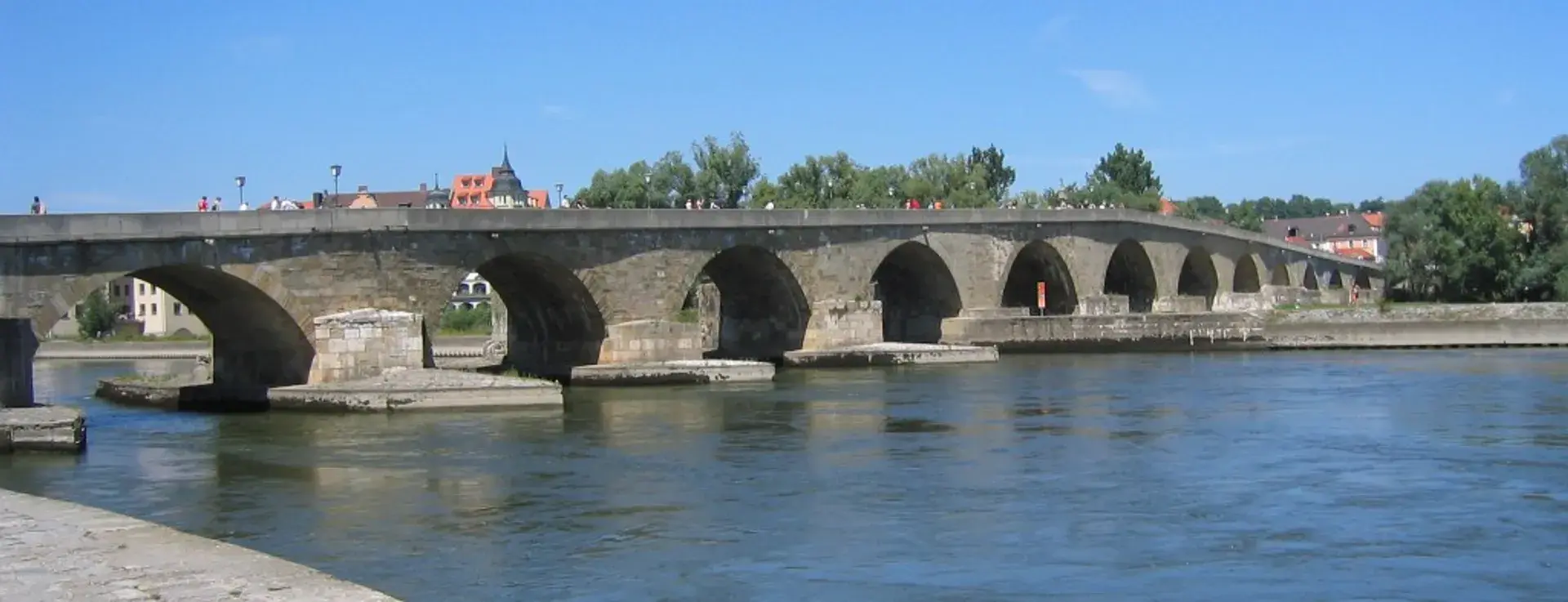
During the Middle Ages, the gateway took on a civilian role. Documents from 932 AD refer to the structure as the Porta Aquarum (Water Gate), reflecting its use as an exit path leading to the Danube River. However, the construction of the Stone Bridge and new municipal defensive rings in the 12th century rendered the Roman portal obsolete as a primary town entrance.
Between 1649 and 1650, the complex was absorbed into urban development when the Bischofshof episcopal brewery was erected directly against and around the ancient stone. The Roman portal was completely enclosed inside new walls, vanishing from public view for centuries. During this era of concealment, the forgotten interior chambers of the Roman tower functioned as a utility space, serving as a brewery storeroom, a beer cellar, and a potato cellar.
Rediscovery and Modern Heritage
In 1885, demolition work on sections of the brewery exposed the ancient limestone blocks. A conservation campaign carried out between 1885 and 1887 cleared the structure, preserving the gateway where it met the 17th-century episcopal palace. This integration created a distinct visual contrast: the colossal, weathered grey-white Roman ashlar blocks merge directly into smooth exterior plaster and painted baroque window frames.
Today, the gate forms an essential anchor of Regensburg’s UNESCO World Heritage designation, marking the city's origins as a Roman legionary garrison. The monumental Roman dedication inscription that originally hung above the portal also survived. Now preserved in the city's Historical Museum, the inscribed stone serves as Regensburg's official "birth certificate" from 179 AD.
Access and Location
The Porta Praetoria stands on Unter den Schwibbögen, positioned between St. Peter's Cathedral and the Danube riverfront. The monument is freely accessible to pedestrians, who can walk beneath the preserved Roman archway into the courtyard beer garden of the Hotel & Restaurant Bischofshof am Dom. Managed as part of the municipal "document Porta Praetoria" archaeological circuit, organized access to the interior tower masonry is coordinated via the city visitor center at Domplatz 5.
FAQ
When was the Porta Praetoria built?
The gate was constructed around 179 AD under Roman Emperor Marcus Aurelius to serve as the northern entrance to the fortress of Castra Regina.
Why was the gate hidden for over two centuries?
Around 1649–1650, the Bischofshof episcopal brewery was constructed around the gate, completely walling it into the building until demolition work revealed it in 1885.
What happened to the gate's original Roman inscription?
The stone dedication tablet survived and is now on display at Regensburg's Historical Museum, functioning as the city's official founding document from 179 AD.
Can the Porta Praetoria be visited today?
Yes. The gateway is freely visible on the street Unter den Schwibbögen and leads into an inner courtyard, with interior tower tours organized through the visitor center at Domplatz 5.