St. Emmeram's Abbey & Schloss Thurn und Taxis
The Origins of St. Emmeram's Abbey
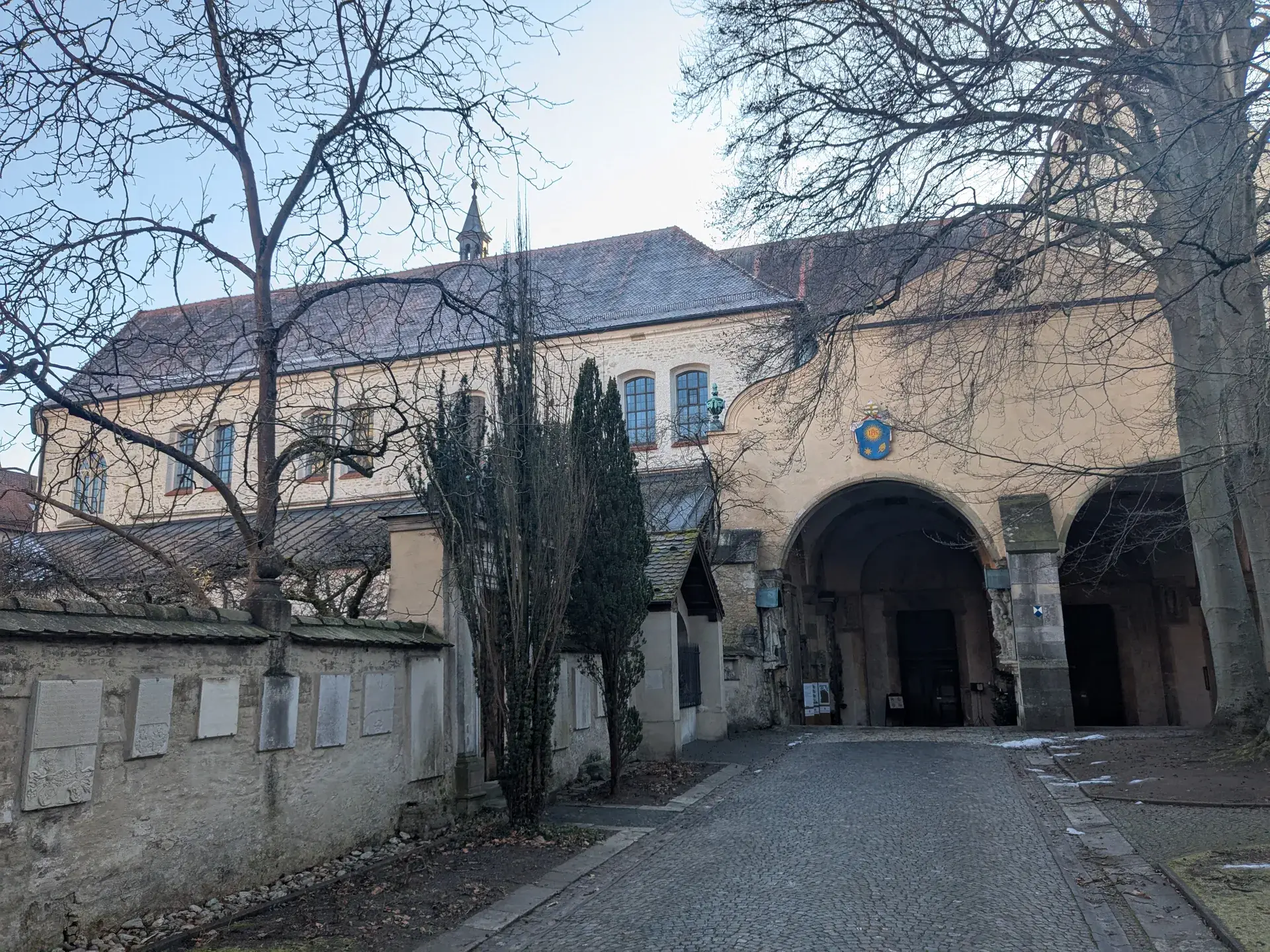
Founded around 739 AD over the burial site of Saint Emmeram, an itinerant missionary bishop and martyr, St. Emmeram's Abbey was established adjacent to the ancient Roman legionary camp of Castra Regina. Tradition holds that Saint Emmeram was martyred by being bound to a ladder and tortured, a legacy reflected in religious art where the saint is consistently depicted holding a ladder. For over a millennium, the Benedictine abbey served as an influential spiritual, intellectual, and scientific center in Bavaria.
The monastery gained Imperial Abbey (reichsunmittelbar) status in 1295, placing it directly under the authority of the Holy Roman Emperor. In 1731, its abbots were elevated to Imperial Princes. The abbey also became the final resting place for royal and historical figures, including East Frankish King and Emperor Arnulf of Carinthia, King Louis the Child, Queen Hemma, and Bavarian historian Johannes Aventinus.
The Postal Empire of Thurn und Taxis
The modern identity of St. Emmeram is linked to the House of Thurn und Taxis. In 1490, Franz von Taxis established an organized courier network linking Habsburg domains across Europe. In 1615, Emperor Matthias made the office of Imperial Postmaster General a hereditary fief of the family, laying the foundation for an unprecedented commercial fortune. Notably, in 1628, Alexandrine von Taxis took over management of the postal service following her husband's death, becoming an early female corporate director in German business history.
In 1748, Prince Alexander Ferdinand of Thurn und Taxis was appointed the Emperor's Principal Commissioner to the Perpetual Imperial Diet, prompting the family to relocate their court to Regensburg. Following secularization during the Napoleonic era, the monastic complex was dissolved. In 1812, the Kingdom of Bavaria granted the monastery buildings and grounds to the Thurn und Taxis family as compensation for the loss and nationalization of their postal monopoly.
Architecture: From Monastic Cloister to Princely Palace
Positioned on Emmeramsplatz at the southern edge of Regensburg's historic center, the five-hectare complex links the Roman-era core and Neupfarrplatz to the Fürst-Anselm-Allee green belt. Between 1731 and 1733, brothers Cosmas Damian and Egid Quirin Asam redesigned the abbey church in a dramatic Late Baroque style, contrasting with the austere stone architecture of the medieval cloister. Adjacent to the sanctuary stands a freestanding Renaissance bell tower housing six historical bells.
After acquiring the property, the princely family converted the monastery into a grand private seat. This transformation culminated in an expansive 150-meter Neo-Renaissance south wing designed by architect Max Schultze in the 1880s. Encompassing more than 500 rooms, Schloss St. Emmeram contains more rooms than Buckingham Palace and stands as the largest privately inhabited palace in Germany.
Schloss St. Emmeram and Present-Day Use
Schloss St. Emmeram continues to serve as the private residence of the House of Thurn und Taxis, headed by Albert II. Despite its private residential status, several historic wings are open to the public through guided tours, including the princely state apartments, the medieval cloister, and the Neo-Gothic crypt chapel. The former royal stables house the Marstallmuseum, which displays historic coaches, sleighs, and liveries, alongside the Princely Treasury.
The Basilica of St. Emmeram remains an active Roman Catholic parish church and pilgrimage destination, having been elevated to a papal basilica minor in 1964. The palace grounds also serve as a venue for regional celebrations, including the annual Schlossfestspiele music festival in July and an open-air Christmas market during Advent.
FAQ
Who owns and lives in Schloss St. Emmeram?
Schloss St. Emmeram is the private residence of the House of Thurn und Taxis, currently headed by Albert II, Prince of Thurn und Taxis.
How did the Thurn und Taxis family acquire St. Emmeram's Abbey?
Following secularization during the Napoleonic era, the Kingdom of Bavaria granted the former abbey complex to the Thurn und Taxis family in 1812 as compensation for nationalizing their hereditary postal monopoly.
How large is Schloss St. Emmeram?
The estate encompasses approximately five hectares and over 500 rooms, making it the largest privately inhabited palace in Germany.
Which notable historical figures are buried at the Basilica of St. Emmeram?
The basilica houses burials of several royal and historical figures, including Emperor Arnulf of Carinthia, King Louis the Child, Queen Hemma, and the Bavarian historian Johannes Aventinus.