Adlerturm: Rüdesheim’s Medieval Defense Tower
Late Gothic Architecture and Fortification
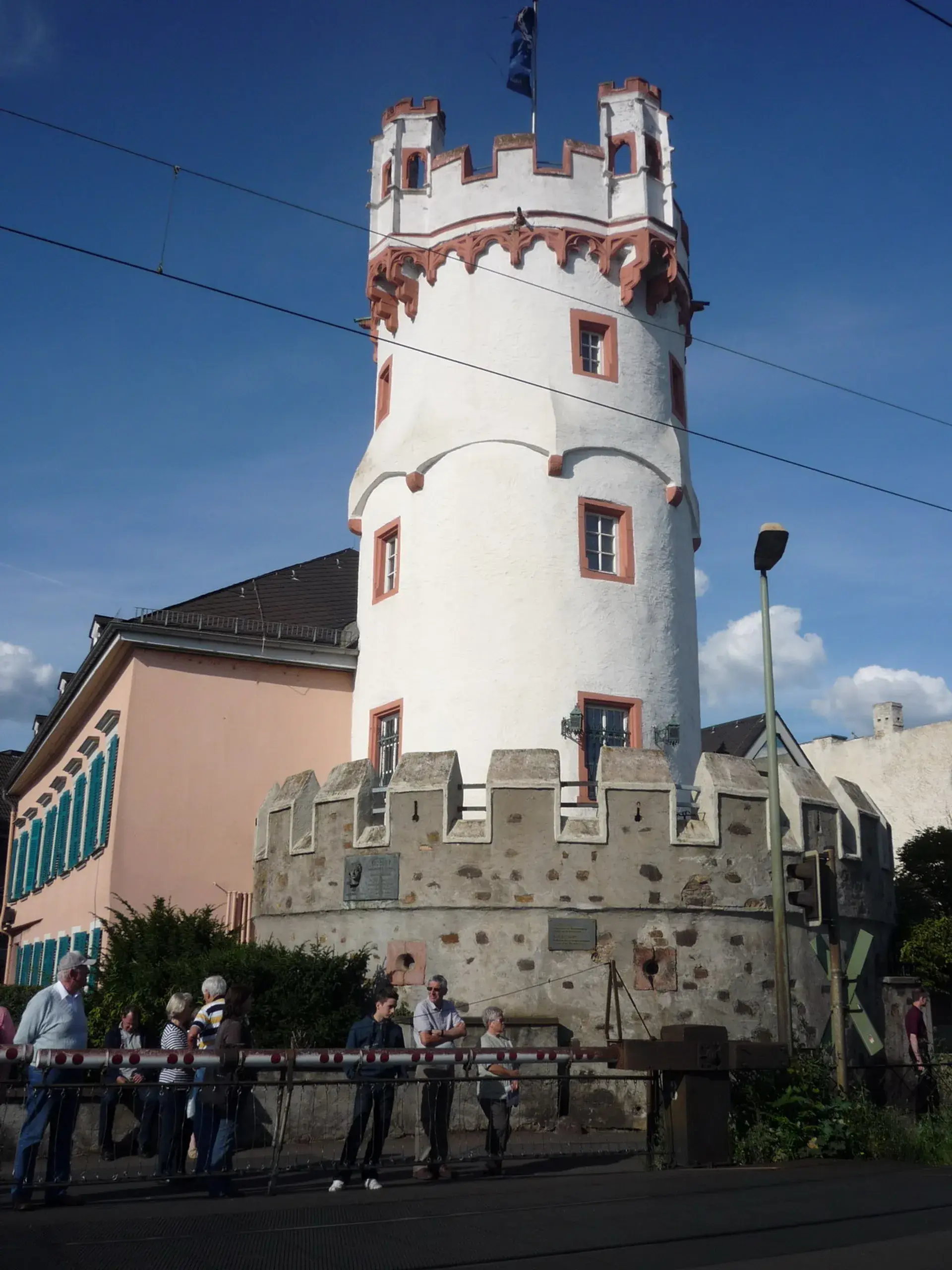
Standing 20.5 meters tall on Rheinstraße at the southeastern edge of Rüdesheim am Rhein, the Adlerturm (Eagle Tower) is the only surviving fortified tower from the town's late medieval outer defensive wall. Built with plastered rubble stone masonry (Bruchsteinmauerwerk) and accented with red sandstone trim, the circular structure rests on a two-story base. Its defensive walls measure roughly 1 meter in thickness, enclosing an interior space approximately 5 meters in diameter.
The tower rises through four upper storeys above a vaulted subterranean basement. Originally designed as a dungeon (Verlies), this subterranean chamber lacked a standard doorway and was accessible only via a narrow opening in the stone vault ceiling known as an Angstloch.
River Defense and Railway Expansion
Constructed during the second half of the 15th century, the Adlerturm was built as a corner fortification and gunpowder tower (Pulverturm) to reinforce Rüdesheim's expanding circuit defenses. At the time of its erection, the tower rose directly out of the Rhine riverbank to safeguard the southeastern river approaches against potential invaders.
The fortification's direct physical connection to the river was permanently cut off during the 19th century with the construction of the Rhine railway line. Around 1845, the tower was acquired by the owner of the neighboring Gasthaus "Zum Adler," an inn that gave the tower its current name.
Winter Ice Warnings and the Alter Eisbrech
In addition to its military duties, the Adlerturm functioned as an important winter safety installation for the river community. Watchmen hoisted a signal pole bearing a suspended fire basket (Feuerkorb) from the tower to alert river navigators and residents to dangerous moving ice floes (Eisgang) on the Rhine.
Directly riverside along the historic towpath stands the tower's functional counterpart, the "Alter Eisbrech." This massive sandstone ice-break buttress protected the riverbank and remains preserved with historical high-water and river-gauge carvings.
Literary Connections and Modern Landmark Status
The site also maintains a notable connection to Johann Wolfgang von Goethe, who lodged and dined at the adjoining inn during his travels across the Rheingau. A commemorative bronze plaque on the tower's exterior marks his stay and quotes his impression: "Der steile Fußpfad nach Rüdesheim führt durch die herrlichsten Weinberge!" ("The steep footpath to Rüdesheim leads through the most splendid vineyards!").
Today, the Adlerturm is protected as an official cultural monument (Kulturdenkmal) under Hessian heritage law. The tower and former inn are owned by the regional savings bank Nassauische Sparkasse (Naspa), which operates a branch on the property. Although the interior is not accessible as a public museum, the tower anchors passenger ferry docks, riverboat landings, and local transit stops designated "Am Adlerturm," marking the southeastern entry to the historic town route leading toward aristocratic seats like Brömserburg and Boosenburg.
FAQ
What was the original purpose of the Adlerturm?
Built in the late 15th century, the tower originally functioned as a corner defensive fortification and gunpowder tower that stood directly in the riverbank to guard the southeastern approaches to Rüdesheim.
Can visitors tour the interior of the Adlerturm?
No, the interior is not open as a regular public museum. The building is owned by the Nassauische Sparkasse bank and functions primarily as a preserved exterior historical monument.
How was the tower used as an ice-warning station?
During winter months, keepers raised a signal pole with a suspended fire basket from the tower to warn riverboats and townspeople of hazardous drifting ice floes on the Rhine.
Where does the name Adlerturm come from?
The tower acquired its name around 1845 when it was purchased by the innkeeper of the adjacent Gasthaus 'Zum Adler'.