Brömserhof: Rüdesheim's Mechanical Music Estate
Architecture and Medieval Origins
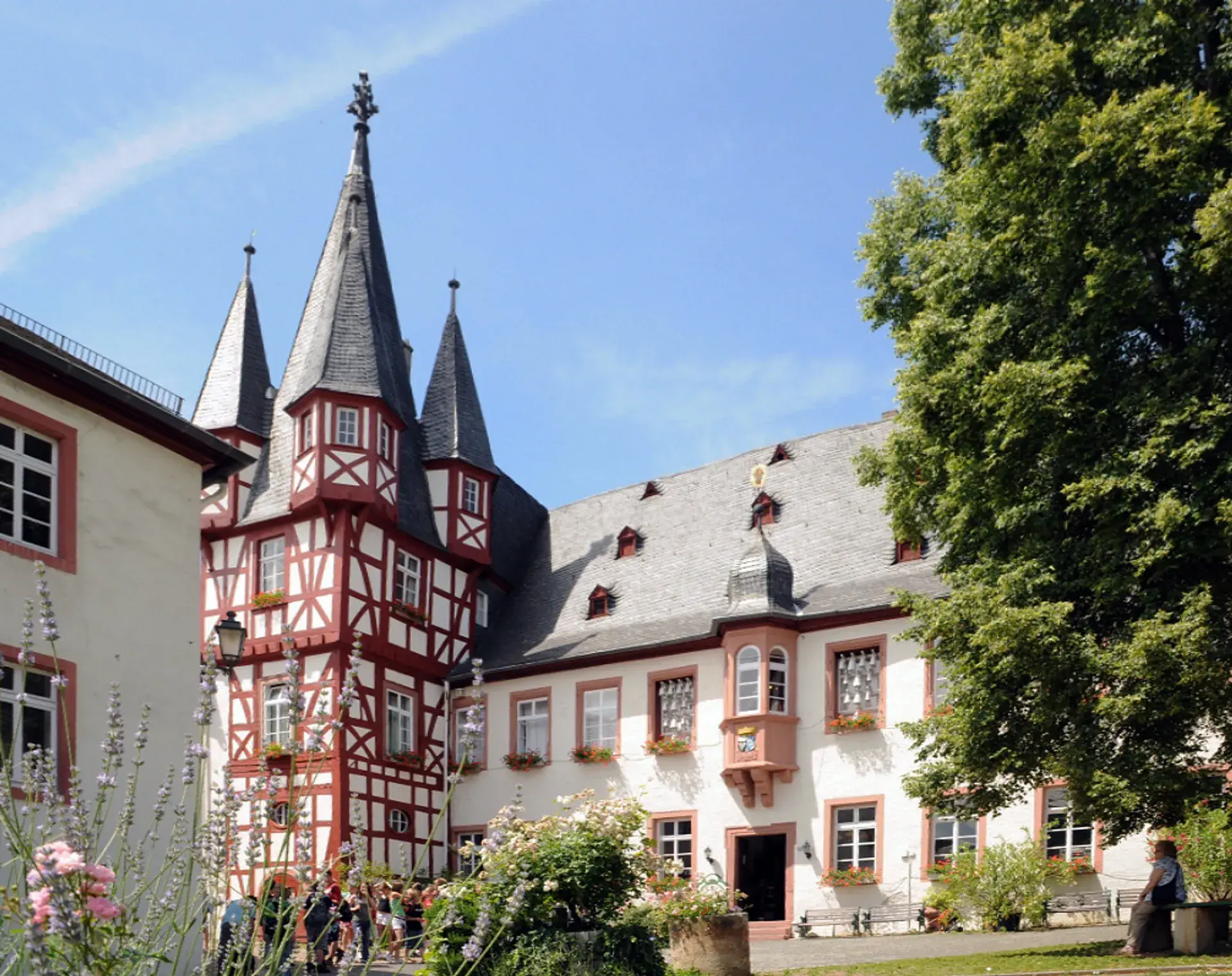
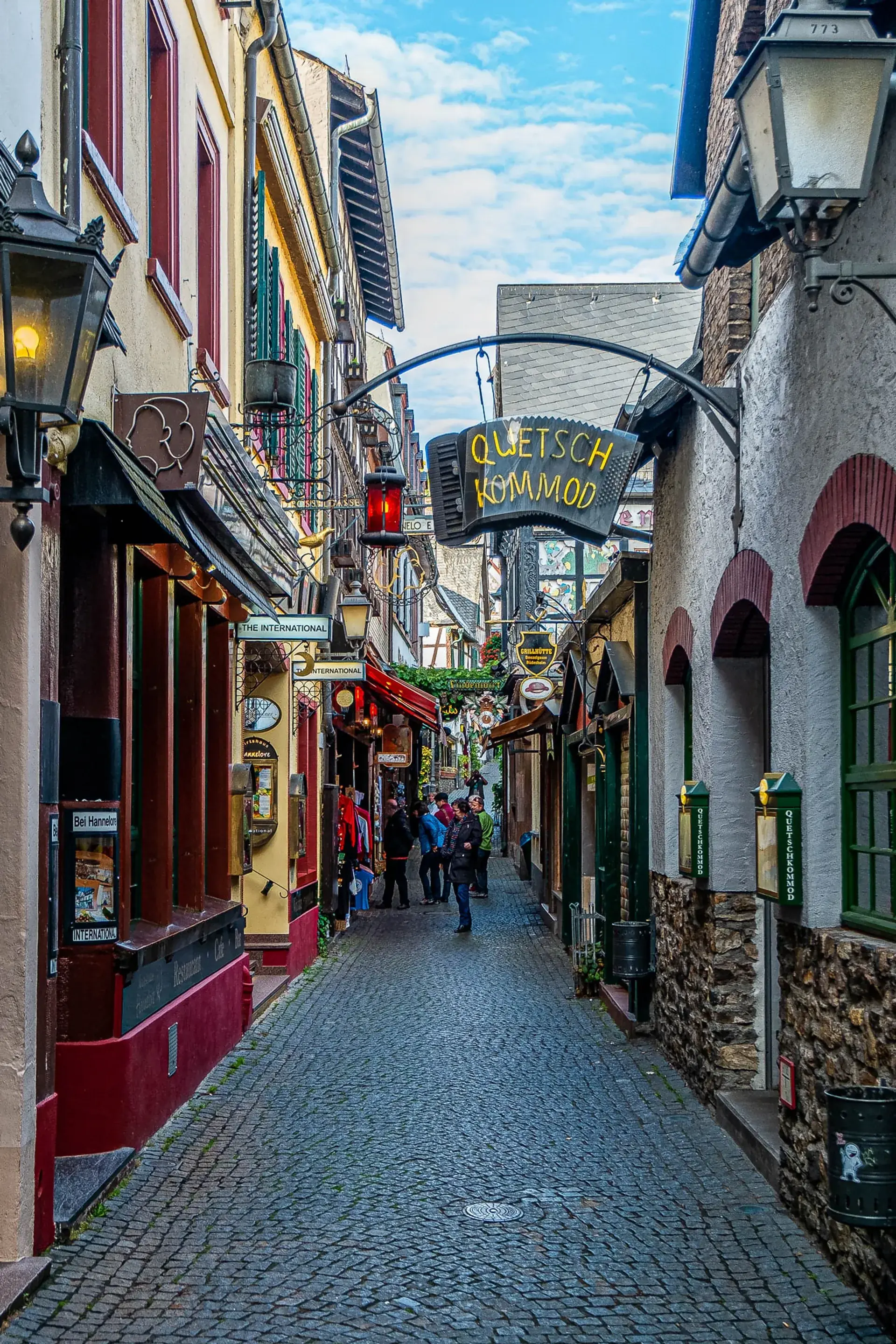
Located at Oberstraße 29 directly above the upper exit of the Drosselgasse, the Brömserhof is a historic aristocratic residence (Adelshof) originally built for the Brömser von Rüdesheim family. The site developed on land tied to the medieval Brömserburg, beginning with a fortified stone house (Festes Haus) constructed around 1310. This early structure remains the core of the northwest wing. Around 1500, when Rüdesheim erected new town defenses, the fortified manor was integrated directly into the perimeter wall as an internal corner bastion.
The complex expanded significantly during the Renaissance. In the 1540s, Heinrich I Brömser and his wife Apollonia von Ingelheim added an east wing and a stair tower. Later in the 16th century, the upper chambers were embellished with Renaissance wall and ceiling paintings funded partly by the inheritance of Walpurga von Greiffenclau. In 1609, Johann Reichard Brömser and Margarete von Kronberg oversaw the construction of the Mang'sche Haus on the eastern side of the courtyard.
Transition and the Birth of the Music Cabinet
The Brömser male lineage ended in 1668, after which the property passed through several noble families, including the Bettendorf, Erthal, and Frankenstein lines. In the 1830s, Sophie von Coudenhoven sold the estate into private hands, and by the 1850s, the town of Rüdesheim acquired parts of the complex for municipal and charitable purposes.
Following damage sustained during World War II, partial demolitions, and decades of vacancy, the municipality offered the property in the 1970s to collector Siegfried Wendel. Between 1974 and 1975, Wendel relocated his private collection to the estate. Wendel had originally collected antique pendulum clocks until an encounter in the 1960s—when a couple brought an antique walnut Polyphon music machine in the back of a Volkswagen—inspired him to sell his clocks and dedicate his life to preserving automated music.
The Collection of Automated Instruments
Today, the Brömserhof houses Siegfried’s Mechanical Music Cabinet (Siegfrieds Mechanisches Musikkabinett), Germany’s first public museum devoted to self-playing musical instruments. The collection spans roughly 350 to 400 historical instruments dating from the 18th to the early 20th century.
Notable exhibits include an early 19th-century Geneva-crafted snuffbox made by Bruguier, which conceals a miniature mechanical songbird that emerges through an oval trapdoor, flaps feathered wings, moves its beak to sing, and drops back inside. The museum also displays the Hupfeld Phonoliszt Violina, an early 20th-century instrument that uses an internal revolving circular bow to play three vertically mounted violins alongside an automated piano. Other curiosities include Bernhard Dufner's calliope, regarded as the largest doll automaton band built, consisting of 27 distinct mechanical musician figurines, as well as van-sized orchestrions like the 1905 Weber Maesto that mimic full orchestras with automated violins, organ pipes, and percussion.
Preservation and the Visitor Experience
The acoustic playback inside the Brömserhof operates entirely without digital amplification or speakers. Sound resonates through Gothic and Renaissance chambers with thick stone walls, driven purely by the motion of clockwork gears, hissing pneumatic bellows, felt hammers hitting percussion drums, and automated horsehair bows pressing against real violin strings.
The museum also maintains active workshops containing historic repair machinery, tools, master rolls, and punch cards used to restore clockwork, pneumatic, and disc-driven mechanisms. Positioned in central Rüdesheim, the Brömserhof provides a distinct technical and cultural contrast to the surrounding landscape of vineyards, castles, and wine taverns.
FAQ
What is the Brömserhof?
The Brömserhof is a 14th-century aristocratic residence in Rüdesheim am Rhein that served as a medieval bastion and now houses Siegfried’s Mechanical Music Cabinet.
What exhibits can be seen inside the Brömserhof?
The museum exhibits roughly 350 to 400 automated musical instruments dating from the 18th to the early 20th century, including orchestrions, singing-bird snuffboxes, automated violins, and a 27-piece mechanical doll band.
How can visitors access the mechanical music collection?
The museum is open daily from 10:00 am to 5:00 pm, and access is provided exclusively through 45-minute live guided tours offered in up to nine languages, during which selected instruments are demonstrated.