Niederwalddenkmal: Rüdesheim's Ridge Monument
Origins and Imperial Unification
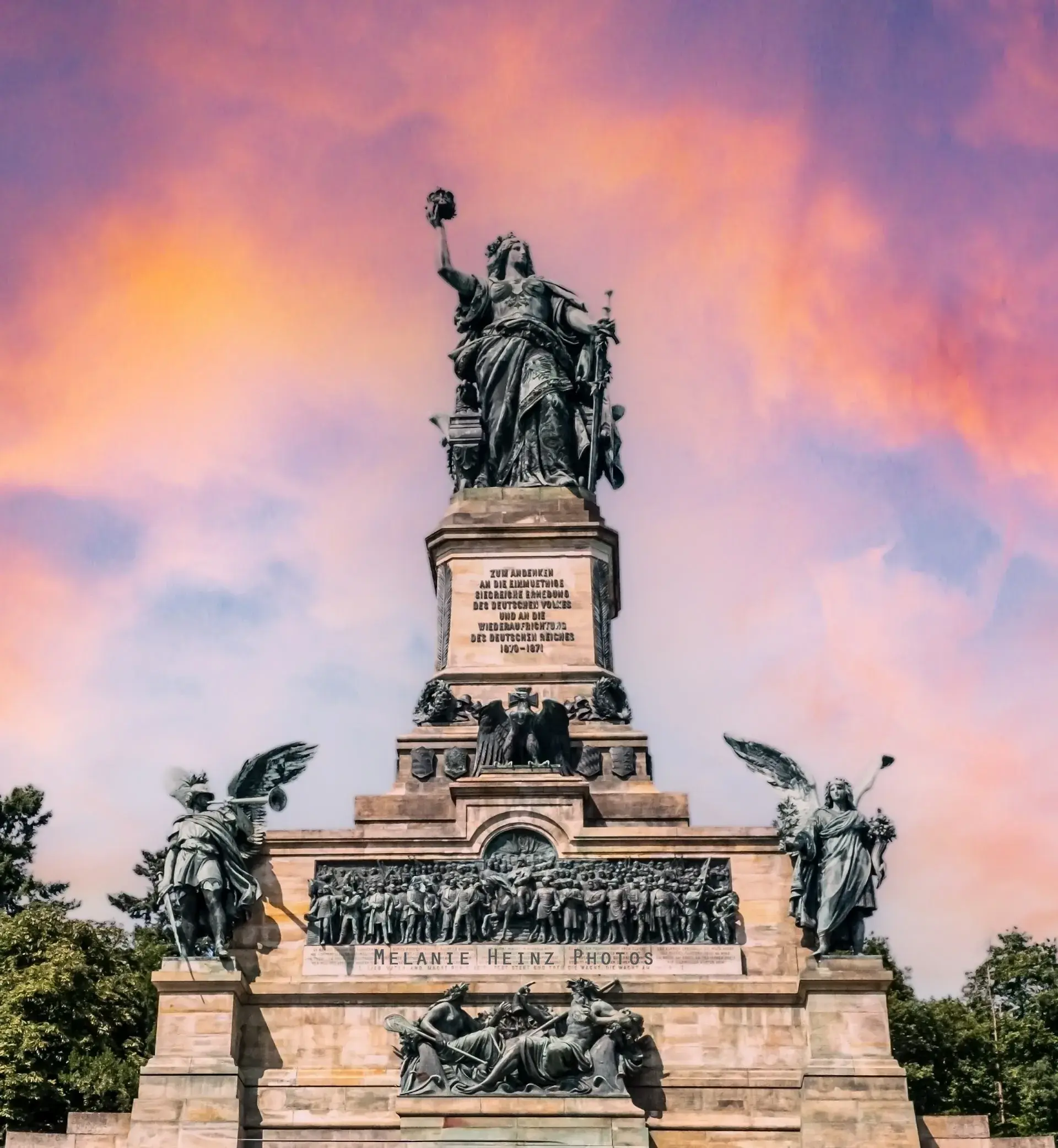
Perched roughly 355 meters above sea level on the crest of the Niederwald ridge, the Niederwalddenkmal overlooks the town of Rüdesheim am Rhein and the surrounding Rhine Gorge. Conceived to celebrate the German victory in the Franco-Prussian War of 1870–1871, the structure marks the unification of 25 separate German states into an empire led by the Prussian Hohenzollern dynasty.
The strategic location directly above the Rhine intentionally transformed a historically contested border into a prominent symbol of national defense. Emperor Wilhelm I laid the monument's foundation stone on September 16, 1877, and the site was officially inaugurated on September 28, 1883. Designed by sculptor Johannes Schilling and architect Karl Weißbach, the pedestal's primary inscription designated the event as a "re-establishment" (Wiederaufrichtung) of the empire, rhetorically connecting the modern Prussian-led constitutional state to the legacy of the Holy Roman Empire dissolved in 1806.
Architectural and Sculptural Design
The entire stone and bronze structure reaches a height of approximately 38 meters. Crowned at the apex stands an imposing bronze figure of Germania, measuring between 10.5 and 12.5 meters tall and weighing roughly 32 tons. Germania is depicted holding the reclaimed imperial crown aloft in her right hand while resting a lowered sword peacefully in her left. The individual bronze elements were cast in Dresden and transported across Germany by rail and river barge before assembly.
Beneath the central figure, a monumental bronze relief depicts Kaiser Wilhelm I on horseback, flanked by German princes, military commanders, and infantry. The relief features an engraving of lyrics from the patriotic anthem "Die Wacht am Rhein" (The Watch on the Rhine) and is flanked by sculpted personifications of War and Peace. Because Protestant Prussia held dominance over the predominantly Catholic Rheingau region, local residents historically referred to the towering Germania figure as the "Prussian Madonna."
The 1883 Dedication Plot
The formal inauguration ceremony on September 28, 1883, was the target of a failed assassination plot against Kaiser Wilhelm I and attending German military figures. Anarchists organized by August Reinsdorf concealed dynamite inside a drainage ditch positioned directly along the imperial procession route.
The plot unraveled due to a minor logistical compromise. Rather than procuring a waterproof fuse, one of the conspirators purchased an inexpensive hemp cord. Persistent morning rain soaked the fuse, preventing ignition and leaving the imperial party completely unaware of the threat during the ceremonies.
Landscape, Access, and Transit History
Today, the monument is an anchor of the UNESCO World Heritage Site "Upper Middle Rhine Valley." Its observation terrace and surrounding grounds remain open to the public daily without an admission charge. The site functions as a junction for walking trails throughout the Niederwald landscape park, linking paths toward the Niederwald Temple, the Jagdschloss, and the chairlift to Assmannshausen as part of the regional Ring Tour.
Tourist transportation to the ridge began in 1884 with a dedicated cogwheel railway. Following the World Wars, this rail line was decommissioned and eventually replaced in 1954 by the Rüdesheimer Seilbahn. This two-person open-air cable car system departs from the valley station on Oberstraße in Rüdesheim's pedestrian district, lifting passengers above steep, stone-walled vineyards of Riesling grapes before arriving at the breezy oak and beech woodlands lining the ridge.
FAQ
What historical event does the Niederwalddenkmal commemorate?
The monument commemorates the German victory in the Franco-Prussian War (1870–1871) and the resulting unification of 25 German states into an empire under Emperor Wilhelm I.
How large is the Germania statue atop the monument?
The bronze Germania figure stands between 10.5 and 12.5 meters tall and weighs approximately 32 tons, resting atop a monument reaching an overall height of roughly 38 meters.
How do visitors reach the Niederwalddenkmal from Rüdesheim?
Visitors can walk along pedestrian trails through the terraced vineyards or ride the two-person open-air cable car system departing from the valley station on Oberstraße.
Why was the monument targeted during its 1883 inauguration?
Anarchists led by August Reinsdorf planted dynamite along the procession path to assassinate Kaiser Wilhelm I and German military leaders, though rain-soaked hemp fuses caused the plot to fail.
Discover Rudesheim-am-rhein like never before
Dive into Rudesheim-am-rhein hidden stories and secret spots with Ciceru interactive tours.
Explore tour
Audioguide
Quizzes
Maps
Solo
Couples
Groups & families

© Photo by Melanie Heinz via Google Maps · Google Places