Schwerin Marktplatz: History & Architecture
The Marktplatz, officially known as the Altstädtischer Markt, is the civic and commercial heart of Schwerin. Laid out following the city's charter in 1160, the square anchors the historic core between the Schwerin Cathedral to the north and the Schweriner Schloss to the south. Historically, it served as the commercial counterbalance to the ducal authority concentrated at the lakeside palace.
Architectural Contrasts
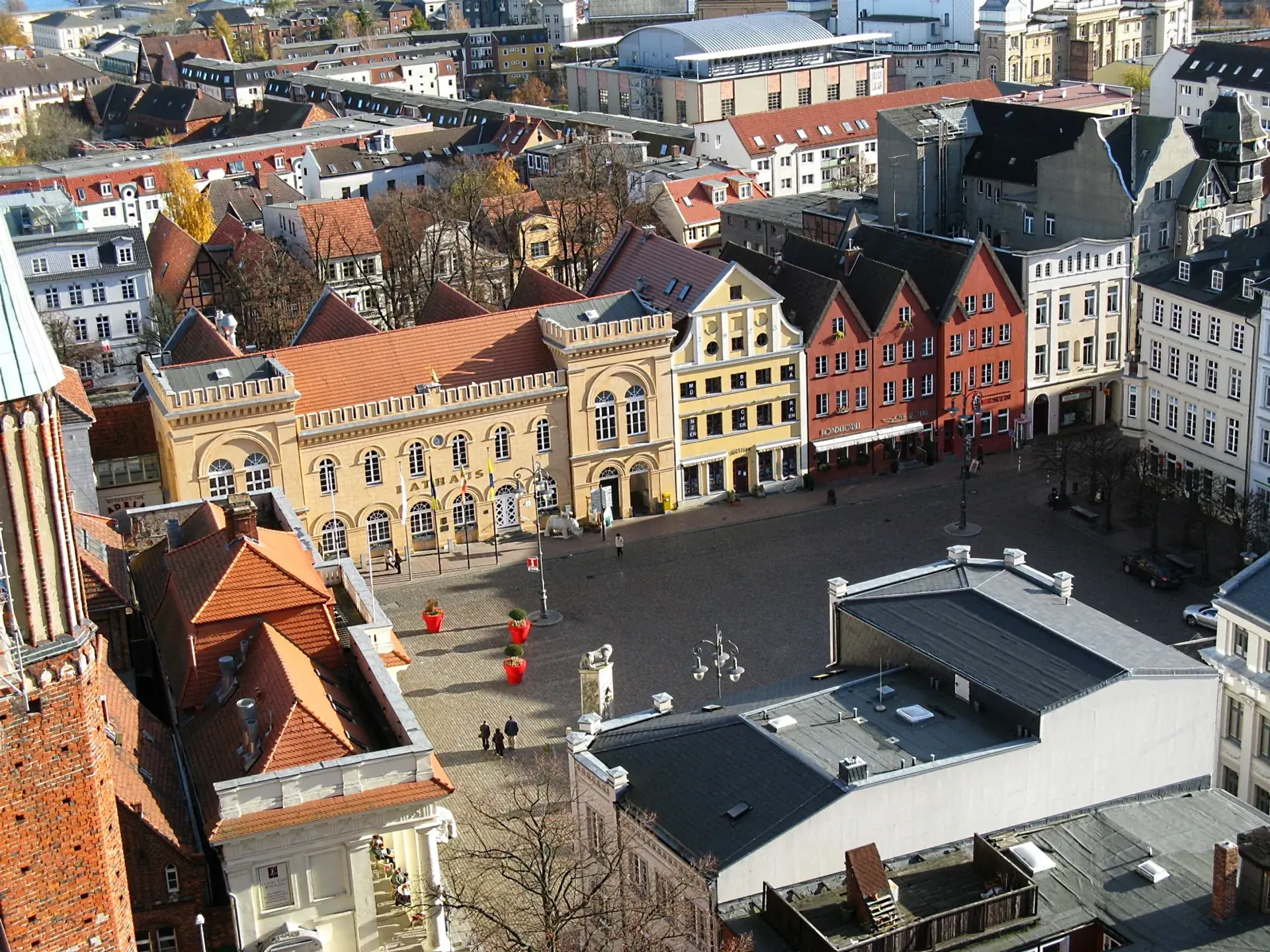
The square is defined by the striking contrast between two prominent buildings. On the west side stands the Altstädtisches Rathaus (Town Hall). Although a town hall has occupied this footprint since at least 1338, its current ochre-and-red Tudor Revival facade was designed by court architect Georg Adolf Demmler in 1835. This remodeling concealed older 17th-century half-timbered structures, leaving only a pointed archway on the east side as a surviving medieval remnant. A gilded 18th-century equestrian figure of Henry the Lion, matching the city's coat of arms, gleams from the central gable of the roofline.
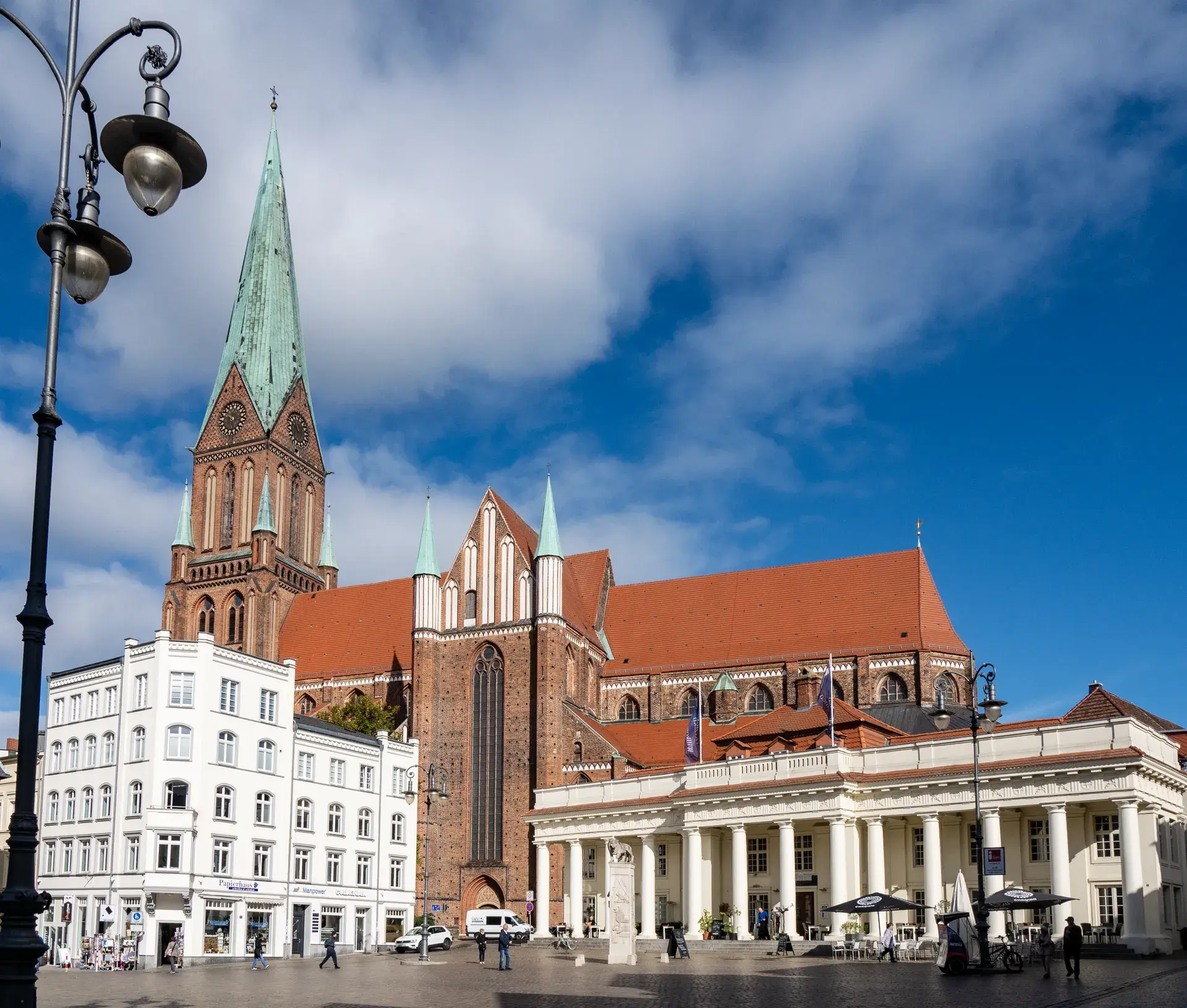
On the northern edge of the square sits the Säulengebäude, or The Colonnade. Designed by ducal court architect Johann Joachim Busch and constructed between 1783 and 1785, this Late Baroque and Early Neoclassical building features a prominent portico of fourteen white Doric columns. Duke Friedrich commissioned the building as an indoor market hall to replace and sanitize the chaotic open-air wooden merchant stalls. The frieze still displays carved stone reliefs of merchant iconography, including wheels and Hermes' staff. The structure was intentionally limited to two storeys to ensure the massive red-brick gothic towers of the Schwerin Cathedral directly behind it remained visible from the marketplace.
Monuments and Civic Life
The original medieval square was much smaller but was significantly expanded to roughly 115 by 45 meters following a series of devastating town fires, most notably in 1651. Today, the Marktplatz remains an active pedestrian hub hosting weekly farmers' markets and seasonal events.
The Altstädtisches Rathaus continues to serve as the meeting venue for Schwerin’s city council and houses the official Tourist Information center. The Säulengebäude now operates as a hospitality venue with outdoor seating beneath its classical columns, while also providing space for cultural exhibitions.
Adding a touch of modern curiosity to the historic square is the Löwendenkmal, a 4.5-meter-high limestone column created by sculptor Peter Lenk and unveiled in 1995. The monument depicts several historical episodes from the life of Duke Henry the Lion. One side features a provocative detail: rows of outward-facing bare buttocks. This references a local legend in which the citizens of the rival town of Bardowick mockingly bared their behinds to the Duke as he passed through.
FAQ
When was the Schwerin Marktplatz established?
The Marktplatz was laid out following Schwerin's city charter in 1160. It originally measured about 60 by 20 meters before being expanded after a devastating fire in 1651.
What is the history behind the Säulengebäude?
Constructed between 1783 and 1785 by architect Johann Joachim Busch, the Säulengebäude was commissioned by Duke Friedrich as an indoor market to replace chaotic open-air wooden stalls. Its height was limited to two storeys so the Schwerin Cathedral would remain visible from the square.
What does the Lion Monument (Löwendenkmal) in the square represent?
Erected in 1995 by Peter Lenk, the 4.5-meter limestone column depicts historical episodes of Duke Henry the Lion. It notably features a carving of bare buttocks, referencing a legend where citizens of the town of Bardowick mocked the Duke.