Schelf Church: Schwerin's Brick Baroque Masterpiece
A Baroque Transformation Born from a Storm
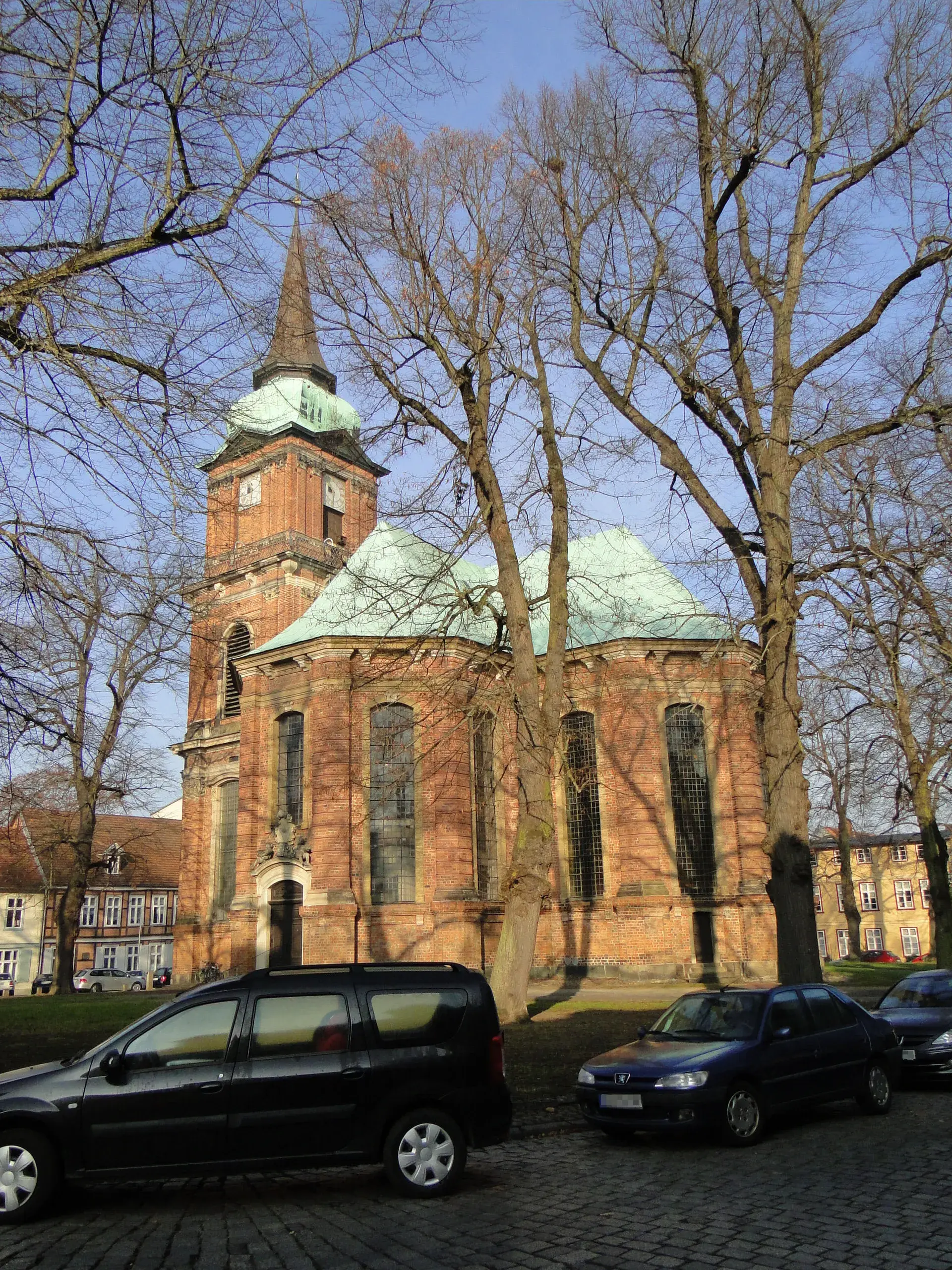
The site of the Schelf Church, officially named St. Nikolai, has hosted ecclesiastical buildings since at least 1217. A stone church endowed between 1228 and 1238 stood on the grounds until a severe hurricane in December 1703 collapsed its medieval spire. Duke Friedrich Wilhelm I of Mecklenburg-Schwerin seized this destruction as an opportunity. He commissioned a new sanctuary to serve as the religious centerpiece for his planned 18th-century Baroque suburb, Schelfstadt. The resulting structure marked Schwerin's transition from its medieval core to its early modern ducal expansions.
Architectural Significance and Design
Commissioned between 1705 and 1708, the Schelf Church stands as the first major post-Reformation church built in Mecklenburg and the only pure brick Baroque church in the West Mecklenburg region. Its deep-red brick facade and prominent tower rise abruptly over the cobblestones of the open Schelfmarkt. The building is a rare northern German central-plan church designed in the shape of a Greek cross.
The original architect, Jacob Reutz, died before the church's consecration in September 1713. His successor, Leonhard Christoph Sturm, completed the project with a divergent interior layout. In 1858, Grand Duke Friedrich Franz II and preservationist Georg Christian Friedrich Lisch restored the church closer to Reutz's initial spatial design. The interior now features an airy, symmetrical layout centered on white-and-gold woodwork, stained-glass windows, a raised Grand Ducal Box, and a Gaston Lenthe altarpiece alongside a Friedrich Friese III organ.
The Royal Crypt and Natural Mummification
From 1713 to 1813, the crypt beneath the altar served as the official burial place for the Mecklenburg-Schwerin ducal line. Neither Duke Friedrich Wilhelm I nor architect Jacob Reutz lived to see the building finished, and the Duke became the very first person laid to rest in the new vault.
Today, the 45-square-meter crypt holds the coffins of 17 members of the ducal dynasty, including Queen Sophie Luise of Prussia. A unique microclimate originally caused several of the entombed royals to naturally mummify. Their remains were preserved in velvet-covered coffins, still wearing brocade coats, ruffled shirts, and silk stockings. These artifacts were fully conserved after modern remediation efforts addressed mold and dry rot between 2006 and 2008.
Modern Role and UNESCO Status
The Schelf Church continues to function as an active Evangelical Lutheran parish church. Open daily to the public, the building hosts regular worship services, cultural events, and classical concerts that take advantage of its notable acoustics. Visitors can also access the restored ducal crypt during designated visiting hours. In 2024, the church's historical and architectural value was formally recognized when it was inscribed as an integral component of the Schwerin Residence Ensemble UNESCO World Heritage site.
FAQ
What is the architectural style of the Schelf Church?
The Schelf Church is a rare northern German red-brick Baroque central-plan church designed in the shape of a Greek cross. It is the only pure brick Baroque church in the West Mecklenburg region.
Who is buried in the crypt of the Schelf Church?
The crypt contains the coffins of 17 members of the Mecklenburg-Schwerin ducal dynasty. This includes Duke Friedrich Wilhelm I, who commissioned the church, and Queen Sophie Luise of Prussia.
Is the Schelf Church open to the public?
Yes, the building functions as an active Evangelical Lutheran parish church and is open daily to visitors. It hosts worship services, cultural events, and classical concerts, and the restored ducal crypt is accessible during designated visiting hours.