Pfaffenteich: Schwerin's Historic Lake Promenade
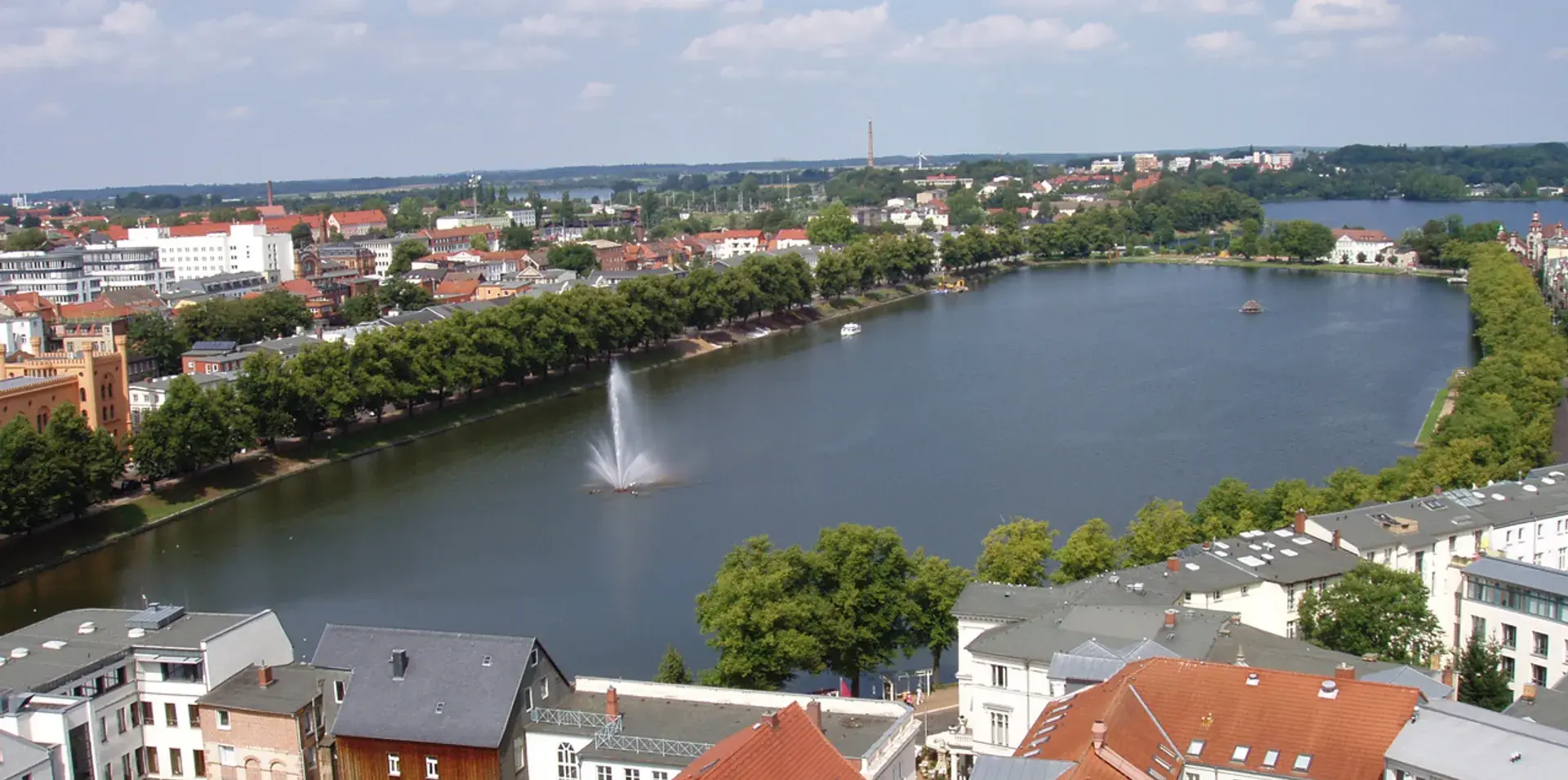
Situated between Schwerin's main railway station and the medieval Altstadt, the Pfaffenteich is a 12-hectare artificial lake fed by the Aubach stream. The basin acts as a scenic threshold, introducing the city's 19th-century civic expansion while framing southward views of the older cathedral precinct.
From Medieval Mill Pond to Urban Promenade
The lake was originally formed around 1178 when a dam was built across the Aubach to power town mills and feed Schwerin's defensive moat. The area retained its working status for centuries. Its name derives from the "Pfaffen," referring to the clergy of Schwerin Cathedral who historically tended and irrigated gardens along its eastern shore.
In the 1840s, Grand Duke Friedrich Franz II initiated the transformation of the mill pond into an elegant urban basin. Court Architect Georg Adolph Demmler redesigned the water body, framing it with tree-lined promenades. Between 1840 and 1844, Demmler constructed the Neo-Tudor Arsenal on the eastern embankment, which was soon accompanied by bourgeois townhouses around the lake's perimeter.
Lakeside Features and Hidden Details
Today, the Pfaffenteich serves as a circular gathering space characterized by outdoor cafes, broad pathways, and terraced stone stairs. From spring through autumn, the low chug and bell of a small passenger ferry, the "Petermännchen," echoes across the water, blending with the chatter from nearby open-air café tables.
The promenade holds several curious historical details. An 1895 bronze bust on the eastern shore commemorates Mecklenburg-born archaeologist Heinrich Schliemann, famous for excavating ancient Troy. Out on the water, a floating wooden refuge with a thatched-roof shelter known as the Schwaneninsel (Swan Island) has been anchored for resident wildfowl since 1937. Additionally, due to dense weed growth in the lake, municipal boats equipped with underwater cutting machinery mow the lakebed annually.
A Disguised Power Plant and Modern Culture
On the northern bank sits an ornate, castle-like structure featuring Renaissance Revival brickwork and turrets. Rather than a royal palace, this building was constructed as an active municipal power station that operated from 1904 to 1944. It was deliberately disguised by architects to preserve the romantic aesthetic of the lakeside promenade.
The former power plant has since been repurposed and currently functions as a performance stage for the Mecklenburg State Theatre. Beyond theatrical performances, the Pfaffenteich remains an active civic hub, hosting annual public events such as the Schwerin Dragon Boat Festival.
FAQ
Why is the lake called the Pfaffenteich?
The name Pfaffenteich comes from the word "Pfaffen," which refers to the clergy of the nearby Schwerin Cathedral. These clerics historically tended gardens along the lake's eastern shore.
What is the castle-like building on the north bank?
The ornate building on the northern shore is a former municipal power station built in 1904. It was specifically designed with Renaissance Revival brickwork and turrets to disguise its industrial purpose and protect the aesthetic of the promenade.
Are there boat rides available on the Pfaffenteich?
Yes, a small passenger ferry called the "Petermännchen" operates on the lake from spring through autumn.