Schlossbrücke: The Historic Bridge to Schwerin Castle
The ceremonial bridge to Schwerin Castle was actually the first piece of the grand palace project to be finished, built out of pure logistical necessity rather than aesthetic grandeur. The historic Schlossbrücke features ornate statues and provides sweeping views of the palace grounds.
A Vital Logistical Artery
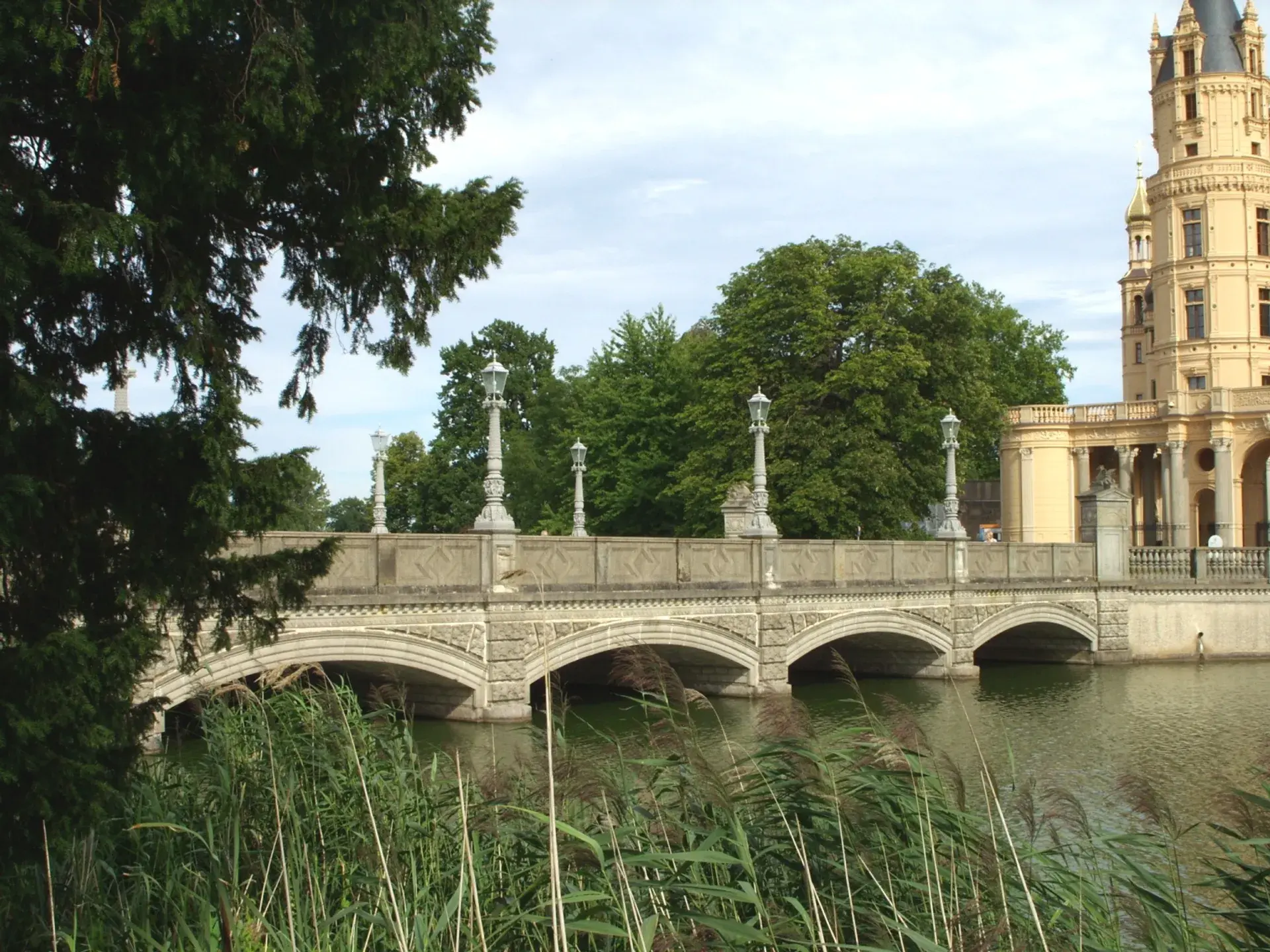
Before the 19th century, a defensive timber drawbridge linked the castle island to the mainland. The current massive stone structure replaced it to serve as a logistics artery. It was essential for transporting heavy building materials for the complete reconstruction of the palace between 1845 and 1857.
Designed by court architect Georg Adolph Demmler and approved by Grand Duke Friedrich Franz II in January 1844, the Schlossbrücke opened on April 13, 1845. This utilitarian necessity meant the bridge was dedicated a full twelve years before the completion of the grand Romantic Historicist palace complex it was built to serve.
Architectural Features and Flaws
The Schlossbrücke is a 48-meter-long and 16.3-meter-wide masonry arch bridge featuring five spans. Its design includes paved stone walkways, red-brick vaulting, classical balustrades, ornate ironwork, and gas-style lanterns. The city entrance of the bridge is marked by monumental zinc-cast sculptures titled Rossbändiger, created by sculptor Christian Genschow and installed in 1876.
The original construction relied on wooden foundation piles driven 23 meters into the muddy lakebed. However, these piles lacked the necessary battering to counteract the horizontal thrust of the vaults, leading to structural displacement and spalling over time. Following severe damage in 1981, the bridge underwent a complete historical reconstruction and stabilization in the mid-1980s.
The bridge's low stone arches also presented an unexpected navigational limitation. Cargo barges were unable to pass beneath the spans to reach the inner harbor at Burgsee. This issue eventually necessitated the construction of a separate swing bridge on the island's perimeter in 1897.
The Bridge Today
Today, the Schlossbrücke forms the physical and symbolic hinge between civic Schwerin and the state authority concentrated on the castle island. It serves as the primary pedestrian and cyclist promenade connecting the historic city center and the Alter Garten square to the castle grounds and the state museum.
The structure also acts as the ceremonial gateway to the Landtag of Mecklenburg-Vorpommern. While primarily serving foot traffic, limited authorized vehicle access is permitted for official state functions.
FAQ
When was the Schlossbrücke in Schwerin built?
Designed by court architect Georg Adolph Demmler, the Schlossbrücke was approved in 1844 and officially opened on April 13, 1845, twelve years before the completion of Schwerin Castle.
What are the statues on the Schlossbrücke?
The bridge's city entrance is flanked by two monumental zinc-cast sculptures called Rossbändiger. They were created by sculptor Christian Genschow and installed in 1876.
Why was the Schlossbrücke rebuilt in the 1980s?
The bridge's original 23-meter-deep wooden foundation piles lacked battering to counteract horizontal thrust, causing structural displacement. Severe damage in 1981 led to a complete historical reconstruction and stabilization in the mid-1980s.