State Museum Schwerin: Dutch Masters & Modern Art
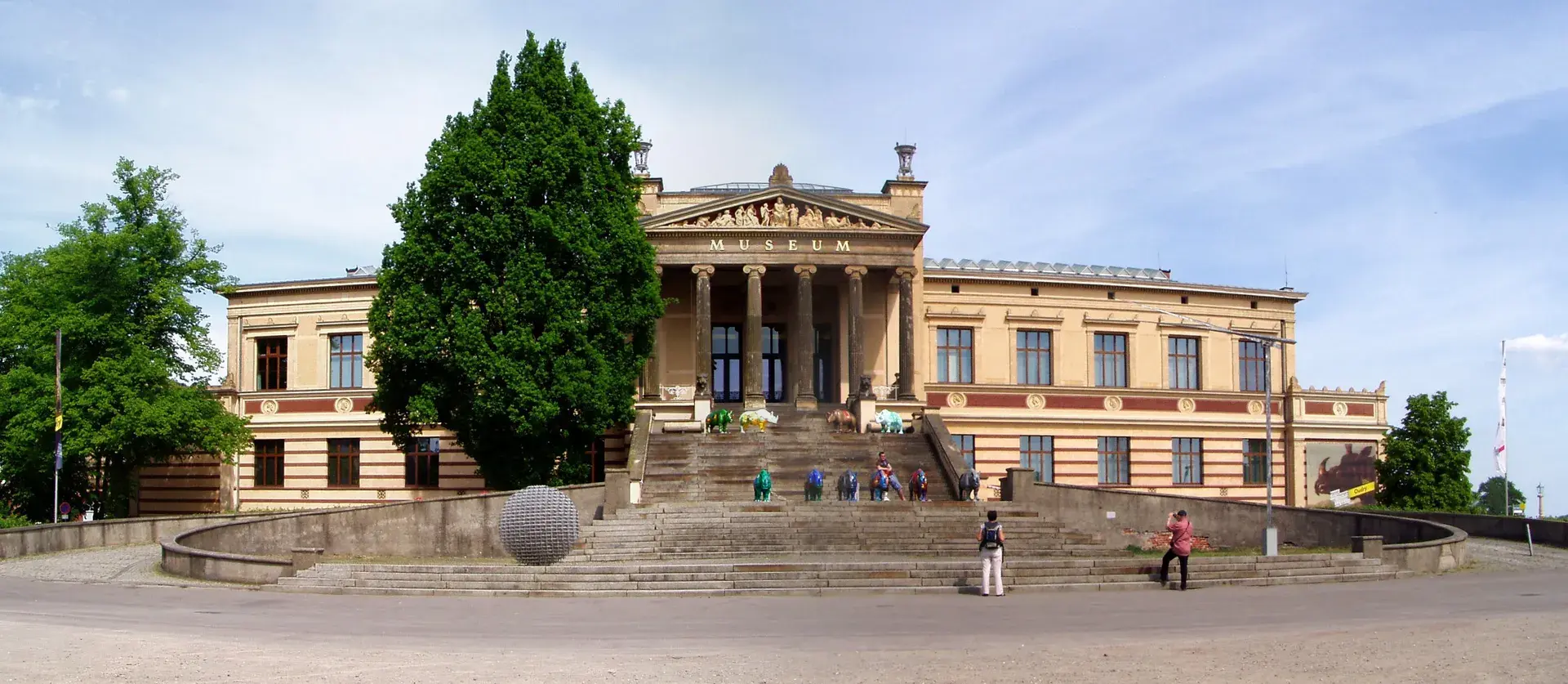
Take in the grand neoclassical facade of the State Museum Schwerin at Alter Garten, home to renowned Dutch and Flemish masterpieces. The imposing Neo-Renaissance sandstone portico features restored Ionic columns and a wide exterior staircase overlooking the open plaza. Situated between the lakeside palace island and the civic cultural quarter of the Old Town, the museum anchors an impressive civic ensemble alongside the State Theatre and the State Chancellery.
A Royal Collection Made Public
The museum's collection originated in the eighteenth century when Duke Christian Ludwig II systematically purchased Dutch and Flemish masterworks to elevate the status of the ducal house. By the late nineteenth century, Grand Duke Frederick Francis II sought to make these treasures accessible to the public. He commissioned the construction of a dedicated museum building, originally known as the Staatsgalerie, which opened in 1882.
Following the post-World War I abdication of the grand ducal monarchy, the collection transitioned from royal to public hands. The Free State of Mecklenburg-Schwerin formally secured the art treasures through state purchases negotiated in 1920 and 1930.
Masterpieces and Modern Contrasts
Inside, high natural skylights illuminate large-scale canvas paintings. The galleries feature intricate parquet wood inlays and tall decorative wall fabrics. The museum is internationally recognized for its historic holdings, including masterpieces by Frans Hals, Carel Fabritius, Peter Paul Rubens, and Jacob Jordaens. It also houses the world's largest collection of paintings and drawings by the French court animal painter Jean-Baptiste Oudry.
Despite its origins as a historic royal collection, the museum offers an unexpected avant-garde counterweight. It holds one of Europe's most significant collections of works by conceptual artist Marcel Duchamp, comprising ninety distinct pieces, alongside other modern and contemporary art.
Historical Curiosities
The museum's collection features several highly unusual artifacts from European history. One highlight is a monumental, life-sized 1749 portrait of Clara, an Indian rhinoceros that became a famous traveling sensation throughout eighteenth-century Europe.
Another notable display includes four surviving animal wall panels painted in 1572 by Flemish artist Maerten de Vos. Depicting a camel, an elephant, a leopard, and a unicorn, these panels were originally embedded directly into the wooden walls of Schwerin Castle.
A Restored Civic Anchor
In October 2025, the museum reopened following a four-year, €11.5-million structural modernization. The extensive renovation added 400 square meters of new exhibition space, introduced digital interactive stations, and meticulously restored the original 1882-era wall and floor finishes. Thanks to private foundation funding, general admission to the museum is offered completely free of charge for the four years immediately following its reopening.
FAQ
When was the State Museum Schwerin built?
The monumental historicist building was commissioned by Grand Duke Frederick Francis II and originally opened to the public in 1882.
What kind of art is displayed at the State Museum Schwerin?
The museum features 17th- and 18th-century Dutch and Flemish Old Masters, the world's largest collection of works by Jean-Baptiste Oudry, medieval altarpieces, and significant modern art holdings, including a collection of 90 works by Marcel Duchamp.
Is there an admission fee for the State Museum Schwerin?
Following its modernization and reopening in October 2025, general admission is free for four years, underwritten by a private foundation.